

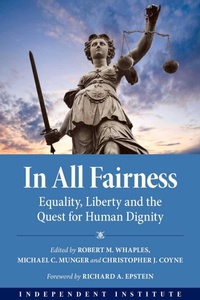
In All Fairness
Equality, Liberty, and the Quest for Human Dignity
Published on 1. October 2019
336 pages
978-1-59813-337-0 (ISBN)
Description

Has growing concern about inequality led to proposals to remake American society according to ill-conceived and coercive "egalitarian" measures that are fundamentally unjust and harmful?
This unique book reveals the modern romance with equality of outcomes as destructive folly. Those elites and bureaucrats who advocate such notions claim that they champion the poor?but more often than not the nostrums of this managerial class undermine, rather than advance, economic and civil liberties, mass prosperity and human well-being.
The authors of In All Fairness challenge all of the prevailing "egalitarian ideas," including the claim that market-based societies are riven by the social injustice of inequity in the first place. After all, an economy thrives with a division of labor that allows individuals who are unequal in interests and talents to pursue their own unique goals. Looked at in this way, equality is far more widespread than misplaced rhetoric might lead one to expect?as factual data show.
But it is an equality of a particularly valuable type?one arrived at, not by top-down, oilgarchic attempts to impose economic uniformity, but by our respecting inviolable rules of fair play and the dignity of each person, a dignity that requires everyone to respect the voluntary transactions of others. This approach holds equity, liberty, diversity, and prosperity together. Would we want it any other way in America and anywhere around the world?
The authors draw on economics, philosophy, religion, law, political science, and history to provide answers to a perennial question that especially agitates the American public today: Can the coercive powers of the state be used to achieve a kind of arithmetic equality? The authors, each in their own way, make a strong case that such powers should never be used in this fashion.
Love inequality or loathe it, In All Fairness is full of key insights about the connections among fairness, liberty, equality and the quest for human dignity. You won't think about wealth and poverty, equality and inequality, in the same way ever again.
This unique book reveals the modern romance with equality of outcomes as destructive folly. Those elites and bureaucrats who advocate such notions claim that they champion the poor?but more often than not the nostrums of this managerial class undermine, rather than advance, economic and civil liberties, mass prosperity and human well-being.
The authors of In All Fairness challenge all of the prevailing "egalitarian ideas," including the claim that market-based societies are riven by the social injustice of inequity in the first place. After all, an economy thrives with a division of labor that allows individuals who are unequal in interests and talents to pursue their own unique goals. Looked at in this way, equality is far more widespread than misplaced rhetoric might lead one to expect?as factual data show.
But it is an equality of a particularly valuable type?one arrived at, not by top-down, oilgarchic attempts to impose economic uniformity, but by our respecting inviolable rules of fair play and the dignity of each person, a dignity that requires everyone to respect the voluntary transactions of others. This approach holds equity, liberty, diversity, and prosperity together. Would we want it any other way in America and anywhere around the world?
The authors draw on economics, philosophy, religion, law, political science, and history to provide answers to a perennial question that especially agitates the American public today: Can the coercive powers of the state be used to achieve a kind of arithmetic equality? The authors, each in their own way, make a strong case that such powers should never be used in this fashion.
Love inequality or loathe it, In All Fairness is full of key insights about the connections among fairness, liberty, equality and the quest for human dignity. You won't think about wealth and poverty, equality and inequality, in the same way ever again.
More details
Other editions
Additional editions
Chris J. Coyne | Michael C. Munger | Robert M. Whaples
In All Fairness
Equality, Liberty, and the Quest for Human Dignity
Book
10/2019
Independent Institute,U.S.
€25.50
Shipment within 3-4 weeks
Persons
Robert M. Whaples is a Senior Fellow at the Independent Institute, Co-Editor and Managing Editor of The Independent Review, Professor of Economics at Wake Forest University, Director and Book Review Editor for EH.NET, and a member of the Board of Advisors for the Center on Culture and Civil Society at the Independent Institute. He is the co-editor of the Independent Institute books Is Social Justice Just?, In All Fairness, and Pope Francis and the Caring Society. He received his Ph.D. in economics from the University of Pennsylvania. He has also served as Assistant Professor of History at the University of Wisconsin at Milwaukee, Associate Editor of the Business Library Review, Chair of the Cliometric Society, and editor of EH.Net's Encyclopedia of Economic and Business History.
Michael C. Munger is Senior Fellow and former co-editor of The Independent Review at the Independent Institute, and Professor of Political Science, Economics and Public Policy and Director of the Philosophy, Politics, and Economics Program at Duke University. He has been Staff Economist at the Federal Trade Commission, President of the Public Choice Society, and President of the North Carolina Political Science Association, and he has taught at Dartmouth College, University of Texas at Austin, and the University of North Carolina at Chapel Hill.
Christopher J. Coyne is a Senior Fellow at the Independent Institute and Co-Editor of The Independent Review, Professor of Economics and Director of Graduate Programs for the Department of Economics at George Mason University, Co-Editor of the Review of Austrian Economics, and Book Review Editor at Public Choice. He received his Ph.D. in economics from George Mason University. He has taught at the University of West Virginia and Hampden-Sydney College, and he has been the Hayek Visiting Fellow at the London School of Economics and Visiting Scholar at the Social Philosophy and Policy Center at Bowling Green State University.
Michael C. Munger is Senior Fellow and former co-editor of The Independent Review at the Independent Institute, and Professor of Political Science, Economics and Public Policy and Director of the Philosophy, Politics, and Economics Program at Duke University. He has been Staff Economist at the Federal Trade Commission, President of the Public Choice Society, and President of the North Carolina Political Science Association, and he has taught at Dartmouth College, University of Texas at Austin, and the University of North Carolina at Chapel Hill.
Christopher J. Coyne is a Senior Fellow at the Independent Institute and Co-Editor of The Independent Review, Professor of Economics and Director of Graduate Programs for the Department of Economics at George Mason University, Co-Editor of the Review of Austrian Economics, and Book Review Editor at Public Choice. He received his Ph.D. in economics from George Mason University. He has taught at the University of West Virginia and Hampden-Sydney College, and he has been the Hayek Visiting Fellow at the London School of Economics and Visiting Scholar at the Social Philosophy and Policy Center at Bowling Green State University.
Content
- Front Cover
- Title Page
- Half Title
- Copyright
- Contents
- Foreword: The Theoretical and Practical Pitfallsin Egalitarian Thought-Richard A. Epstein
- Introduction: New Thinking on Equality, Liberty,and Human Dignity-Robert M. Whaples
- Part I: Problems with the Modern Philosophy of Egalitarianism
- 1. How "Experts" Hijacked Egalitarianism-Adam G. Martin
- 2. The Misuses of Egalitarianism-James R. Otteson
- 3. The Conceptual Marriage of Rawls and Hayek-Michael C. Munger
- 4. The Role of Negative Rights-Aeon J. Skoble
- 5. The Impossibility of Egalitarian Ends-Jeremy Jackson and Jeffrey Palm
- Part II: The Historical Development of Egalitarian Ideas
- 6. Religion and the Idea of Human Dignity-Peter J. Hill
- 7. A Descent from Equality to Egalitarianism-Jason Morgan
- 8. Why Redistributionism Must Collapse-James R. Harrigan and Ryan M. Yonk
- 9. The Retreat from Equality before the Law-William J. Watkins Jr.
- Part III: Egalitarianism, Economic Performance, and the Laws of Economics
- 10. Classroom Egalitarianism-Steven Shmanske
- 11. Financial Egalitarianism in America-Robert E. Wright
- 12. The End of Absolute Poverty-Art Carden, Sarah Estelle, and Anne R. Bradley
- 13. The Unfair Cost of Reducing Inequality-Nikolai G. Wenzel
- 14. Equality Comes from Economic Growth-Ben O'Neill
- 15. Taxes and the Myth of Egalitarianism-Brian J. Gaines
- 16. Pushing for More Equality of Income and Wealth-Edward P. Stringham
- 17. Good and Bad Inequality-Vincent Geloso and Steven G. Horwitz
- Conclusion: Final Thoughts on Egalitarianism-Michael C. Munger
- Notes
- Bibliography
- Index
- About the Editors and Contributors
- Credits
