

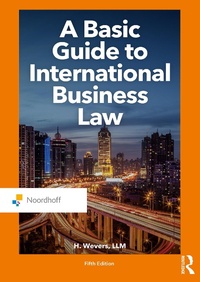
A Basic Guide to International Business Law
5th Edition
Published on 26. May 2021
224 pages
978-1-000-41803-3 (ISBN)
Description

A Basic Guide to International Business Law aims to give students an understanding as well as practical knowledge of legal problems arising in the area of international business, and to equip them with the skills needed to prevent and tackle these problems.
All Chapters employ the same didactic structure. Introductory case studies, examples, annotated case law, glossaries, diagrams, summaries and exercises are all designed to familiarize students quickly with relevant aspects of international (business) law. A Basic Guide to International Business Law deals with the following topics:
* Introduction to International Private Law and European Law
* Legal aspects of negotiations
* International contracts: matters of jurisdiction and the law applicable to these contracts
* International contracts of sale
* Competion law
* Free movement of goods, workers, the freedom of capital and establishment and the freedom to provide services
* International payments
* Carriage of goods by road and sea
* Incoterms
* Entry modes (agents, representatives, distributors, licensing, franchising)
All Chapters employ the same didactic structure. Introductory case studies, examples, annotated case law, glossaries, diagrams, summaries and exercises are all designed to familiarize students quickly with relevant aspects of international (business) law. A Basic Guide to International Business Law deals with the following topics:
* Introduction to International Private Law and European Law
* Legal aspects of negotiations
* International contracts: matters of jurisdiction and the law applicable to these contracts
* International contracts of sale
* Competion law
* Free movement of goods, workers, the freedom of capital and establishment and the freedom to provide services
* International payments
* Carriage of goods by road and sea
* Incoterms
* Entry modes (agents, representatives, distributors, licensing, franchising)
More details
Series
Edition
5th edition
Language
English
Place of publication
London
United Kingdom
Publishing group
Taylor & Francis Ltd
Target group
College/higher education
Product notice
Reflowable
Illustrations
11 Line drawings, color; 11 Illustrations, color
ISBN-13
978-1-000-41803-3 (9781000418033)
Copyright in bibliographic data and cover images is held by Nielsen Book Services Limited or by the publishers or by their respective licensors: all rights reserved.
Schweitzer Classification
Other editions
Additional editions
Harm Wevers
A Basic Guide to International Business Law
Book
05/2021
5th Edition
Routledge
€230.27
Shipment within 10-20 days

Harm Wevers
A Basic Guide to International Business Law
Book
05/2021
5th Edition
Wolters-Noordhoff B.V.
€95.51
Shipment within 15-20 days
Person
Harm Wevers
Content
1 Introduction to International Private Law and European
Law
1.1 Introduction to International Private Law
1.2 Introduction to European Law
1.3 Cases of the European Court of Justice
Case Costa vs ENEL
Case Van Gend & Loos
Case Francovich
Case of Foglia vs Novello
Case of Cilfit
2 Negotiations
2.1 Reaching an agreement
2.2 Legal aspects of negotiations
Case of Baris vs Riezenkamp
2.3 Breaking off negotiations: breach of contract or tort?
2.4 Cases at the preliminary stage
Case AGA - Bouw
Case VSH vs Shell
3 Courts
3.1 What court of law has jurisdiction?
3.2 Brussels I Regulation: what countries are involved?
3.3 Rules concerning jurisdiction of the Brussels I Regulation
3.4 Execution of the verdict under the Brussels I Regulation
3.5 Arbitration
4 Law
4.1 Introduction to Rome I
4.2 Conditions on the use of Rome I
4.3 Content of Rome I
Case of Sanchez
Case of Alnati
4.4 Combination of Brussels I and Rome I
Case of BOA
4.5 Law applicable to international torts Rome II
5 CISG
5.1 Introduction to the CISG
5.2 Application of the CISG
5.3 Content of the CISG
5.4 Answers to CISG Exercises
5.5 Art. Brussels I, determining place of performance of obligation in question
6 The free movement of goods, persons, services and capital
6.1 Introduction to the free movement of goods
6.2 Quantitative restrictions
6.3 Measures having an effect equivalent to quantitative restrictions
6.4 Art. 36 TFEU: derogation from Art. 34 and 35 TFEU
6.5 Case law to justify restrictions on the free movement of goods
6.6 The free movement of workers
6.7 The freedom of establishment
6.8 The freedom to provide services
6.9 The freedom of capital
6.10 Cases of the European Court of Justice on the free movement of goods, workers
and capital, the freedom to provide services and the freedom of establishment
Case Dassonville
Case Cassis de Dijon
Case Rueffler
Case Engelmann
7 Competition law
7.1 Introduction to competition and cartel law
7.2 The cartel law of Art. 101 TFEU
7.3 The abuse of a dominant position under Art. 102 TFEU
7.4 Mergers
7.5 Cases of the European Court of Justice on cartel law
Case Vereeniging van Cementhandelaren
Case ICI
Case Grundig vs Consten
Case Chiquita
8 Carriage, Incoterms, Payment and Entry modes
8.1 Carriage
8.2 Incoterms
8.3 International payments
8.4 Entry modes
Index
Law
1.1 Introduction to International Private Law
1.2 Introduction to European Law
1.3 Cases of the European Court of Justice
Case Costa vs ENEL
Case Van Gend & Loos
Case Francovich
Case of Foglia vs Novello
Case of Cilfit
2 Negotiations
2.1 Reaching an agreement
2.2 Legal aspects of negotiations
Case of Baris vs Riezenkamp
2.3 Breaking off negotiations: breach of contract or tort?
2.4 Cases at the preliminary stage
Case AGA - Bouw
Case VSH vs Shell
3 Courts
3.1 What court of law has jurisdiction?
3.2 Brussels I Regulation: what countries are involved?
3.3 Rules concerning jurisdiction of the Brussels I Regulation
3.4 Execution of the verdict under the Brussels I Regulation
3.5 Arbitration
4 Law
4.1 Introduction to Rome I
4.2 Conditions on the use of Rome I
4.3 Content of Rome I
Case of Sanchez
Case of Alnati
4.4 Combination of Brussels I and Rome I
Case of BOA
4.5 Law applicable to international torts Rome II
5 CISG
5.1 Introduction to the CISG
5.2 Application of the CISG
5.3 Content of the CISG
5.4 Answers to CISG Exercises
5.5 Art. Brussels I, determining place of performance of obligation in question
6 The free movement of goods, persons, services and capital
6.1 Introduction to the free movement of goods
6.2 Quantitative restrictions
6.3 Measures having an effect equivalent to quantitative restrictions
6.4 Art. 36 TFEU: derogation from Art. 34 and 35 TFEU
6.5 Case law to justify restrictions on the free movement of goods
6.6 The free movement of workers
6.7 The freedom of establishment
6.8 The freedom to provide services
6.9 The freedom of capital
6.10 Cases of the European Court of Justice on the free movement of goods, workers
and capital, the freedom to provide services and the freedom of establishment
Case Dassonville
Case Cassis de Dijon
Case Rueffler
Case Engelmann
7 Competition law
7.1 Introduction to competition and cartel law
7.2 The cartel law of Art. 101 TFEU
7.3 The abuse of a dominant position under Art. 102 TFEU
7.4 Mergers
7.5 Cases of the European Court of Justice on cartel law
Case Vereeniging van Cementhandelaren
Case ICI
Case Grundig vs Consten
Case Chiquita
8 Carriage, Incoterms, Payment and Entry modes
8.1 Carriage
8.2 Incoterms
8.3 International payments
8.4 Entry modes
Index
