

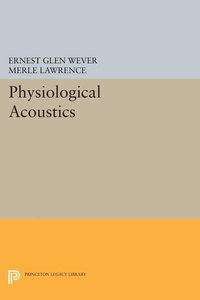
Physiological Acoustics
Published on 25. July 2016
476 pages
978-1-4008-7643-3 (ISBN)
Description

This book deals with the ear as an acoustic instrument: as a piece of physical apparatus functioning for the reception of sounds from the outside, for conveying them inward to the auditory sense cells, and finally for producing a mechanical stimulation of these cells.
Originally published in 1954.
The Princeton Legacy Library uses the latest print-on-demand technology to again make available previously out-of-print books from the distinguished backlist of Princeton University Press. These editions preserve the original texts of these important books while presenting them in durable paperback and hardcover editions. The goal of the Princeton Legacy Library is to vastly increase access to the rich scholarly heritage found in the thousands of books published by Princeton University Press since its founding in 1905.
Originally published in 1954.
The Princeton Legacy Library uses the latest print-on-demand technology to again make available previously out-of-print books from the distinguished backlist of Princeton University Press. These editions preserve the original texts of these important books while presenting them in durable paperback and hardcover editions. The goal of the Princeton Legacy Library is to vastly increase access to the rich scholarly heritage found in the thousands of books published by Princeton University Press since its founding in 1905.
More details
Other editions
Additional editions
Ernest Glen Wever | Merle Lawrence
Physiological Acoustics
Book
04/2016
Princeton University Press
€199.30
Article not available at the moment
Ernest Glen Wever | Merle Lawrence
Physiological Acoustics
Book
12/2015
Princeton University Press
€73.10
Article not available at the moment

Ernest Glen Wever | Merle Lawrence
Physiological Acoustics
Book
01/1954
Princeton University Press
€71.92
Article exhausted; check different version
Persons
Ernest Glen Wever & Merle Lawrence
Content
Frontmatter, pg. i
Preface, pg. vii
Contents, pg. xi
PART I: Introduction, pg. 1
PART II: The Middle Ear as a Mechanical Transformer, pg. 67
PART III: The Problem of Distortion, pg. 115
PART IV. Further Characteristics of the Middle Ear, pg. 177
PART V. Sound Conduction in the Cochlea, pg. 213
PART VI. Clinical Applications, pg. 333
PART VII. Further Theoretical Considerations, pg. 379
Appendixes, References and Index, pg. 411
Preface, pg. vii
Contents, pg. xi
PART I: Introduction, pg. 1
PART II: The Middle Ear as a Mechanical Transformer, pg. 67
PART III: The Problem of Distortion, pg. 115
PART IV. Further Characteristics of the Middle Ear, pg. 177
PART V. Sound Conduction in the Cochlea, pg. 213
PART VI. Clinical Applications, pg. 333
PART VII. Further Theoretical Considerations, pg. 379
Appendixes, References and Index, pg. 411
