

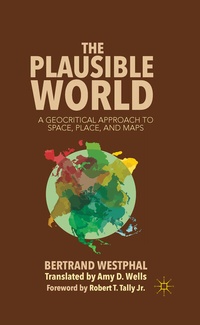
The Plausible World
Description

Reviews / Votes
"Admirably learned and wide-ranging in its exempla, Westphal's geocritical study de-centers and redraws the most cherished mappings of Occidental modernity, opening up place and space to postmodern incursions. Its chronotopic richness and theoretical adventurousness will repay careful scrutiny by contemporary cartographers of past, plural, and plausible worlds." - David H.J. Larmour, Paul Whitfield Horn Professor of Classics, Texas Tech University, USA, and author of The Sites of Rome: Time, Space, Memory
"A vast rhizomatic and immensely learned romp through the literary spaces of the last three thousand years. Wells's translation of Westphal's The Plausible World will put geocriticism firmly on the map." - Paul Allen Miller, Carolina Distinguished Professor of Classics and Comparative Literature, University of South Carolina, USA
"The Plausible World digs deep into the archives of the literary and cartographic arts in order to show how maps are shaped by stories. In so doing, it takes us on a sometimes meandering, often playful, and always gripping voyage through the spatial history of the world, emphasizing mankind's fiction-fueled quest to know (and master) the smooth New Worlds that seem always to beckon to us from just beyond the horizon of that striated center we call home." - Eric Prieto, Professor of French, University of California, Santa Barbara, USA, and author of Literature, Geography, and the Postmodern Poetics of Place
More details
Other editions
Additional editions
Person
Bertrand Westphal is a Professor of General and Comparative Literature at the Université de Limoges, France where he directs the "Espaces Humains et Interactions Culturelles" research team. He is the author of Geocriticism: Real and Fictional Spaces, as well as numerous works on geocriticism, Austrian literature, the Mediterranean, and the theory of the novel.
Amy Wells is an Associate Professor of English in the Applied Foreign Languages Department at the Cherbourg Satellite of the Université de Caen de Basse Normandie, France. She is a member of the research team Equipe de recherche interdisciplinaire sur la Grande-Bretagne, l'Irlande et l'Amérique du nord [Interdisciplinary research team on Great Britain, Ireland, and North America] (ERIBIA), and she has published numerous articles on geocriticism and literary cartography including 'The Intertextual, Sexually-Coded Rue Jacob.'
