

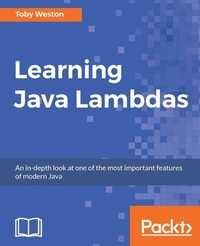
Learning Java Lambdas
An in-depth look at one of the most important features of modern Java
Published on 8. July 2025
114 pages
978-1-78728-102-8 (ISBN)
Description

No detailed description available for "Learning Java Lambdas".
More details
Edition
Digital original
Language
English
Place of publication
Birmingham
United Kingdom
Target group
Professional and scholarly
US School Grade: College Graduate Student
Edition type
Digital original
File size
0,62 MB
ISBN-13
978-1-78728-102-8 (9781787281028)
Copyright in bibliographic data and cover images is held by Nielsen Book Services Limited or by the publishers or by their respective licensors: all rights reserved.
Schweitzer Classification
Other editions
Additional editions
Person
Weston Toby :
Toby Weston - Independent Software DeveloperI specialise in modern software development; functional and object-oriented programming, agile and lean best practice. I wrote the book Essential Acceptance Testing and have written for magazines as well as regularly blogging.I've been part of the software industry for more than fifteen years and love what I do. I love talking and writing about it and sharing my experiences online with Udemy.
Toby Weston - Independent Software DeveloperI specialise in modern software development; functional and object-oriented programming, agile and lean best practice. I wrote the book Essential Acceptance Testing and have written for magazines as well as regularly blogging.I've been part of the software industry for more than fifteen years and love what I do. I love talking and writing about it and sharing my experiences online with Udemy.
Content
- Cover
- Copyright
- Credits
- About the Author
- www.PacktPub.com
- Customer Feedback
- Table of Contents
- Preface
- Chapter 1: Introduction
- The road to modern Java
- Modern Java features
- Chapter 2: Lambdas Introduction
- ?s in functional programming
- 1930s and the lambda calculus
- 1950s and LISP
- What is a lambda
- Functions vs classes
- Lambdas in modern Java
- Some theoretical differences
- Functions vs classes
- Some concrete differences
- Capture semantics
- Shadowed variables
- Summary
- ? basic syntax
- Syntax breakdown
- Summary
- Chapter 3: Lambdas in Depth
- Functional interfaces
- @FunctionalInterface
- Extension
- Other interface improvements
- Summary
- Type inference improvements
- Java type inference
- Target-typing for lambdas
- Type parameters in method calls
- Type parameters in chained method calls
- Method references
- Example
- Method reference types
- Constructor reference
- Static method reference
- Instance method reference of particular object (in this case, a closure)
- Instance method reference of a arbitrary object whose instance is supplied later (lambda)
- Summary
- Scoping
- Effectively final
- Circumventing final
- Exception handling
- Using a callback
- Dealing with exceptions when writing lambdas
- As a caller (dealing with exceptions when calling lambdas)
- Lambdas vs closures
- Basic differences
- Other differences
- Summary
- Bytecode recap
- Descriptors
- Converting a method signature
- Code examples
- Example 1
- Example 2
- Example 3
- Example 4
- Example 4 (with method reference)
- Example 5
- Summary
- Appendix: Bytecode
- WaitFor
- Example 1
- Example 2
- Example 3
- Example 4
- Example 4 (with Method Reference)
- Example 5
- Index
