

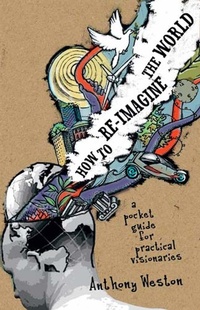
How To Re-Imagine The World
Description

Who says that all possible social and political systems have already been invented? Or that work-or marriage, or environmentalism, or anything else-must be just what they are now?
This book is a conceptual toolbox for imagining and initiating radical social change. Chapters offer specific, focused, and shareable techniques:
- Seeking a Whole Vision: Creating a pull and not just a push toward change
- Generative Thinking: Looking for "Seeds" and "Sparks", Stretching and Twisting Ideas, and Going Two Steps Too Far
- Looking for Unexpected Openings: "Weeds" and "Wild Cards," Inside Tracks, Leverage Points, and Hidden Possibilities
- Working at the Roots: Reconstructing the built world, cultural practices, even worldviews
- Building Momentum: Playing to our Strengths, Reclaiming the Language, "Allying Everywhere," Doing it Now, Going for Broke
Leap-frogging new kinds of cars and better mass transit in turn, why not a world in which "transportation" itself is unneeded? What about remaking New Orleans as a floating city, or putting only extreme surfers in the path of hurricanes? And why not dream of the stars? The question is not whether radical change is coming. It is already well underway. The only question is who will make it. Why not us?
Anthony Weston is a professor of philosophy at Elon University in North Carolina, where he teaches ethics, environmental studies, and "Millennial Imagination." He is the author of ten other books, including Back to Earth, Jobs for Philosophers, and Creativity for Critical Thinkers.
More details
Other editions
Additional editions

Person
Content
Introduction: Got possibilities? Real movement begins with vision - with inspiration and engagement, with a pull and not a push.
1. Work from a vision Go beyond complaints and resistances and reactions. What truly motivates and inspires is a picture of what the world might be instead.
2. Work from a whole vision Envision changes that are mutually supportive, mutually necessary and mutually in flow. Paint the big picture.
To formulate truly new ideas we need to undertake new styles of generative thinking.
3. Seeds Nearly anything can provoke new thinking. Watch for suggestive facts: overtones, hints, clues.
4. Sparks No need to wait; we can actively generate new and unheard-of associations as well.
5. Stretches Exaggerate, extrapolate, push beyond incremental changes to qualitative shifts.
6. Twists For rougher provocations, deliberately rearrange and transpose ideas. Reverse expected relationships, think opposites.
7. "The problem is the solution" What useful background conditions do our problems throw into relief? What might the very problem itself be a resource for?
8. What's the next step? Sustained creative rethinking takes many steps. Keep pushing to the next one; interject new associations; provoke ideas to morph and morph again.
Certain distinctive tipping points, vectors and dynamics make unexpected openings for creative change-making.
9. Inside tracks Much of the change we want is already happening - only in unexpected places. Look for ways to join and accelerate change movements already in flow.
10. Leverage points Look for the small interventions that can produce huge changes downstream.
11. Weeds Aim for changes that insistently re-emerge on their own and that diffuse widely, wildly and almost irresistibly.
12. Wild cards Prepare, both conceptually and on the ground, for the proverbial crises-that-are-also-opportunities.
13. Hidden possibilities Systems have immense but unseen capacities for change and self-reorganization - only we may have to offer a certain kind of invitation up front to get things moving.
Behind and beneath the salient social problems lie cultural norms, practices, structures, ultimately even worldviews. These in turn can be shifted and reconstructed. For the most creative leverage we sometimes need to work at the roots.
14. Rebuild from the ground up Some problems virtually follow from the ways in which the world itself is built. Imagine rebuilding!
15. Cultures and practices Other problems are shaped by our prevailing values, assumptions and practices. Here too there can be dramatic room to move.
16. Worldviews Worldviews themselves shape our problems - through both practices and structures in turn. Can we re-imagine whole worldviews, then?
Re-entering the struggle with creative momentum, let us rethink where and how we stand and with whom. What are we waiting for?
17. Play to your strengths Optimism, celebration, freedom in expression, cos- mopolitanism, good food, good music, imagination itself - since these are our forte, let us start with them to make change.
18. Reclaim the language The shaping of terms is also the shaping of thought. Re-create a richer and more critically edged language.
19. More new words New and reclaimed concepts for environmental and religious thinking.
20. Ally everywhere Look for commonalities and common ground; avoid thinking in pre-set oppositions. Speak to "interests" not "positions," remembering that interests them- selves are fluid and overlapping.
21. The Tao of change The wisdom of the martial arts: don't resist the onrushing energy of opposition, but let it rush by, use what you can, work cheerfully just beyond its reach.
22. Do it now New kinds of communities, new governments, new kinds of art and new ways to live - none of this needs permission or consensus. We can practice do- it-yourself social change, right now.
23. Go for broke Imagine not just two steps down the road, but all the way. Why not?
Afterword Notes
