

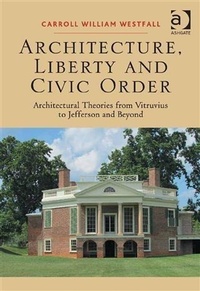
Architecture, Liberty and Civic Order
Architectural Theories from Vitruvius to Jefferson and Beyond
Published on 28. July 2015
220 pages
978-1-4724-5654-0 (ISBN)
Description

This book brings to light central topics that are neglected in current histories and theories of architecture and urbanism. These include the role of imitation in earlier centuries and its potential role in present practice; the necessary relationship between architecture, urbanism and the rural districts; and their counterpart in the civil order that builds and uses what is built. The narrative traces two models for the practice of architecture. One follows the ancient model in which the architect renders his service to serve the interests of others; it survives and is dominant in modernism. The other, first formulated in the fifteenth century by Leon Battista Alberti, has the architect use his talent in coordination with others to contribute to the common good of a republican civil order that seeks to protect its own liberty and that of its citizens. Palladio practiced this way, and so did Thomas Jefferson when he founded a uniquely American architecture, the counterpart to the nation's founding. This narrative gives particular emphasis to the contrasting developments in architecture on the opposite sides of the English Channel.
The book presents the value for clients and architects today and in the future of drawing on history and tradition. It stresses the importance, indeed, the urgency, of restoring traditional practices so that we can build just, beautiful, and sustainable cities and rural districts that will once again assist citizens in living not only abundantly but also well as they pursue their happiness.
The book presents the value for clients and architects today and in the future of drawing on history and tradition. It stresses the importance, indeed, the urgency, of restoring traditional practices so that we can build just, beautiful, and sustainable cities and rural districts that will once again assist citizens in living not only abundantly but also well as they pursue their happiness.
Reviews / Votes
`The alphabet of wood and stone has been arranged over the ages to shape and express the values and aspirations embodied in civic life. Architecture, Liberty and Civic Order is at once a commanding chapter in architectural history and a significant treatise on philosophy of art. Professor Westfall's narrative guides the reader to the various purposes served by that one form of art that is irreducibly civic. The treatment is authoritative and accessible; rich and deeply suggestive. It is also a much needed challenge to conventional wisdom on the alleged "progressive" evolution of genres.'Daniel Robinson, Oxford University, UK and Georgetown University, USA
`Westfall presents this immensely impressive and intellectually innovative study of the great names in the history of architecture and architectural theory from antiquity to the present day as "a book about the most important thing we can make, the city". He sees throughout the significance of religion and politics, noting how "Vitruvius prided himself for being the client of his imperial patron", while Alberti presented the architect "as a citizen who renders his service as a participant in the protection of his city's liberty and ... the pursuit of the good". He observes of the International Style that "Buildings based on the machine analogy remain mere buildings and cannot become architecture". There are challenging thoughts on every page of this deeply researched book on the classical language of architecture, timeless but ever new.'
David Watkin, University of Cambridge, UK and Honorary Fellow of the Royal Institute of British Architects
More details
Edition
New edition
Language
English
Place of publication
Farnham
United Kingdom
Publishing group
Taylor & Francis Ltd
Target group
Professional and scholarly
Edition type
New edition
Illustrations
Includes 24 b&w illustrations
File size
4,77 MB
ISBN-13
978-1-4724-5654-0 (9781472456540)
Copyright in bibliographic data and cover images is held by Nielsen Book Services Limited or by the publishers or by their respective licensors: all rights reserved.
Schweitzer Classification
Other editions
Additional editions
Carroll William Westfall
Architecture, Liberty and Civic Order
Architectural Theories from Vitruvius to Jefferson and Beyond
Book
06/2015
1st Edition
Routledge
€215.77
Shipment within 10-20 days
Person
Carroll William Westfall's PhD in the history of architecture was conferred by Columbia University. Since 1982 he has taught students in history and architecture at the Universities of Illinois in Chicago, Virginia, and most recently Notre Dame. His special interest has always been the history of the city with particular attention to the reciprocity between the political life and the urban and architectural elements that serve the needs of citizens.
In classes and in two previous books and numerous articles he has explored the role of the classical tradition in architecture in serving and building the good and beautiful city. His approach uses theories of architecture and the practices of architects and those who hire them to interpret how their buildings serve and express the interests of those who possess the authority that allows them to build. The answer lies within the center of the classical tradition whose history is a constant revision to the best possible use of the universal and enduring qualities of the good and the beautiful in governing and building the good and beautiful city. In the center of this narrative is the role of the imitating the order, harmony, and proportionality of nature that uses tradition as a guide and innovation as a vivifying tonic, a topic neglected in the current narrative of the history of architecture.
In classes and in two previous books and numerous articles he has explored the role of the classical tradition in architecture in serving and building the good and beautiful city. His approach uses theories of architecture and the practices of architects and those who hire them to interpret how their buildings serve and express the interests of those who possess the authority that allows them to build. The answer lies within the center of the classical tradition whose history is a constant revision to the best possible use of the universal and enduring qualities of the good and the beautiful in governing and building the good and beautiful city. In the center of this narrative is the role of the imitating the order, harmony, and proportionality of nature that uses tradition as a guide and innovation as a vivifying tonic, a topic neglected in the current narrative of the history of architecture.
Content
Contents: Preface; Imitation in general; Vitruvius; Alberti on the art of building; Alberti, architect and urbanist; Vitruvianism and Palladio; Events in the classical tradition on the Continent; The classical tradition's fate west of the Channel; Jefferson, architect, and the classical tradition; Imitation and architecture's restoration; The beautiful and good city; Bibliography; Index.
