

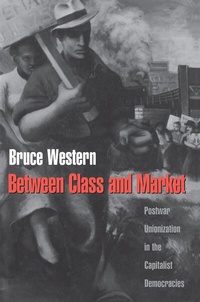
Between Class and Market
Postwar Unionization in the Capitalist Democracies
1st Edition
Published on 8. February 2021
256 pages
978-0-691-21457-3 (ISBN)
Description

In the United States, less than one worker in five is currently in a labor union, while in Sweden, virtually the entire workforce is unionized. Despite compelling evidence for their positive effects, even the strongest European unions are now in retreat as some policymakers herald the U.S. model of market deregulation. These differences in union power significantly affect workers' living standards and the fortunes of national economies. What explains the enormous variation in unionization and why has the last decade been so hostile to organized labor? Bruce Western tackles these questions in an analysis of labor union organization in eighteen capitalist democracies from 1950 to 1990. Combining insights from sociology and economics in a novel way, Western views unions as the joint product of market forces and political and economic institutions.
The author argues that three institutional conditions are essential for union growth: strong working-class political parties, centralized collective bargaining, and union-run unemployment insurance. These conditions shaped the impact of market currents and explain variations across industries, across countries, and over time for the four decades since 1950. Between Class and Market traces the story of the postwar labor movements supported by a blend of historical investigation and sophisticated statistical analysis in an innovative framework for comparative research. Western tightly integrates institutional explanation and comparative method in a way that balances comparative generality with the unique historical experiences of specific cases.
The author argues that three institutional conditions are essential for union growth: strong working-class political parties, centralized collective bargaining, and union-run unemployment insurance. These conditions shaped the impact of market currents and explain variations across industries, across countries, and over time for the four decades since 1950. Between Class and Market traces the story of the postwar labor movements supported by a blend of historical investigation and sophisticated statistical analysis in an innovative framework for comparative research. Western tightly integrates institutional explanation and comparative method in a way that balances comparative generality with the unique historical experiences of specific cases.
More details
Other editions
Additional editions
Book
08/1999
Princeton University Press
€51.10
Shipment within 10-20 days

Book
11/1997
Princeton University Press
€59.42
Article exhausted; check different version
Person
Bruce Western is Assistant Professor of Sociology and a faculty associate of the Office of Population Research at Princeton University.
Content
- Cover Page
- Half-title Page
- Title Page
- Copyright Page
- Dedication Page
- Contents
- List of Figures
- List of Tables
- Acknowledgments
- Abbreviations
- Part I: The Problem
- One: Class Power, Market Power, and the Comparative Method
- Two: Variation in Union Membership
- Part II: The Institutional Sources of Union Growth
- Three: Labor Market Centralization
- Four: The Ghent System
- Five: Political Parties and Trade Unions
- Part III: Estimating The Institutional Effects
- Six: Cross-Sectional Analysis of Union Density
- Seven: The Business Cycle and Union Growth
- Eight: The Structure of Labor Markets
- Part IV: The Turbulent 1980s
- Nine: Introducing the Decline of Unions in the 1980s
- Ten: Power, Efficiency, and Institutional Change
- Eleven: Globalization, Institutional Change, and Union Decline in the 1980s
- Twelve: Conclusion
- Appendix: Data and Methods
- Bibliography
- Index
