

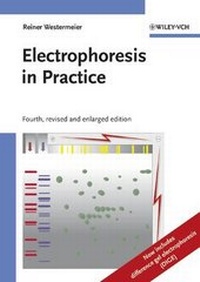
Electrophoresis in Practice
A Guide to Methods and Applications of DNA and Protein Separations
4th Edition
Published on 6. March 2006
XX, 406 pages
978-3-527-60444-9 (ISBN)
Description

This laboratory guide for successful electrophoretic separations is divided into two parts to provide readers with a thorough presentation of the fundamentals followed by a detailed description of the most common methods currently in use.
This fourth edition retains the successful concept of its predecessors, yet features a brand-new layout, and is further enhanced by a section on difference gel electrophoresis, while the chapter on proteome analysis is practically all new and considerably extended, plus there are now around 10 % new literature references.
This fourth edition retains the successful concept of its predecessors, yet features a brand-new layout, and is further enhanced by a section on difference gel electrophoresis, while the chapter on proteome analysis is practically all new and considerably extended, plus there are now around 10 % new literature references.
Reviews / Votes
From the reviews of previous editions:"The illustrations are informative and to the point...The book clearly illustrates the competence of the author. He generously shares his experience and knowledge with the reader, especially in the field of gel-based electrophoresis...an excellent reference to help the reader to become acquainted with the field of electrophoresis. The book contains theoretical and ample practical information that serves not only the practician in the electrophoresis laboratory, but also students and lecturers in electrophoretic methods."
Clinical Chemistry
"The rigorous description of each method along with the extensive figures will easily allow the novice to reproduce these methods in the laboratory"
The Analyst
"An excellent book which we recommend greatly and which has not to be missed in any laboratory of cellular and molecular biology which respects itself."
Cellular and Molecular Biology
"As a comprehensive guide to the huge variety of electrophoretic methods now available, this is very good value. The superb troubleshooting appendix almost justifies the price on its own."
Laboratory Equipment Digest
More details
Other editions
Additional editions
Reiner Westermeier
Electrophoresis in Practice
A Guide to Methods and Applications of DNA and Protein Separations
Book
10/2004
4th Edition
Wiley-Blackwell
€125.00
Article exhausted; check for reprint
Person
Born in 1951, Reiner Westermeier gained his diploma in engineering in 1976, and his doctorate in 1981 at the Technical University of Munich, Germany.
He remained at the TU engaged in the development of new electrophoresis methods and applications until 1983, a period that also involved several international collaborations and lecturing tours.
From 1984 to 1987 Dr. Westermeier was employed as an electrophoresis products and applications specialist at LKB Instrument GmbH thereafter until 1990 at Pharmacia Biotech. He founded ETC Elektrophorese-Technik in 1991 for the development of new electrophoresis methods, media, and equipment. From January 1996 to July 1997 he was manager of scientific support Europe at Pharmacia Biotech in Freiburg, Germany. He has been at Amersham Pharmacia Biotech since July 1997, and its Senior Scientist for Proteomics since January 2002.
Reiner Westermeier is the author of several publications and two books, both published by WILEY-VCH.
He remained at the TU engaged in the development of new electrophoresis methods and applications until 1983, a period that also involved several international collaborations and lecturing tours.
From 1984 to 1987 Dr. Westermeier was employed as an electrophoresis products and applications specialist at LKB Instrument GmbH thereafter until 1990 at Pharmacia Biotech. He founded ETC Elektrophorese-Technik in 1991 for the development of new electrophoresis methods, media, and equipment. From January 1996 to July 1997 he was manager of scientific support Europe at Pharmacia Biotech in Freiburg, Germany. He has been at Amersham Pharmacia Biotech since July 1997, and its Senior Scientist for Proteomics since January 2002.
Reiner Westermeier is the author of several publications and two books, both published by WILEY-VCH.
Content
PART I: FUNDAMENTALS
Introduction
Electrophoresis
Isotachophoresis
Isoelectric Focusing
Blotting
Interpretation of Electropherograms
Proteome Analysis
Instrumentation
PART II: EQUIPMENT AND METHODS
Equipment for Part II
Method 1: PAGE of Dyes
Method 2: Agarose and Immuno Electrophoresis
Method 3: Titration Curve Analysis
Method 4: Native PAGE in Amphoteric Buffers
Method 5: Agarose IEF
Method 6: PAGIEF in Rehydrated Gels
Method 7: Horizontal SDS-PAGE
Method 8: Vertical PAGE
Method 9: Semi-dry Blotting of Proteins
Method 10: IEF in Immobilized pH Gradients
Method 11: High-resolution 2D Electrophoresis
Method 12: PAGE of Double Stranded DNA
Method 13: Native PAGE of Single Stranded DNA
Method 14: Denaturing Gradient Gel Electrophoresis
Method 15: Denaturing PAGE of DNA
Appendix A: Trouble-shooting
References
Index
Introduction
Electrophoresis
Isotachophoresis
Isoelectric Focusing
Blotting
Interpretation of Electropherograms
Proteome Analysis
Instrumentation
PART II: EQUIPMENT AND METHODS
Equipment for Part II
Method 1: PAGE of Dyes
Method 2: Agarose and Immuno Electrophoresis
Method 3: Titration Curve Analysis
Method 4: Native PAGE in Amphoteric Buffers
Method 5: Agarose IEF
Method 6: PAGIEF in Rehydrated Gels
Method 7: Horizontal SDS-PAGE
Method 8: Vertical PAGE
Method 9: Semi-dry Blotting of Proteins
Method 10: IEF in Immobilized pH Gradients
Method 11: High-resolution 2D Electrophoresis
Method 12: PAGE of Double Stranded DNA
Method 13: Native PAGE of Single Stranded DNA
Method 14: Denaturing Gradient Gel Electrophoresis
Method 15: Denaturing PAGE of DNA
Appendix A: Trouble-shooting
References
Index
