

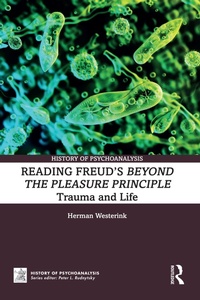
Reading Freud's Beyond the Pleasure Principle
Description

Reading Freud's Beyond the Pleasure Principle presents a new reading of this foundational text, based on the hypothesis that the work was written in two phases.
Herman Westerink explores the idea that Freud put the first version of 1919 aside because he found the conclusions he drew from his line of reasoning difficult if not impossible to accept. The book considers which clinical and theoretical problems Freud wanted to address in the first version of the text, what arguments he developed, and in what way these explorations and arguments resulted in implications he considered problematic. Returning to the text in 1920, Westerink asserts that Freud introduced theories of the life and death drives as a response and possible solution to the problems and implications of his 1919 inquiries.
Reading Freud's Beyond the Pleasure Principle will be a significant reference for academics and scholars of Freud, psychoanalytic studies, trauma, critical theory, philosophy and the history of science. It will be of great interest to psychoanalysts in practice and in training.
More details
Other editions
Additional editions
Person
Herman Westerink is Associate and Endowed Professor at the Center for Contemporary European Philosophy, Radboud University Nijmegen, Netherlands. He has published many books and articles on Freudian psychoanalysis, sexuality, and religion.
Content
Acknowledgements
Introduction
Chapter 1. The pleasure principle
Chapter 2. Traumatic Neuroses and Repetitions
Chapter 3. Pathoanalysis and bioanalysis
Chapter 4. Theories of the drives
Bibliography
