

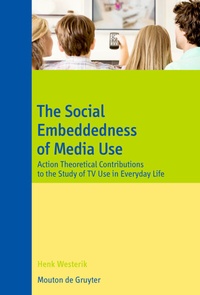
The Social Embeddedness of Media Use
Description

Scholars in the field of communication research have extensively studied television viewing in general and watching television news in particular. The book looks at the subject from an integrative theoretical perspective. Based on Schutzean sociology and action theoretical approaches to media use, the author argues that immediate social influences and other everyday life situations largely determine television use, and that the influence of short-term situational characteristics are often overlooked in person-centered explanatory models.
In three empirical studies, the role of short-term situations and the influence of immediate social surroundings is analyzed. The use of Discrete Time Event History Analysis is an innovative way to look at household diary data. Findings reveal how family members influence each other in many ways. Watching television turns out to be an integral part of everyday life in the family, but also a force that may reduce family interaction. It is shown that television may serve as a surrogate for those family members that are not present, and that family members while present at home follow each others example. Partners are shown to mimic each other, children to mimic their parents, and parents follow the example set by their children.
Television news viewing, in contrast to general television viewing is less determined by the immediate influence of others. Also, the individual motivations for news viewing vary throughout the day. First exposure to television news appears to be motivated by other factors than subsequent exposure. A need for 'surveillance' dominates first exposure, but subsequent exposure appears to be governed by other, more 'ritualistic' motivations.
The book is important to scholars, graduate-level students, and practitioners who are concerned with theoretical and methodological insights in the phenomenon of television viewing in everyday life.
More details
Other editions
Additional editions
Person
Content
2 - Contents [Seite 7]
3 - Chapter 1. The social embeddedness of media use: An introduction [Seite 9]
4 - Chapter 2. Transcending Uses and Gratifications: Media use as social action and the use of event history analysis [Seite 17]
5 - Chapter 3. The situational and time-varying context of routines in television viewing [Seite 33]
6 - Chapter 4. Watching television news in everyday life: An event history analysis [Seite 61]
7 - Chapter 5. The social character of parental and adolescent television viewing [Seite 85]
8 - Chapter 6. On the use of an action theoretical approach to television (news) viewing [Seite 113]
