

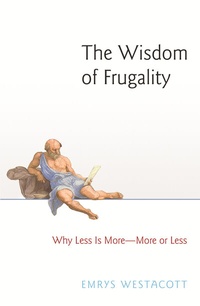
The Wisdom of Frugality
Why Less Is More - More or Less
1st Edition
Published on 24. October 2016
328 pages
978-1-4008-8330-1 (ISBN)
Description

Why philosophers have advocated simple living for 2,500 years-and why we ignore them at our peril
From Socrates to Thoreau, most philosophers, moralists, and religious leaders have seen frugality as a virtue and have associated simple living with wisdom, integrity, and happiness. But why? And are they right? Is a taste for luxury fundamentally misguided? If one has the means to be a spendthrift, is it foolish or reprehensible to be extravagant?
In this book, Emrys Westacott examines why, for more than two millennia, so many philosophers and people with a reputation for wisdom have been advocating frugality and simple living as the key to the good life. He also looks at why most people have ignored them, but argues that, in a world facing environmental crisis, it may finally be time to listen to the advocates of a simpler way of life.
The Wisdom of Frugality explores what simplicity means, why it's supposed to make us better and happier, and why, despite its benefits, it has always been such a hard sell. The book looks not only at the arguments in favor of living frugally and simply, but also at the case that can be made for luxury and extravagance, including the idea that modern economies require lots of getting and spending.
A philosophically informed reflection rather than a polemic, The Wisdom of Frugality ultimately argues that we will be better off-as individuals and as a society-if we move away from the materialistic individualism that currently rules.
From Socrates to Thoreau, most philosophers, moralists, and religious leaders have seen frugality as a virtue and have associated simple living with wisdom, integrity, and happiness. But why? And are they right? Is a taste for luxury fundamentally misguided? If one has the means to be a spendthrift, is it foolish or reprehensible to be extravagant?
In this book, Emrys Westacott examines why, for more than two millennia, so many philosophers and people with a reputation for wisdom have been advocating frugality and simple living as the key to the good life. He also looks at why most people have ignored them, but argues that, in a world facing environmental crisis, it may finally be time to listen to the advocates of a simpler way of life.
The Wisdom of Frugality explores what simplicity means, why it's supposed to make us better and happier, and why, despite its benefits, it has always been such a hard sell. The book looks not only at the arguments in favor of living frugally and simply, but also at the case that can be made for luxury and extravagance, including the idea that modern economies require lots of getting and spending.
A philosophically informed reflection rather than a polemic, The Wisdom of Frugality ultimately argues that we will be better off-as individuals and as a society-if we move away from the materialistic individualism that currently rules.
All prices
More details
Language
English
Place of publication
Princeton, NJ
United States
Publishing group
De Gruyter
Target group
Professional and scholarly
Edition type
Digital original
Product notice
Reflowable
Illustrations
2 b/w illus.
File size
2,77 MB
ISBN-13
978-1-4008-8330-1 (9781400883301)
Schweitzer Classification
Other editions
Additional editions
Book
04/2018
Princeton University Press
€21.00
Shipment within 10-20 days
Book
10/2016
Princeton University Press
€34.72
Shipment within 10-20 days
Person
Emrys Westacott is professor of philosophy at Alfred University in New York.
Content
INTRODUCTION 1
1 What Is Simplicity? 9
2 Why Simple Living Is Supposed to Improve Us 40
3 Why Simple Living Is Thought to Make Us Happier 73
4 Why the Philosophy of Frugality Is a Hard Sell 136
5 The Pros and Cons of Extravagance 163
6 The Philosophy of Frugality in a Modern Economy 200
7 The Environmentalist Case for Simple Living 249
CONCLUSION 275
Acknowledgments 289
Notes 293
Index 307
1 What Is Simplicity? 9
2 Why Simple Living Is Supposed to Improve Us 40
3 Why Simple Living Is Thought to Make Us Happier 73
4 Why the Philosophy of Frugality Is a Hard Sell 136
5 The Pros and Cons of Extravagance 163
6 The Philosophy of Frugality in a Modern Economy 200
7 The Environmentalist Case for Simple Living 249
CONCLUSION 275
Acknowledgments 289
Notes 293
Index 307

