

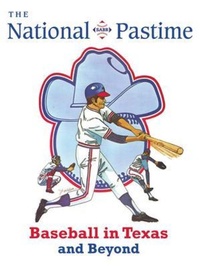
The National Pastime
Description

In this issue, to coincide with SABR's annual convention being held in Dallas-Fort Worth, we explore baseball across northern Texas and Oklahoma. The region has a deep tradition of baseball from long before the arrival of the Rangers. Major league teams in the early twentieth century took advantage of the weather and railroad accessibility to hold spring training in Texas. The minors flourished, with teams in almost every town, while Black barnstorming teams and Negro League teams came and went. And of course, college ball thrives to this day in Texas and Oklahoma.
"Spring Training Ballparks at Marlin, Texas" by Monte Cely
John McGraw announced he would take the Giants to Marlin for the 1908 preseason. The Giants had trained in Los Angeles in 1907, and McGraw wanted a location with fewer distractions. Most of the Giants left New York City by steamship for New Orleans, then traveled by rail from there. John Murphy, groundskeeper at the Polo Grounds, was sent ahead to work on the East Side Fairgrounds fields. Murphy said "... it is lucky they sent me ahead, as the grounds had been given up for steers, pigs, and horses... but the field is now in shape, with the infield grassy and the outfield as smooth as a billiard table." The first group of Giants, mostly "yannigans" trying to make the team, arrived in Marlin on February 19, 1908, led by veteran catcher Roger Bresnahan.
"Baseball in the Middle of Nowhere: The Unique Story of Herbert Kokernot and the Alpine Cowboys"
by C. Paul Rogers III
Herbert Kokernot, Jr. after buying the local team and building a stadium adjacent to Sul Ross State College, recruited many college stars including Adrian Burk and Larry Isbell of Baylor, and Yale Lary of Texas A&M. Under NCAA rules, college athletes were not allowed to be paid for playing their sport in the summer, so Kokernot hired the players for $400 a month to work on his ranch, while they played baseball for the Cowboys ostensibly for free. One of the typical jobs was killing jackrabbits, which were a plague on the ranch. The players used old Jeeps and drove through the prairie armed with .22s and even pistols, chasing the rabbits down until the critters tired and stopped.
"Dave Hoskins and the Uneven, Unheralded, and Unfinished Integration of the Texas League"
by Jason A. Schwartz
Dave Hoskins immediately established himself as the league's best pitcher, one of its leading hitters, and by far its top box office draw, both at home and on the road. None of this suggests Hoskins himself had it easy. A Black man in the Jim Crow South, Hoskins could neither eat at the same restaurants nor stay in the same hotels as teammates. White fans at every ballpark greeted "the Savior of the Texas League" with name-calling and hostility. The roughest destination was always Shreveport, where just a week after proposed legislation sought to bar integrated athletic competition statewide, even death threats entered the mix. Regardless, Hoskins kept on pitching, kept on winning, and kept on spinning league turnstiles at breakneck pace.
More details
Content
Contents
FROM THE EDITOR: Steve West
Deadball Era Major League Baseball Comes to Waxahachie, Texas: Jim Chapman
Spring Training Ballparks at Marlin, Texas
Early 20th Century Major League Baseball in a Central Texas Town: Monte Cely
The 1919 Texas Negro Baseball League Championship:
Dallas Black Giants vs. San Antonio Black Aces: Bill Staples Jr.
Nokona Baseball Gloves
America's Pastime, American Made: Joseph Wancho
From Athens, Texas, to the Cincinnati Reds
The Saga of Pete Donohue: Steve Krevisky
Semi-Pro and Collegiate Baseball in Enid, Oklahoma: Thomas E. Van Hyning
The 1943 Camp Hood Baseball Season: Andrew Jett
Baseball in the Middle of Nowhere
The Unique Story of Herbert Kokernot and the Alpine Cowboys: C. Paul Rogers III
Four Hundred Hitters, Home Run Barrages and Jim Crow
The Post-War Bush Leagues in Texas: C. Paul Rogers III
When the Babe Came to Dallas, 1947: Bob LeMoine
Bobby Layne-28-0
Hall of Fame Caliber Pitcher for the Texas Longhorns (1944, 1946-48): Herm Krabbenhoft
The "Savior" Does Not Answer Letters
Dave Hoskins and the Uneven, Unheralded, and Unfinished Integration of the Texas League: Jason A. Schwartz
Integration Comes to the Texas League, 1952-58: Alan Cohen
Waco Pirates
A Tale of Two Cities: Eric Bynum
How the Metroplex Went Major League: John Bauer
An Encounter with Cliff Gustafson: Charlie Grassl
Stars and Orphans
Over A Half Century of Rangers Relief Pitching: Wayne M. Towers
Jack Allen
Baseball in the Land of "Gushers" and Cowboys: Jarrod Schenewark, PhD
A Day from Hell at the Office
Lenny Randle's Attack on Frank Lucchesi Created Wounds That Never Healed: Daniel VanDeMortel
Oklahoma State Cowboy Baseball
The Remarkable Gary Ward Years: Ronald Elliott, PhD and Wade McWhorter
Boos to Cheers
Darrell Porter and the 1982 World Series: Doug Wedge
Jimmy Porter
A Man or a Legend?: Steve West
Southwest Conference Baseball History: Bo Carter
Abigail Moore
Breaking Barriers: Leslie Heaphy and Cecilia M. Tan
Did the Texas Rangers Buy a World Series?: Josh West
