

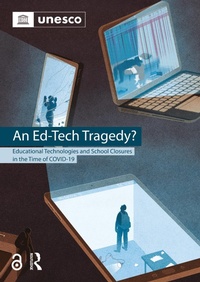
An Ed-Tech Tragedy?
Educational Technologies and School Closures in the Time of COVID-19
Published on 10. October 2025
660 pages
978-1-040-43587-8 (ISBN)
Description

The COVID-19 pandemic pushed education from schools to educational technologies at a pace and scale with no historical precedent. For hundreds of millions of students, formal learning became fully dependent on technology - whether internet-connected digital devices, televisions or radios.
An Ed-Tech Tragedy? examines the numerous adverse and unintended consequences of the shift to ed-tech. It documents how technology-first solutions left a global majority of learners behind and details the many ways education was diminished even when technology was available and worked as intended.
Using tragedy as a metaphor and borrowing the organization of a three-act theatrical play, the book shows how technology-first modes of learning introduced novel health and safety risks, handed significant control of public education to for-profit companies, expanded invasive digital surveillance and carried detrimental environmental repercussions, in addition to adversely impacting educational access, equity, quality and outcomes in most contexts.
Dedicated sections consider alternative and less technology-reliant educational responses to COVID-19 disruptions that had the potential to be more inclusive and equitable. The analysis further explains how pandemic models of learning are rippling beyond school closures and influencing the future of education.
Holistically, the work invites readers to reconsider a turbulent chapter in education history and reexamine the purposes and roles of technology in education.
An Ed-Tech Tragedy? examines the numerous adverse and unintended consequences of the shift to ed-tech. It documents how technology-first solutions left a global majority of learners behind and details the many ways education was diminished even when technology was available and worked as intended.
Using tragedy as a metaphor and borrowing the organization of a three-act theatrical play, the book shows how technology-first modes of learning introduced novel health and safety risks, handed significant control of public education to for-profit companies, expanded invasive digital surveillance and carried detrimental environmental repercussions, in addition to adversely impacting educational access, equity, quality and outcomes in most contexts.
Dedicated sections consider alternative and less technology-reliant educational responses to COVID-19 disruptions that had the potential to be more inclusive and equitable. The analysis further explains how pandemic models of learning are rippling beyond school closures and influencing the future of education.
Holistically, the work invites readers to reconsider a turbulent chapter in education history and reexamine the purposes and roles of technology in education.
Reviews / Votes
"Challenges views that digital technologies are synonymous with educational equality and progress."-The New York Times
"The most extensive examination of the global lockdown experience in education."
-The Financial Times
"Groundbreaking and extraordinary. A world-spanning record of the impacts of screen-dependent learning."
-Jonathan Haidt, Thomas Cooley Professor of Ethical Leadership in the Stern School of Business at New York University, USA, and author of The Anxious Generation
"Wonderful and important. A warning we ignore at our peril."
-Diane Ravitch, Founder and President of the Network for Public Education
"Brings strong evidence of the detrimental impact of digitalization of education on the right to education. Its forceful voice amplifies the chorus of voices opposing the digitalization of education as a replacement to on-site schooling with teachers."
-Farida Shaheed, UN Special Rapporteur on the Right to Education
"Boldly resisting the temptation to forget the lessons of the COVID years, this landmark work gives us a sober guide to where new educational technologies can help us, and how they could lead us significantly astray."
-Arjun Appadurai, Elected Fellow of the Royal Anthropological Institute of Great Britain and Ireland
"To date, the book represents the most detailed analysis of how the rhetoric of technological solutionism comes to shape both policy debates and specific action on the ground"
-Evgeny Morozov, author of Net Delusions and To Save Everything, Click Here
"Provides a crucial moral and intellectual compass to direct us away from the ed-tech solutionism that is causing unparalleled exclusion and is in the process of untethering the right to education from that of schooling."
-Payal Arora, Professor of Inclusive AI Cultures at Utrecht University, The Netherlands, Co-Founder of Inclusive AI Lab as well as FemLab, and author of The Next Billion Users and From Pessimism to Promise
"An immense achievement, and a hugely critical intervention into debates about the future role of digital technologies in education."
-Ben Williamson, Senior Lecturer at the Centre for Research in Digital Education and the Edinburgh Futures Institute at the University of Edinburgh, UK.
"Like the best histories, An Ed-Tech Tragedy? shows us how we have arrived at our present moment, and how we can learn lessons from our past to achieve more equitable and inclusive futures."
-Daniel A. Wagner, Professor of Education and UNESCO Chair in Learning and Literacy at the University of Pennsylvania, USA, and author of Learning and Education in Developing Countries and Learning as Development
More details
Language
English
Place of publication
London
United Kingdom
Publishing group
Taylor & Francis Ltd
Target group
College/higher education
Professional and scholarly
Product notice
Reflowable
Illustrations
120 Halftones, color; 120 Illustrations, color
File size
14,15 MB
ISBN-13
978-1-040-43587-8 (9781040435878)
Copyright in bibliographic data and cover images is held by Nielsen Book Services Limited or by the publishers or by their respective licensors: all rights reserved.
Schweitzer Classification
Other editions
Additional editions
Book
10/2025
1st Edition
Routledge
€64.50
Shipment within 15-20 days

Book
10/2025
1st Edition
Routledge
€191.50
Shipment within 15-20 days
Person
Mark West is an education specialist at UNESCO, the United Nations Educational, Scientific and Cultural Organization, where he researches and writes about education with a special focus on technology. He advises governments, international organizations and civil society groups about opportunities and risks for education in an age of accelerating digital change. Prior to joining UNESCO, Mr. West worked as a journalist, history teacher and teacher trainer. He is a graduate of Stanford University and a former Fulbright Fellow.
In addition to an An Ed-Tech Tragedy?, Mr. West is the author of numerous UNESCO publications about technology and education, including I'd Blush if I Could and Reading in the Mobile Era. I'd Blush if I Could prompted Apple and other large technology companies to make changes to the way AI voice assistants project gender. It clarified how education can help close digital gender divides and was praised by experts and media outlets around world. Reading in the Mobile Era brought international attention to the ways governments, schools and families can leverage inexpensive mobile technologies to help advance literacy.
In addition to an An Ed-Tech Tragedy?, Mr. West is the author of numerous UNESCO publications about technology and education, including I'd Blush if I Could and Reading in the Mobile Era. I'd Blush if I Could prompted Apple and other large technology companies to make changes to the way AI voice assistants project gender. It clarified how education can help close digital gender divides and was praised by experts and media outlets around world. Reading in the Mobile Era brought international attention to the ways governments, schools and families can leverage inexpensive mobile technologies to help advance literacy.
Content
INTRODUCTION: Defining ed-tech / The origins and rise of ed-tech / Ed-tech and technology solutionism / Why tragedy? / Situating the disruption / A Netflix moment for commercial ed-tech | Act 1: THE HOPE OF TECH SALVATION: Reformatting schools with technology / Cut the red tape and catapult education to a better future | Act 2: FROM PROMISES TO REALITY: Most learners were left behind / Inequalities were supercharged / Learners engaged less, achieved less and left state-provisioned education/ Education was narrowed and impoverished / Immersion in technology was unhealthy / Environmental tolls multiplied with the ed-tech boom / The private sector tightened its grip on public education / Surveillance, control and machine processes marked the move to ed-tech | Inter-Act: LOOKING BACK TO SEE AHEAD: School closures, the shift to remote learning and public health / Did technology-mediated remote learning contribute to the prolongation of school closures? / If not ed-tech, then what? / Was COVID-19 an education crisis? / Ed-tech finds a new rationale - resilience Is technology a pillar of educational resilience? / If ed-tech is the answer, what is the question? | Act 3: NEW DIRECTIONS FOR ED-TECH: Prioritize the best interests of students and teachers / Reaffirm the primacy of in-person learning / Strengthen digital connectivity, capacities and content / Protect the right to education from shrinking ground | CONCLUSION: Remembering the ed-tech experiences of the pandemic / The arc of tragedy / Reorienting and steering the digital transformation of education
