
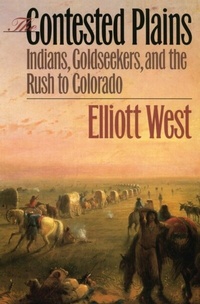
The Contested Plains
Description
Alles über E-Books | Antworten auf Fragen rund um E-Books, Kopierschutz und Dateiformate finden Sie in unserem Info- & Hilfebereich.
Winner: Caroline Bancroft Prize
Winner: Caughey Award
Winner: PEN Center USA West Literary Award in Research Nonfiction
Winner: Francis Parkman Prize
Winner: Ray Allen Billington Prize
Choice Outstanding Title
Deftly retracing a pivotal chapter in one of America's most dramatic stories, Elliott West chronicles the struggles, triumphs, and defeats of both Indians and whites as they pursued their clashing dreams of greatness in the heart of the continent.
The Contested Plains recounts the rise of the Native American horse culture, white Americans' discovery and pursuit of gold in the Rocky Mountains, and the wrenching changes and bitter conflicts that ensued. After centuries of many peoples fashioning many cultures on the plains, the Cheyennes and other tribes found in the horse the power to create a heroic way of life that dominated one of the world's great grasslands. Then the discovery of gold challenged that way of life and led finally to the infamous massacre at Sand Creek and the Indian Wars of the late 1860s.
Illuminating both the ancient and more recent history of the plains and eastern Rocky Mountains, West weaves together a brilliant tapestry interlaced with environmental, social, and military history. He treats the ?frontier? not as a morally loaded term?either in the traditional celebratory sense or the more recent critical sense?but as a powerfully unsettling process that shattered an old world. He shows how Indians, goldseekers, haulers, merchants, ranchers, and farmers all contributed to and in turn were consumed by this process, even as the plains themselves were utterly transformed by the clash of cultures and competing visions.
Exciting and enormously engaging, The Contested Plains is the first book to examine the Colorado gold rush as the key event in the modern transformation of the central great plains. It also exemplifies a kind of history that respects more fully our rich and ambiguous past?a past in which there are many actors but no simple lessons.
All prices
More details
Other editions
Additional editions
Person
Elliott West, professor of history at the University of Arkansas, is the author of The Way to the West: Essays on the Central Plains and Growing Up with the Country: Childhood on the Far-Western Frontier, both of which received the Western Heritage Award for the best non-fiction book on the American West.
Content
List of Illustrations
Acknowledgments
Introduction
1. Prologue: A Scrap and a Panic
Part One: Visions
2. The Old World
3. Frontiers and Visions
4. The Called Out People
Part Two: Gold Rush
5. The Gold
6. The Gathering
7. The Rush
Part Three: Power
8. Path of Empire
9. On the Road to a Flourishing Mountain State
10. The People of the Centre
11. The Miseries of Failure
12. Epilogue: Stories in the Teeth of Life
Notes
Bibliography
Index

System requirements
File format: ePUB
Copy protection: Adobe-DRM (Digital Rights Management)
System requirements:
- Computer (Windows; MacOS X; Linux): Install the free reader Adobe Digital Editions prior to download (see eBook Help).
- Tablet/smartphone (Android; iOS): Install the free app Adobe Digital Editions or the app PocketBook before downloading (see eBook Help).
- E-reader: Bookeen, Kobo, Pocketbook, Sony, Tolino and many more (not Kindle).
The file format ePub works well for novels and non-fiction books – i.e., „flowing” text without complex layout. On an e-reader or smartphone, line and page breaks automatically adjust to fit the small displays.
This eBook uses Adobe-DRM, a „hard” copy protection. If the necessary requirements are not met, unfortunately you will not be able to open the eBook. You will therefore need to prepare your reading hardware before downloading.
Please note: We strongly recommend that you authorise using your personal Adobe ID after installation of any reading software.
For more information, see our ebook Help page.
File format: PDF
Copy-Protection: Adobe-DRM (Digital Rights Management)
System requirements:
- Computer (Windows; MacOS X; Linux): Install the free reader Adobe Digital Editions prior to download (see eBook Help).
- Tablet/smartphone (Android; iOS): Install the free app Adobe Digital Editions or the app PocketBook before downloading (see eBook Help).
- E-reader: Bookeen, Kobo, Pocketbook, Sony, Tolino and many more (only limited: Kindle).
The file format PDF always displays a book page identically on any hardware. This makes PDF suitable for complex layouts such as those used in textbooks and reference books (images, tables, columns, footnotes). Unfortunately, on the small screens of e-readers or smartphones, PDFs are rather annoying, requiring too much scrolling.
This eBook uses Adobe-DRM, a „hard” copy protection. If the necessary requirements are not met, unfortunately you will not be able to open the eBook. You will therefore need to prepare your reading hardware before downloading.
Please note: We strongly recommend that you authorise using your personal Adobe ID after installation of any reading software.
For more information, see our eBook Help page.
File format: ePUB
Copy protection: Watermark-DRM (Digital Rights Management)
System requirements:
- Computer (Windows; MacOS X; Linux): Use a reading software that can process the file format ePUB: e.g., Adobe Digital Editions or FBReader – both free (see eBook Help).
- Tablet/Smartphone (Android; iOS): Before downloading, install the free app Adobe Digital Editions (see eBook Help).
- E-reader: Bookeen, Kobo, Pocketbook, Sony, Tolino and many more (not Kindle).
The file format ePUB works well for novels and non-fiction books – i.e., „flowing” text without complex layout. On an e-reader or smartphone, line and page breaks automatically adjust to fit the small displays.
This eBook uses Watermark-DRM, a „soft” copy protection. This means that there are no technical restrictions to prevent illegal distribution. However, there is a personalised watermark embedded in the eBook that can be used to identify the purchaser of the eBook in the event of misuse and to provide evidence for legal purposes.
For more information, see our eBook Help page.
