

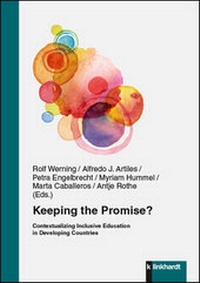
Keeping the Promise?
Contextualizing Inclusive Education in Developing Countries
1st Edition
Published in August 2016
185 pages
978-3-7815-5492-4 (ISBN)
Description

Inclusive education became a global promise corroborated
by international declarations such as the Salamanca
Statement (1994) and the Incheon Declaration
(2015). Most countries worldwide have committed to
the goal of inclusive education, putting a lot of pressure
on so-called developing countries.
Against this backdrop, the threefold purpose of this book
is to:
1. Generate research evidence on the development and
implementation of inclusive education in developing
countries,
2. Contextualize inclusive education in specific developing
countries and contexts, and
3. Reflect on the future of inclusive education in developing
countries.
More details
Other editions
Additional editions
Rolf Werning | Alfredo J. Artiles | Petra Engelbrecht
Keeping the Promise?
Contextualizing Inclusive Education in Developing Countries
Book
08/2016
Verlag Julius Klinkhardt
€17.90
Article exhausted; check different version
Persons
Content
1 - Rolf Werning / Alfredo J. Artiles /Petra Engelbrecht / Myriam Hummel /Marta Caballeros / Antje Rothe(Eds.):Keeping the Promise? [Seite 1]
2 - Impressum [Seite 2]
3 - Content [Seite 6]
4 - Nidhi Singal: Foreword [Seite 8]
5 - Introduction [Seite 10]
6 - Petra Engelbrecht and Alfredo J. Artiles: 1 Inclusive Education: Contextualizing the Historyof a Global Movement [Seite 16]
6.1 - 1 History of Inclusive Education [Seite 17]
6.2 - 2 Global Debates and Research on the Implementation of Inclusive Education [Seite 19]
6.3 - 3 Main Themes from Research on Inclusive Education in Developing Countries [Seite 22]
6.4 - 4 Conclusions [Seite 26]
6.5 - References [Seite 27]
7 - Myriam Hummel, Petra Engelbrecht and Rolf Werning: 2.1 Developing an Understanding of Inclusive Education in Malawi [Seite 30]
7.1 - 1 Malawi's Socio-Economic and Cultural Contexts [Seite 30]
7.2 - 2 The Malawi Education System [Seite 31]
7.3 - 3 Central Research Findings [Seite 38]
7.4 - 4 Future Perspectives [Seite 45]
7.5 - References [Seite 45]
8 - Antje Rothe, Evance Charlie and Anderson Chikumbutso Moyo: 2.2 Global Processes and Local Manifestations: Two Case Studies from Malawi [Seite 48]
8.1 - 1 Methodological Issues [Seite 49]
8.2 - 2 Characteristics of the Selected Case Study Schools [Seite 51]
8.3 - 3 Dimensions of Analysis and Findings: Special Education and Inclusive Education [Seite 54]
8.4 - 4 Dimensions of Analysis and Findings: Policy Idealism and School Reality [Seite 66]
8.5 - 5 Dimensions of Analysis and Findings: Traditional Orientations versus Formal Education [Seite 80]
8.6 - 6 Comparison [Seite 89]
8.7 - 7 Conclusions [Seite 91]
8.8 - References [Seite 92]
9 - Cristina Perdomo, Marta Caballeros, Alfredo J. Artiles, Magaly Menéndez and Gerson Sontay: 3.1 Developing an Understanding of Inclusive Education in Guatemala [Seite 94]
9.1 - 1 Guatemala's Socio-Economic and Cultural Contexts [Seite 95]
9.2 - 2 The Guatemalan Education System [Seite 98]
9.3 - 3 Methodology of the Study [Seite 101]
9.4 - 4 Inclusive Education from the Stakeholder Perspective [Seite 104]
9.5 - 5 Discussion [Seite 115]
9.6 - 6 Concluding Remarks [Seite 117]
9.7 - References [Seite 118]
10 - Marta Caballeros, Alfredo J. Artiles, Héctor Canto and Cristina Perdomo: 3.2 Inclusive Education in Developing Countries: Two Case Studies from Guatemala [Seite 122]
10.1 - 1 Case Study School 1: Inclusive School in a Slum Area [Seite 126]
10.2 - 2 Inclusive Education in the Midst of Inequality: The Case of a Rural School [Seite 136]
10.3 - 3 Discussion [Seite 143]
10.4 - References [Seite 149]
11 - Myriam Hummel, Antje Rothe and Rolf Werning: 4 Theoretical Annotations of the Research Results from Guatemala and Malawi [Seite 152]
11.1 - 1 Tensions in the Implementation of Inclusive Education [Seite 153]
11.2 - 2 Recontextualization of Inclusive Education on Different System Levels [Seite 157]
11.3 - 3 Inclusive Education: From Negative Pressure to Positive Pressure [Seite 162]
11.4 - 4 Conclusions [Seite 164]
11.5 - References [Seite 165]
12 - Antje Rothe, Marta Caballeros, Myriam Hummel, Petra Engelbrecht, Alfredo J. Artiles and Rolf Werning: 5 Reflections on the Future of Inclusive Education [Seite 168]
12.1 - Future Perspective #1: Using Situated Models of InclusiveEducation [Seite 169]
12.2 - Future Perspective #2: Considering the Importance of Educational Quality in the Process of Realizing Inclusive Education [Seite 171]
12.3 - Future Perspective #3: Creating Positive Pressure [Seite 174]
12.4 - Keeping the Promise? [Seite 177]
12.5 - References [Seite 179]
13 - Short Biographies of the Authors and Editors [Seite 182]
14 - Rückumschlag [Seite 188]
2 - Impressum [Seite 2]
3 - Content [Seite 6]
4 - Nidhi Singal: Foreword [Seite 8]
5 - Introduction [Seite 10]
6 - Petra Engelbrecht and Alfredo J. Artiles: 1 Inclusive Education: Contextualizing the Historyof a Global Movement [Seite 16]
6.1 - 1 History of Inclusive Education [Seite 17]
6.2 - 2 Global Debates and Research on the Implementation of Inclusive Education [Seite 19]
6.3 - 3 Main Themes from Research on Inclusive Education in Developing Countries [Seite 22]
6.4 - 4 Conclusions [Seite 26]
6.5 - References [Seite 27]
7 - Myriam Hummel, Petra Engelbrecht and Rolf Werning: 2.1 Developing an Understanding of Inclusive Education in Malawi [Seite 30]
7.1 - 1 Malawi's Socio-Economic and Cultural Contexts [Seite 30]
7.2 - 2 The Malawi Education System [Seite 31]
7.3 - 3 Central Research Findings [Seite 38]
7.4 - 4 Future Perspectives [Seite 45]
7.5 - References [Seite 45]
8 - Antje Rothe, Evance Charlie and Anderson Chikumbutso Moyo: 2.2 Global Processes and Local Manifestations: Two Case Studies from Malawi [Seite 48]
8.1 - 1 Methodological Issues [Seite 49]
8.2 - 2 Characteristics of the Selected Case Study Schools [Seite 51]
8.3 - 3 Dimensions of Analysis and Findings: Special Education and Inclusive Education [Seite 54]
8.4 - 4 Dimensions of Analysis and Findings: Policy Idealism and School Reality [Seite 66]
8.5 - 5 Dimensions of Analysis and Findings: Traditional Orientations versus Formal Education [Seite 80]
8.6 - 6 Comparison [Seite 89]
8.7 - 7 Conclusions [Seite 91]
8.8 - References [Seite 92]
9 - Cristina Perdomo, Marta Caballeros, Alfredo J. Artiles, Magaly Menéndez and Gerson Sontay: 3.1 Developing an Understanding of Inclusive Education in Guatemala [Seite 94]
9.1 - 1 Guatemala's Socio-Economic and Cultural Contexts [Seite 95]
9.2 - 2 The Guatemalan Education System [Seite 98]
9.3 - 3 Methodology of the Study [Seite 101]
9.4 - 4 Inclusive Education from the Stakeholder Perspective [Seite 104]
9.5 - 5 Discussion [Seite 115]
9.6 - 6 Concluding Remarks [Seite 117]
9.7 - References [Seite 118]
10 - Marta Caballeros, Alfredo J. Artiles, Héctor Canto and Cristina Perdomo: 3.2 Inclusive Education in Developing Countries: Two Case Studies from Guatemala [Seite 122]
10.1 - 1 Case Study School 1: Inclusive School in a Slum Area [Seite 126]
10.2 - 2 Inclusive Education in the Midst of Inequality: The Case of a Rural School [Seite 136]
10.3 - 3 Discussion [Seite 143]
10.4 - References [Seite 149]
11 - Myriam Hummel, Antje Rothe and Rolf Werning: 4 Theoretical Annotations of the Research Results from Guatemala and Malawi [Seite 152]
11.1 - 1 Tensions in the Implementation of Inclusive Education [Seite 153]
11.2 - 2 Recontextualization of Inclusive Education on Different System Levels [Seite 157]
11.3 - 3 Inclusive Education: From Negative Pressure to Positive Pressure [Seite 162]
11.4 - 4 Conclusions [Seite 164]
11.5 - References [Seite 165]
12 - Antje Rothe, Marta Caballeros, Myriam Hummel, Petra Engelbrecht, Alfredo J. Artiles and Rolf Werning: 5 Reflections on the Future of Inclusive Education [Seite 168]
12.1 - Future Perspective #1: Using Situated Models of InclusiveEducation [Seite 169]
12.2 - Future Perspective #2: Considering the Importance of Educational Quality in the Process of Realizing Inclusive Education [Seite 171]
12.3 - Future Perspective #3: Creating Positive Pressure [Seite 174]
12.4 - Keeping the Promise? [Seite 177]
12.5 - References [Seite 179]
13 - Short Biographies of the Authors and Editors [Seite 182]
14 - Rückumschlag [Seite 188]
