

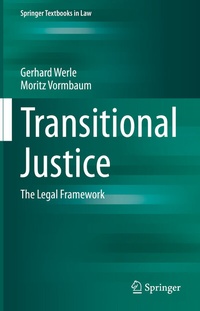
Transitional Justice
Description

The expression "transitional justice" emerged at the end of the Cold War, during the transition from dictatorships to democracies, and serves as a central concept in dealing with systemic injustice. This textbook examines the basic principles of transitional justice and explores its core mechanisms, including prosecutions, amnesties, truth commissions, reparations, and vetting the public service. It elaborates the substance and legal framework of these mechanisms and discusses current challenges.
The book provides extensive material illustrating a wide variety of transitional justice situations.
"This book summarizes the subjects of transitional justice and Vergangenheitsbewältigung systematically and clearly" (Joachim Gauck, German Federal President, 2012-2017).
More details
Other editions
Additional editions
Persons
Gerhard Werle is Professor Emeritus of German and International Criminal Law, Criminal Procedure and Modern Legal History at Humboldt-Universität zu Berlin and Director of the African-German Research Network for Transnational Criminal Justice. He has been an Extraordinary Professor at the University of the Western Cape (South Africa) and holds honorary professorships at North-West University of Political Science and Law (Xi'an, China) and the University of Stellenbosch (South Africa).
Moritz Vormbaum is Professor of Criminal Law, Criminal Procedure and International Criminal Law at the University of Münster (Germany). Before assuming his current position, he was Senior Researcher at Humboldt-Universität zu Berlin, as well as a coordinator and lecturer at the South African-German Centre for Transnational Criminal Justice.
Content
1 What is Transitional Justice?.- 2 What Does 'Transition' Mean?.- 3 Legal Principles of Transitional Justice.- 4 Prosecution.- 5 Amnesty.- 6 Truth Commissions.- 7 Reparations.- 8 Vetting Public Servants.- 9 Evaluating Transitional Justice Processes.- 10 Prospects.
