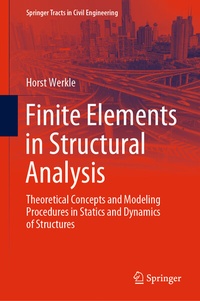
Finite Elements in Structural Analysis
Description

The book introduces the basic concepts of the finite element method in the static and dynamic analysis of beam, plate, shell and solid structures, discussing how the method works, the characteristics of a finite element approximation and how to avoid the pitfalls of finite element modeling. Presenting the finite element theory as simply as possible, the book allows readers to gain the knowledge required when applying powerful FEA software tools. Further, it describes modeling procedures, especially for reinforced concrete structures, as well as structural dynamics methods, with a particular focus on the seismic analysis of buildings, and explores the modeling of dynamic systems. Featuring numerous illustrative examples, the book allows readers to easily grasp the fundamentals of the finite element theory and to apply the finite element method proficiently.
Reviews / Votes
"The theory of FEM is presented 'as simply as possible' and illustrated with many examples. . The book gives the readers the knowledge required when applying powerful FEM software tools in static or dynamic analysis. . The book is based on the lectures for students of the Faculty of Civil Engineering, and is intended for students as well as for structural engineers." (V. Leontiev, zbMATH 1502.74004, 2023)More details
Other editions
Additional editions