

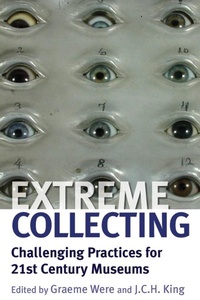
Extreme Collecting
Description

By exploring the processes of collecting, which challenge the bounds of normally acceptable practice, this book debates the practice of collecting 'difficult' objects, from a historical and contemporary perspective; and discusses the acquisition of objects related to war and genocide, and those purchased from the internet, as well as considering human remains, mass produced objects and illicitly traded antiquities. The aim is to apply a critical approach to the rigidity of museums in maintaining essentially nineteenth-century ideas of collecting; and to move towards identifying priorities for collection policies in museums, which are inclusive of acquiring 'difficult' objects. Much of the book engages with the question of the limits to the practice of collecting as a means to think through the implementation of new strategies.
More details
Other editions
Additional editions
Persons
Graeme Were is Chair of Anthropology at the University of Bristol. His current research focuses on material culture and ethnographic museums; digital heritage and source community engagement; and, ethnomathematics in the Pacific. His recent publications include Lines that Connect: Rethinking Pattern and Mind in the Pacific (University of Hawai'i Press, 2010), and Pacific Pattern, with S. Küchler (Thames & Hudson, 2005). He is a Fellow of the Royal Anthropological Institute and an editor of the Journal of Material Culture.
Content
List of Figures
Extreme Collecting: Dealing with Difficult Objects
Graeme Were
Part I: Dificult Objects
Chapter 1. The Material Culture of Persecution: Collecting for the Holocaust Exhibition at the Imperial War Museum
Suzanne Bardgett
Chapter 2. Lyricism and Offence in Egyptian Archaeology Collections
Stephen Quirke
Chapter 3. Contested Human Remains
Jack Lohman
Chapter 4. Extreme or Commonplace: The Collecting of Unprovenanced Antiquities
Kathryn Walker Tubb
Chapter 5. Unfit for Society? The Case of the Galton Collection at University College London
Natasha McEnroe
Part II: Mass Produced
Chapter 6. Knowing the New
Susan Pearce
Chapter 7. T he Global Scope of Extreme Collecting: Japanese Woodblock Prints on the Internet
Richard Wilk
Chapter 8. A wkward Objects: Collecting, Deploying and Debating Relics
Jan Geisbusch
Chapter 9. Great Expectations and Modest Transactions: Art, Commodity and Collecting
Henrietta Lidchi
Part III: Extreme Matters
Chapter 10. Extremes of Collecting at the Imperial War Museum 1917-2009: Struggles with the Large and the Ephemeral
Paul Cornish
Chapter 11. Plastics - Why Not? A Perspective from the Museum of Design in Plastics
Susan Lambert
Chapter 12. T ime Capsules as Extreme Collecting
Brian Durrans
Chapter 13. Canning Cans - a Brand New Way of Looking at History
Robert Opie in conversation with J.C.H. King
Notes on Contributors
Index
