

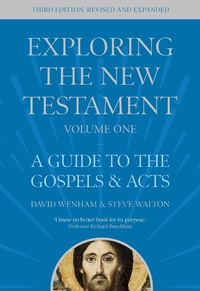
Exploring the New Testament, Volume 1
Description

'A superb one-stop shop for students.'
Dr Elizabeth Shively
Tried, tested and trusted by students and teachers across the world, this widely respected study guide enables you to engage with an array of essential topics, including:
· the Jewish and Greco-Roman background to the New Testament
· literary genres and forms
· issues of authorship, date and setting
· the content and major themes of each book
· well established and newer methods of study
· the latest scholarship in the quest for the historical Jesus
· the intersection of New Testament studies with contemporary faith and culture
Now in its third edition, this popular textbook has been fully revised and updated, and includes new sections on:
· the impact of social memory theory on Gospel studies
· recent work on characterization in narrative studies of the Gospels
· women in the Gospels
· reading the Gospels and Acts theologically
· how the Hebrew Scriptures are read by the New Testament authors
· the resurrection and Ascension of Jesus
· Luke's presentation of Jesus' identity and mission
· updated bibliographies, highlighting the most important and influential works published in the past decade
Drawing on the authors' decades of experience in teaching these topics, this comprehensive textbook gives students a strong understanding and a solid foundation for further study.
More details
Other editions
Additional editions
Persons
Dr David Wenham has taught New Testament at Wycliffe Hall, Oxford, and Trinity College, Bristol. His most recent books include From Good News to Gospels (Eerdmans, 2018) and, as joint editor, Earliest Perceptions of Jesus in Context (Bloomsbury, 2018).
The Revd Professor Steve Walton is Associate Research Fellow and part-time Tutor in New Testament at Trinity College, Bristol. His recent books include jointly editing both Poverty in the Early Church and Today (Bloomsbury T. & T. Clark, 2019) and The Urban World and the First Christians (Eerdmans, 2017).
Content
- Intro
- Title Page
- Copyright Page
- Contents
- List of illustrations
- How to use this book
- A. Setting the Scene
- 1. The historical context of Jesus and the New Testament
- From the Persian period to the Jewish War
- Sources of information
- Old and New Testaments
- Jewish sources
- Greek and Roman historians
- Before the Romans
- The Greeks
- The Maccabees versus the Seleucid Empire
- The Hasmonean Dynasty
- The Romans
- The Herod family
- Pontius Pilate
- After Pilate
- Jesus' context
- Essay topics
- Further reading
- 2. Judaism in first-century Palestine
- Five key marks of second temple Judaism
- One true God
- God has chosen Israel
- God has provided a way of life
- God has given the people a land, focused in the temple
- Hope for the future
- Parties and groups within first-century Judaism
- Pharisees
- Sadducees
- Essenes
- The 'fourth philosophy': the revolutionaries
- Common Judaism
- Further reading
- B. Approaching the Gospels
- 3. What are the Gospels?
- What does 'Gospel' mean?
- The Gospels as like other ancient literature
- The Gospels as unlike other ancient literature
- Truth in both views?
- Why were the Gospels written?
- What about other Gospels?
- Some issues for today
- Essay topics
- Further reading
- 4. Where did the Gospels come from?
- Luke 1:1-4
- Using a Gospels synopsis
- Source criticism
- Form criticism
- Redaction criticism
- And now?
- Essay topics
- Further reading
- 5. Understanding the Gospels today
- Tools for interpreting the Gospels
- Narrative criticism
- Social-scientific approaches
- Rhetorical criticism
- Reader-response approaches
- 'Ideological' approaches
- Structuralism
- Post-structuralism and deconstruction
- Reception history
- Reading the Gospels and Acts theologically
- How the Gospels and Acts read Scripture
- An approach to exegesis of the Gospels
- The process of study
- Pull the ideas together
- Presentation
- Essay topics
- Further reading
- Methods of interpretation: parables, miracles, apocalyptic
- The parables of Jesus
- The miracles of Jesus
- Apocalyptic imagery
- Essay topics
- Further reading
- The historicity of the Gospels
- A subjective issue?
- What sort of documents?
- What sources of information did they have?
- Doubts about the historicity of the contents
- Arguments for historicity from the contents
- Essay topics
- Further reading
- Using the Gospels today
- What are we to make of four different Gospels?
- What about teaching and using the Gospels today?
- Essay topic
- Further reading
- C. Understanding Jesus
- 6. The quest for the historical Jesus
- Individuals and movements
- Rationalism and Hermann Samuel Reimarus
- H. G. Paulus and miracles
- David Strauss and myth
- The liberal lives of Jesus
- Albert Schweitzer and the eschatological Jesus
- Rudolf Bultmann, myth and existentialism
- The new quest
- The Jesus Seminar
- The third quest
- Other modern views of Jesus
- Issues
- Presuppositions and subjectivity
- Miracles
- Sources
- The religious context
- Criteria and method
- History matters
- Essay topics
- Further reading
- 7. The life of Jesus in the light of history
- Birth and beginnings
- John the Baptist
- Galilee
- The road to Jerusalem
- Last days in Jerusalem
- Resurrection!
- Essay topics
- Further reading
- 8. The teaching and aims of Jesus
- Why did Jesus die?
- Jesus' arrival in Jerusalem
- Jesus' demonstration in the temple
- The final steps
- Jesus' perspective
- Jesus and the kingdom of God
- God's reign in the OT and Judaism
- Jesus and the kingdom
- The character of the kingdom
- Welcome for 'sinners'
- The kingdom of the Father
- The response required
- Jesus' ethics and his view of the torah
- Jesus' teaching about the torah
- Jesus' criticisms of the torah
- Was Jesus consistent?
- Who did Jesus think he was?
- Jesus as Israel
- Jesus, his disciples and the renewed Israel
- The aims of Jesus
- Jesus as Messiah
- Jesus as the son of God
- Jesus as the son of man
- Summing up: Jesus and the purposes of Yahweh
- Some issues for today
- Essay topics
- Further reading
- D. Getting into the Four Gospels
- 9. Mark
- Structure
- A walk through Mark
- Some key themes
- Christology
- Discipleship
- Background and purpose
- Authorship and date
- Some issues for today
- Essay topics
- Further reading
- 10. Matthew
- A look into the Gospel
- How the Gospel is structured
- Style
- Theological themes
- Jesus fulfils the OT story
- Jesus fulfils the law and brings the higher righteousness
- Practical obedience and judgement
- Jesus brings good news to the world: Jews, Gentiles and the church
- The Church
- Kingdom and Christology
- Sources of Matthew's Gospel
- The two source theory
- Background and purpose
- Authorship and date
- Some issues for today
- Essay topics
- Further reading
- 11. Luke
- Luke-Acts: a two-volume work
- Structure
- Journeying with Jesus in Luke's Gospel
- Some key themes
- Salvation
- Salvation for all
- Jesus' identity and mission
- The Holy Spirit
- Prayer and praise
- Luke's sources
- Luke's readers, purpose and authorship
- Some issues for today
- Essay topics
- Further reading
- 12. John
- A walk through the Gospel
- Style
- Theological themes
- Jesus as Jewish Messiah
- Jesus as divine son
- Reasons for believing: signs and witnesses
- Is Jesus human in John?
- The death of Jesus: how does it work?
- Eternal life
- The Holy Spirit
- Ethics
- Future hope?
- Believing
- The sources of the Gospel
- John 21
- The prologue
- Dislocations in the text
- Signs source
- Theological variation
- The synoptic Gospels
- The background and purpose of John's Gospel
- Possible explanations of the differences
- Authorship and date of the Gospel
- In favour of the traditional identification
- Against the traditional identification
- If not by John the Apostle
- Some issues for today
- Essay topics
- Further reading
- E. The Acts of the Apostles
- 13. Acts
- Acts as Luke's volume two
- What kind of book is Acts?
- Style and presentation
- Parallelism
- Prophecy and fulfilment
- Structure
- A reading of Acts
- Setting the scene
- Mission in Jerusalem
- Three big men
- The gospel spreads in Syria-Palestine
- Paul begins to travel: the Jerusalem meeting
- Paul's second and third journeys
- To Jerusalem and then Rome
- Acts and history
- Titles and geography
- Time and dates
- Acts and Galatians
- A chronological outline of Acts
- Speeches
- Acts and theology: some major themes
- God
- Jesus
- The Holy Spirit
- Mission and the Church
- Luke's readers and purpose
- Readers
- Why did Luke write?
- Authorship and date
- Who is Luke?
- When did Luke write?
- Reading Acts today
- Some issues for today
- Essay topics
- Further reading
- Glossary
