

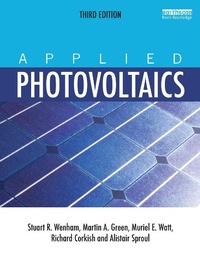
Applied Photovoltaics
3rd Edition
Published on 11. January 2013
304 pages
978-1-136-52830-9 (ISBN)
Description

The new edition of this thoroughly considered textbook provides a reliable, accessible and comprehensive guide for students of photovoltaic applications and renewable energy engineering. Written by a group of award-winning authors it is brimming with information and is carefully designed to meet the needs of its readers.
Along with exercises and references at the end of each chapter, it features a set of detailed technical appendices that provide essential equations, data sources and standards. The new edition has been fully updated with the latest information on photovoltaic cells, modules, applications and policy.
Starting from basics with 'The Characteristics of Sunlight' the reader is guided step-by-step through semiconductors and p-n junctions; the behaviour of solar cells; cell properties and design; and PV cell interconnection and module fabrication. The book covers stand-alone photovoltaic systems; specific purpose photovoltaic systems; remote area power supply systems; grid-connected photovoltaic systems and water pumping. Applied Photovoltaics is highly illustrated and very accessible, providing the reader with all the information needed to start working with photovoltaics.
Along with exercises and references at the end of each chapter, it features a set of detailed technical appendices that provide essential equations, data sources and standards. The new edition has been fully updated with the latest information on photovoltaic cells, modules, applications and policy.
Starting from basics with 'The Characteristics of Sunlight' the reader is guided step-by-step through semiconductors and p-n junctions; the behaviour of solar cells; cell properties and design; and PV cell interconnection and module fabrication. The book covers stand-alone photovoltaic systems; specific purpose photovoltaic systems; remote area power supply systems; grid-connected photovoltaic systems and water pumping. Applied Photovoltaics is highly illustrated and very accessible, providing the reader with all the information needed to start working with photovoltaics.
Reviews / Votes
Praise for previous editions"Recommended reading for any course which deals with hands-on aspects of photovoltaic systems and applications. Earthscan should be applauded" - Tom Markvart, University of Southampton, UK
"An excellent introduction to the science, principles and practice of photovoltaic energy conversion." - Jenny Nelson, Professor of Physics, Imperial College, London, UK
"The leading research, teaching and engineering group has made another important contribution to photovoltaic education." - Allen Barnett, Senior Policy Fellow, Center for Energy and Environmental Policy, University of Delaware, USA.
"This book will make an excellent reference for engineers and scientists involved in photovoltaics. The breadth of knowledge contained within and the detailed equations to support it, as well as being an easy reading style will enable people to get to the understanding of why PV systems are put together the way they are - well beyond rules of thumb." - Mike Dymond, Sowilo Engineering Pty Ltd for Solar Progress
More details
Edition
3rd edition
Language
English
Place of publication
London
United Kingdom
Publishing group
Taylor & Francis Ltd
Target group
College/higher education
Edition type
Revised edition
File size
5,07 MB
ISBN-13
978-1-136-52830-9 (9781136528309)
Copyright in bibliographic data and cover images is held by Nielsen Book Services Limited or by the publishers or by their respective licensors: all rights reserved.
Schweitzer Classification
Other editions
Additional editions
Stuart R. Wenham | Martin A. Green | Muriel E. Watt
Applied Photovoltaics
Book
12/2011
3rd Edition
Earthscan Ltd
€274.40
Shipment within 3-4 weeks
Stuart R. Wenham | Martin A. Green | Muriel E. Watt
Applied Photovoltaics
Book
12/2011
3rd Edition
Earthscan Ltd
€88.00
Shipment within 3-4 weeks
Previous edition
Stuart R. Wenham | Martin A. Green | Muriel E. Watt
Applied Photovoltaics
E-Book
09/2013
1st Edition
Routledge
€72.49
Available for download
Persons
Stuart Wenham is a Scientia Professor at the University of New South Wales and Director of the University's ARC Photovoltaic Centre of Excellence. In a career spanning more than a quarter of a century, he has invented or co-invented eight suites of solar cell technologies that have been licensed to solar cell makers around the world. He is the recipient of numerous Australian and international PV and Innovation awards and established the world's first Photovoltaics Engineering Degree program at the University of NSW.
Martin Green is currently a Scientia Professor at the University of New South Wales, Sydney, Australia and Executive Research Director of the University's Photovoltaic Centre of Excellence. His group's contributions to photovoltaics include development of the world's highest efficiency silicon solar cells and commercialization of several different cell technologies. He is the author of several books on solar cells and numerous papers. His work has resulted in many major international awards including the 2002 Right Livelihood Award, commonly known as the Alternative Nobel Prize, the 2007 SolarWorld Einstein Award and the 2009 ENI Award for Renewable and Non Conventional Energy.
Muriel Watt is a Senior Lecturer at the School of Photovoltaic and Renewable Energy Engineering, University of NSW. Current appointments include Chair of the Australian Photovoltaic Association, Australian representative on the Executive Committee of the International Energy Agency Photovoltaics Power Systems Programme (PVPS) and member of the Research Advisory Committee for the Australian Solar Institute. She has undertaken research, teaching and consultancy work in the areas of renewable energy development, policy and application since 1980.
Richard Corkish graduated with distinction as a Communications Engineer from the Royal Melbourne Institute of Technology in 1986 then worked with the CSIRO Division of Radiophysics on satellite earth-station antenna design and testing before studying for a PhD degree under the supervision of Professor Martin Green at the University of New South Wales' Centre for Photovoltaic Devices and Systems. After a brief period working with the Rainbow Power Company in Nimbin he has worked on solar cell theory, applications and education at UNSW. He is currently the Head of School at the School of Photovoltaic and Renewable Energy Engineering, UNSW.
Alistair Sproul has been involved in photovoltaics and energy efficiency since 1985, holding various positions in both industry and academia. He is currently an Associate Professor within the School of Photovoltaic and Renewable Energy Engineering. His teaching and research interests are in the areas of PV systems, efficient buildings and high efficiency pumping systems.
Martin Green is currently a Scientia Professor at the University of New South Wales, Sydney, Australia and Executive Research Director of the University's Photovoltaic Centre of Excellence. His group's contributions to photovoltaics include development of the world's highest efficiency silicon solar cells and commercialization of several different cell technologies. He is the author of several books on solar cells and numerous papers. His work has resulted in many major international awards including the 2002 Right Livelihood Award, commonly known as the Alternative Nobel Prize, the 2007 SolarWorld Einstein Award and the 2009 ENI Award for Renewable and Non Conventional Energy.
Muriel Watt is a Senior Lecturer at the School of Photovoltaic and Renewable Energy Engineering, University of NSW. Current appointments include Chair of the Australian Photovoltaic Association, Australian representative on the Executive Committee of the International Energy Agency Photovoltaics Power Systems Programme (PVPS) and member of the Research Advisory Committee for the Australian Solar Institute. She has undertaken research, teaching and consultancy work in the areas of renewable energy development, policy and application since 1980.
Richard Corkish graduated with distinction as a Communications Engineer from the Royal Melbourne Institute of Technology in 1986 then worked with the CSIRO Division of Radiophysics on satellite earth-station antenna design and testing before studying for a PhD degree under the supervision of Professor Martin Green at the University of New South Wales' Centre for Photovoltaic Devices and Systems. After a brief period working with the Rainbow Power Company in Nimbin he has worked on solar cell theory, applications and education at UNSW. He is currently the Head of School at the School of Photovoltaic and Renewable Energy Engineering, UNSW.
Alistair Sproul has been involved in photovoltaics and energy efficiency since 1985, holding various positions in both industry and academia. He is currently an Associate Professor within the School of Photovoltaic and Renewable Energy Engineering. His teaching and research interests are in the areas of PV systems, efficient buildings and high efficiency pumping systems.
Content
Introduction 1. The Characteristics of Sunlight 2. Semiconductors and P-N Junctions 3. The Behaviour of Solar Cells 4. Cell Properties and Design 5. PV Cell Interconnection and Module Fabrication 6. Stand-alone Photovoltaic System Components 7. Desisigning Stand-alone Photovoltaic Systems 8. Specific Purpose Photovoltaic Applications 9. Remote Area Power Supply Systems 10. Grid Connected Photovoltaic Systems 11. Photovoltaic Water Pumping. Index
