

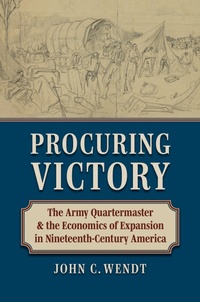
Procuring Victory
Description

A groundbreaking study of U.S. Army quartermasters during the wars of the nineteenth century. Historian John Wendt shows how the federal dollars exchanged between military personnel and civilians underwrote American expansion and had profound effects on the course of American military, economic, and social history.
The United States Army of the nineteenth century has been called many things??conquerors,? ?constabularies,? ?peacekeepers,? and ?professionals,? among others. Yet, despite spending hundreds of millions of dollars throughout the rapidly growing United States, rarely has the nineteenth-century Army ever been seen as a business. The Army's quartermasters were almost entirely reliant on local banks, merchants, and markets to supply campaigns across North America, including the Second Seminole War, the Mexican-American War, and the Civil War, From this novel vantage point, John Wendt stitches together seemingly disparate military and economic events into a coherent narrative of military spending across the mid-nineteenth century.
The Army's Quartermaster Department served as the Army's chief military logistics agency, responsible for procuring transportation, clothing, and food. One quartermaster in particular, George Hampton Crosman, served in the department for nearly four decades of military campaigns, territorial expansion, and institutional transformation. Wendt allows readers to see through Crosman's eyes how North American regions on the fringe of warfronts navigated the economic realities of financial crisis, western expansion, and industrialization. Significantly, he uncovers new insights into the numerous written and unwritten rules that governed the financial, logistical, and moral terms of civil-military relationships and sheds light on the individuals who quietly shaped the arc American history.
More details
Other editions
Additional editions
Person
John C. Wendt is Executive Director of the Pueblo County Historical Society in Pueblo, Colorado. He holds a PhD in history from Texas A&M University.
