

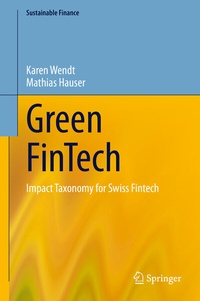
Green FinTech
Description

This publication is the first one to develop a global impact taxonomy for FinTechs that aspire to fulfill the SDGs. The transformative arena of impact investing is witnessing significant shifts, through innovation and technology advances and through the emergence ad application of a new global societal contract. Finance and FinTech companies experience an increasing exposure to the evolving landscape of impact investing, the authors have identified an exigent need to construct a standardized Impact Taxonomy for FinTechs. This taxonomy is envisaged to create a uniform system, thereby enabling FinTechs to quantify their impact in a standardized manner. The inherent heterogeneity in the FinTechs industry and the still emergent implementation knowledge on "how to " implement the SDGs, necessitates the development of this taxonomy, which aims to enhance clarity, transparency, and comparability in measuring impacts, thus facilitating informed decision-making for investors, regulators, and the fintech entities themselves. This publication is conceived as an academic response to the specified need, coming up with the first framework of an impact taxonomy.
This book explores the impact innovation potential of emerging technologies and machine learning in the FinTech industry from an entrepreneurial perspective. It maps the current initiatives, is substantiating a detailed examination and proposing a framework for a first global Impact Taxonomy tailored to the fintech sector.
In the entrepreneurial sphere and analyses and develops strategies for identifying impact on governance and decision making and for managing risk.It provides practical advice on evaluating, strategizing and improving sustainability in the digital asset sector. This book offers a useful guide for finance professionals, entrepreneurs and early-stage investors.
More details
Other editions
Additional editions
Persons
Karen Wendt is the President of Sustainable Finance (Cham, Switzerland) and CEO of ECCOS Impact GmbH (Cham, Switzerland). She is also a serial entrepreneur, scientist and co-editor of the Sustainable Finance book series at Springer. She advises companies on sustainability and is proven expert in impact investing, international management, sustainable finance, and strategy development. She is currently conducting research on social entrepreneurship, stock exchanges and portfolio engineering.
Mathias Hauser is a highly educated finance professional with expertise in mergers & acquisitions (M&A), corporate finance, private equity investment controlling, and capital markets. He is currently working on his M.Sc. in Finance at the Frankfurt School of Finance Management (Germany).
Content
.- Introduction.
.- A simple mathematical model.
.- Low order Lagrange Finite Elements.
.- The standard Finite Element Method.
.- Nitsche Finite Element Method.
.- Nitsche for Signorini.
.- About meshing and discretization error.
