

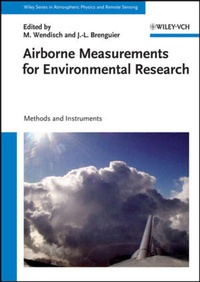
Airborne Measurements for Environmental Research
Methods and Instruments
1st Edition
Published on 22. March 2013
XXX, 611 pages
978-3-527-65323-2 (ISBN)
Description

This first comprehensive review of airborne measurement principles covers all atmospheric components and surface parameters. It describes the common techniques to characterize aerosol particles and cloud/precipitation elements, while also explaining radiation quantities and pertinent hyperspectral and active remote sensing measurement techniques along the way. As a result, the major principles of operation are introduced and exemplified using specific instruments, treating both classic and emerging measurement techniques.
The two editors head an international community of eminent scientists, all of them accepted and experienced specialists in their field, who help readers to understand specific problems related to airborne research, such as immanent uncertainties and limitations. They also provide guidance on the suitability of instruments to measure certain parameters and to select the correct type of device.
While primarily intended for climate, geophysical and atmospheric researchers, its relevance to solar system objects makes this work equally appealing to astronomers studying atmospheres of solar system bodies with telescopes and space probes.
The two editors head an international community of eminent scientists, all of them accepted and experienced specialists in their field, who help readers to understand specific problems related to airborne research, such as immanent uncertainties and limitations. They also provide guidance on the suitability of instruments to measure certain parameters and to select the correct type of device.
While primarily intended for climate, geophysical and atmospheric researchers, its relevance to solar system objects makes this work equally appealing to astronomers studying atmospheres of solar system bodies with telescopes and space probes.
More details
Other editions
Additional editions
Manfred Wendisch | Jean-Louis Brenguier
Airborne Measurements for Environmental Research
Methods and Instruments
Software
03/2013
Wiley-VCH
€239.57
No shipping information available
Manfred Wendisch | Jean-Louis Brenguier
Airborne Measurements for Environmental Research
Methods and Instruments
Book
03/2013
1st Edition
Wiley-VCH
€189.00
Article exhausted; check different version
Persons
Manfred Wendisch is a professor and director of the Institute of Meteorology at the University of Leipzig, Germany, and holds a permanent guest professor appointment at the Chinese Academy of Sciences in Beijing. Professor Wendisch is member of the Saxonian Academy of Sciences.
Jean-Louis Brenguier is Director of the Experimental and Instrumental meteorology Group of the French Meteorological Service, and Coordinator of the European facilities for Airborne Research (EUFAR). His research activities comprise aerosol detection.
Both authors are highly regarded with the community.
Jean-Louis Brenguier is Director of the Experimental and Instrumental meteorology Group of the French Meteorological Service, and Coordinator of the European facilities for Airborne Research (EUFAR). His research activities comprise aerosol detection.
Both authors are highly regarded with the community.
Content
1 Introduction
2 Thermodynamic and Dynamic Parameters
2.1 Introduction
2.2 Historical
2.3 Aircraft State Parameters
2.4 Static Air Pressure
2.5 Static Air Temperature
2.6 Water Vapor Measurements
2.7 Three Dimensional Wind Vector
2.8 Flux Measurements
2.9 Small Scale Turbulence
3 In Situ Trace Gas Measurements
3.1 Rationale and Historical Perspective
3.2 Introduction
3.3 Spectroscopic Techniques
3.4 Chemical Ionization Mass Spectrometry
3.5 Chemical Conversion Techniques
3.6 Whole Air Sampling and Chromatographic Techniques
4 In Situ Measurements of Aerosol Particles
4.1 Physical Characterization of Aerosol Particles
4.2 Aerosol Particle Number Concentration
4.3 Aerosol Particle Size Distribution
4.4 Aerosol Chemistry
4.5 Optical Properties of Aerosols
4.6 Cloud Condensation and Ice Nuclei
4.7 Challenges and Emerging Techniques
5 In Situ Measurements of Cloud and Precipitation Particles
5.1 Overview
5.2 Single Particle Size Distributions and Morphology
5.3 Integral Properties of an Ensemble of Particles
5.4 Measurement Issues
5.5 Emerging Technologies
6 Aerosol and Cloud Particle Sampling
6.1 Introduction
6.2 Aircraft Influence
6.3 Aerosol Particle Sampling
6.4 Cloud Particle Sampling
6.5 Summary and Guidelines
7 Radiation Measurements
7.1 Motivation
7.2 Fundamentals
7.3 Solar Radiation
7.4 Terrestrial Radiation
7.5 Microwave (MW) Radiation
8 Hyperspectral Remote Sensing
8.1 Introduction
8.2 Definition
8.3 Development and History
8.4 HRS Sensors
8.5 Potential and Applications
8.6 Sensor Principles
8.7 Planning of an HRS Mission
8.8 Data Analysis
8.9 Sensor Calibration
8.10 Summary and Conclusion
9 LIDAR and RADAR Observations
9.1 Historical Perspective
9.2 Introduction
9.3 Principles of LIDAR and RADAR Remote Sensing
9.4 LIDAR Atmospheric Observations and Related Systems
9.5 Cloud and Precipitation Observations with RADAR
9.6 Results of Airborne RADAR Observations - Some Examples
9.7 Parameters Derived from Combined Use of LIDAR and RADAR
9.8 Conclusion and Perspectives
Appendix A (please find it online)
2 Thermodynamic and Dynamic Parameters
2.1 Introduction
2.2 Historical
2.3 Aircraft State Parameters
2.4 Static Air Pressure
2.5 Static Air Temperature
2.6 Water Vapor Measurements
2.7 Three Dimensional Wind Vector
2.8 Flux Measurements
2.9 Small Scale Turbulence
3 In Situ Trace Gas Measurements
3.1 Rationale and Historical Perspective
3.2 Introduction
3.3 Spectroscopic Techniques
3.4 Chemical Ionization Mass Spectrometry
3.5 Chemical Conversion Techniques
3.6 Whole Air Sampling and Chromatographic Techniques
4 In Situ Measurements of Aerosol Particles
4.1 Physical Characterization of Aerosol Particles
4.2 Aerosol Particle Number Concentration
4.3 Aerosol Particle Size Distribution
4.4 Aerosol Chemistry
4.5 Optical Properties of Aerosols
4.6 Cloud Condensation and Ice Nuclei
4.7 Challenges and Emerging Techniques
5 In Situ Measurements of Cloud and Precipitation Particles
5.1 Overview
5.2 Single Particle Size Distributions and Morphology
5.3 Integral Properties of an Ensemble of Particles
5.4 Measurement Issues
5.5 Emerging Technologies
6 Aerosol and Cloud Particle Sampling
6.1 Introduction
6.2 Aircraft Influence
6.3 Aerosol Particle Sampling
6.4 Cloud Particle Sampling
6.5 Summary and Guidelines
7 Radiation Measurements
7.1 Motivation
7.2 Fundamentals
7.3 Solar Radiation
7.4 Terrestrial Radiation
7.5 Microwave (MW) Radiation
8 Hyperspectral Remote Sensing
8.1 Introduction
8.2 Definition
8.3 Development and History
8.4 HRS Sensors
8.5 Potential and Applications
8.6 Sensor Principles
8.7 Planning of an HRS Mission
8.8 Data Analysis
8.9 Sensor Calibration
8.10 Summary and Conclusion
9 LIDAR and RADAR Observations
9.1 Historical Perspective
9.2 Introduction
9.3 Principles of LIDAR and RADAR Remote Sensing
9.4 LIDAR Atmospheric Observations and Related Systems
9.5 Cloud and Precipitation Observations with RADAR
9.6 Results of Airborne RADAR Observations - Some Examples
9.7 Parameters Derived from Combined Use of LIDAR and RADAR
9.8 Conclusion and Perspectives
Appendix A (please find it online)
