


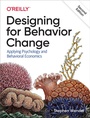
Designing for Behavior Change
Applying Psychology and Behavioral Economics
1st Edition
Published on 5. November 2013
394 pages
978-1-4493-6797-8 (ISBN)
Description

A new wave of products is helping people change their behavior and daily routines, whether its exercising more (Jawbone Up), taking control of their finances (HelloWallet), or organizing their email (Mailbox). This practical guide shows you how to design these types of products for users seeking to take action and achieve specific goals.Stephen Wendel, HelloWallets head researcher, takes you step-by-step through the process of applying behavioral economics and psychology to the practical problems of product design and development. Using a combination of lean and agile development methods, youll learn a simple iterative approach for identifying target users and behaviors, building the product, and gauging its effectiveness. Discover how to create easy-to-use products to help people make positive changes.Learn the three main strategies to help people change behaviorIdentify your target audience and the behaviors they seek to changeExtract user stories and identify obstacles to behavior changeDevelop effective interface designs that are enjoyable to useMeasure your products impact and learn ways to improve itUse practical examples from products like Nest, Fitbit, and Opower
More details
Other editions
New editions
E-Book
06/2020
2nd Edition
O'Reilly
€32.99
Available for download
Additional editions

Book
12/2013
1st Edition
O'Reilly
€32.00
Article exhausted; check for reprint
Content
- Intro
- Contents
- Foreword
- Preface
- Part I: Understanding the Mind and Behavior Change
- Chapter 1: How the Mind Decides What to Do Next
- The Deliberative and Intuitive Mind
- Making Sense of the Mind
- Most of the Time, We're Not Actually "Choosing" What to Do Next
- Even When We "Choose," Our Minds Save Work
- The Obvious, Simple Stuff Is Really Important
- A Map of the Decision-Making Process
- On a Napkin
- Chapter 2: Why We Take Certain Actions and Not Others
- A Simple Model of When, and Why, We Act
- The Create Action Funnel
- On a Napkin
- Chapter 3: Strategies for Behavior Change
- A Decision or a Reaction: Three Strategies to Change Behavior
- Strategy 1: Cheat!
- Strategy 2: Make or Change Habits
- Strategy 3: Support the Conscious Action
- A Recap of the Three Strategies
- On a Napkin
- Part II: Discovering the Right Outcome, Action, and Actor
- Chapter 4: Figuring Out What You Want to Accomplish
- Start with the Product Vision
- Nail Down the Target Outcome
- Identify Additional Constraints
- Generate a List of Possible Actions for Users to Take
- On a Napkin
- Chapter 5: Selecting the Right Target Action
- Research Your Target Users
- Select the Ideal Target Action
- Define Success and Failure
- How to Handle Very Diverse Populations
- On a Napkin
- Part III: Developing the Conceptual Design
- Chapter 6: Structuring the Action
- Start the Behavioral Plan
- Tailor It
- Simplify It
- Make It "Easy"
- On a Napkin
- Chapter 7: Constructing the Environment
- Tactics You Can Use
- Increase Motivation
- Cue the User to Act
- Generate a Feedback Loop
- Knock Out the Competition
- Remove or Avoid Obstacles
- Update the Behavioral Plan
- On A Napkin
- Chapter 8: Preparing the User
- Tactics You Can Use
- Narrate the Past to Support Future Action
- Associate with the Positive and the Familiar
- Educate Your Users
- How Training Your Users Fits In
- Update the Behavioral Plan
- How Behavior Change Techniques Relate to the Thought the Behavior Requires
- On a Napkin
- Part IV: Designing the Interface and Implementing It
- Chapter 9: Moving from Conceptual Designs to Interface Designs
- Take Stock
- Extract the Stories or Specs
- Provide Structure for Magic to Occur
- On a Napkin
- Chapter 10: Reviewing and Fleshing Out the Interface Designs
- Look for Big Gaps
- Look for Tactical Opportunities
- On a Napkin
- Chapter 11: Turning the Designs into Code
- Put the Interface Design in Front of Users
- Build the Product
- Go Lean If Possible
- On a Napkin
- Part V: Refining the Product
- Chapter 12: Measuring Impact
- Why Measure Impact?
- Where to Start: Outcomes and Metrics
- How to Measure Those Metrics
- Determining Impact: Running Experiments
- Determining Impact: Unique Actions and Outcomes
- Other Ways to Determine Impact
- What Happens If the Outcome Isn't Measurable Within the Product?
- On a Napkin
- Chapter 13: Identifying Obstacles to Behavior Change
- Watch Real People Using the Product
- Check Your Data
- Figure Out How to Fix the Obstacles
- On a Napkin
- Chapter 14: Learning and Refining the Product
- Determine What Changes to Implement
- Measure the Impact of Each Major Change
- When Is It "Good Enough"?
- How to (Re-)Design for Behavior Change with an Existing Product
- On a Napkin
- Part VI: Putting It into Practice
- Chapter 15: Common Questions and a Start-to-Finish Example
- An Example of the Approach
- Questions About How and Why We Act
- Questions About the Mechanics of Building Behavior Change Products
- Chapter 16: Conclusion
- Four Lessons
- Themes
- Looking Ahead
- Appendix A: Glossary of Terms
- Appendix B: Resources to Learn More
- Appendix C: Bibliography
- Appendix D: Endnotes
- Index
- About the Author
