

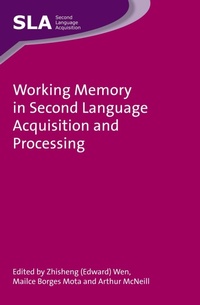
Working Memory in Second Language Acquisition and Processing
Published on 1. May 2015
315 pages
978-1-78309-360-1 (ISBN)
Description

This unique volume offers a comprehensive discussion of essential theoretical and methodological issues concerning the pivotal role of working memory in second language learning and processing. The collection opens with a foreword and introductory theoretical chapters written by leading figures in the field of cognitive psychology. Following these are three research sections containing chapters providing original data and innovative insights into the dynamic and complex relationships between working memory and specific areas of second language processing, instruction, performance and development. Each section concludes with a commentary which is written by a noted SLA researcher and which charts the course for future research. This book provides a fascinating collection of perspectives on the relationship between working memory and second language learning and will appeal to those interested in the integration of cognitive psychology with SLA research.
Reviews / Votes
Overall, the volume is successful in fulfilling its editors' aims, i.e. to provide a forum for dialogue between SLA and WM research and to further integrate the two fields. The diversity and reach of the field is amply demonstrated by the range of empirical bases it covers. By including a range of opinions on how to move the WM-SLA field forward, the volume can serve as inspiration for future research programs, thus contributing to the already highly dynamic interface between WM and SLA research. -- Tom Rankin, Vienna University of Economics and Business, Austria * Second Language Research, ?1- 11, 2016 * The editors have done an impressive job of gathering the biggest names from the fields of cognitive psychology and SLA to present a comprehensive review of the state of the art in this field, as well as have created a discussion forum on the SLA-WM relationship. -- Adriana Biedron, Pomeranian University in Slupsk, Poland * Studies in Second Language Learning and Teaching 5 (4). 2015. 697-713 * The collection has synthesized and compiled a diversified body of research on WM and its relation to SLA supported by accessible writing styles. Many readers would appreciate that the volume provides an overview of theoretical WM models and empirical studies that are well elaborated by interesting background information, through which the readers come to understand the complex L2 processing strategies, cognitive processes, their measurements in L1 and L2 research, feedback type and L2 self-repair behavior. Combining a range of the theoretical and methodological innovation of WM-SLA research is a particular strength of the volume. As such, this book would be a valuable reference for readers in areas such as cognitive psychology, theoretical linguistics, and education, especially those engaging with topics related to L2 syntactic structures, vocabulary, L2 proficiency, and speech and writing studies. -- Asmaa Shehata, University of Calgary, Canada * LINGUIST List 27.1512, 2016 *More details
Series
Language
English
Place of publication
Bristol
United Kingdom
Publishing group
Channel View Publications Ltd
Target group
College/higher education
Professional and scholarly
ISBN-13
978-1-78309-360-1 (9781783093601)
Copyright in bibliographic data and cover images is held by Nielsen Book Services Limited or by the publishers or by their respective licensors: all rights reserved.
Schweitzer Classification
Other editions
Additional editions
Zhisheng (Edward) Wen | Mailce Borges Mota | Arthur McNeill
Working Memory in Second Language Acquisition and Processing
Book
05/2015
Multilingual Matters
€56.60
Shipment within 10-20 days
Persons
Zhisheng (Edward) Wen is Associate Professor at the School of Languages and Translation at Macao Polytechnic Institute. He has been lecturing in key universities in Mainland China, Hong Kong and Macao for over 15 years and has researched and published extensively in second language acquisition, psycholinguistics and other areas of applied linguistics.
Mailce Borges Mota is Professor in the Department of Foreign Languages and Literatures at the Federal University of Santa Catarina, Brazil and a research fellow of the prestigious Brazilian National Council for Scientific and Technological Development (CNPq). Her research focuses on the relationship between language processing and memory systems.
Arthur McNeill is Director of the Center for Language Education and Associate Dean of the School of Humanities and Social Science at the Hong Kong University of Science and Technology. He has research expertise and publications in key areas of applied linguistics, SLA, teacher education and vocabulary teaching and learning.
Mailce Borges Mota is Professor in the Department of Foreign Languages and Literatures at the Federal University of Santa Catarina, Brazil and a research fellow of the prestigious Brazilian National Council for Scientific and Technological Development (CNPq). Her research focuses on the relationship between language processing and memory systems.
Arthur McNeill is Director of the Center for Language Education and Associate Dean of the School of Humanities and Social Science at the Hong Kong University of Science and Technology. He has research expertise and publications in key areas of applied linguistics, SLA, teacher education and vocabulary teaching and learning.
Content
Acknowledgements
Notes on Contributors
Foreword: Michael Bunting & Randall Engle
Zhisheng Wen, Mailce Borges Mota and Arthur McNeill: Introduction and Overview
Part I: Theoretical Perspectives and Models
1. Alan Baddeley: Working Memory in Second Language Learning
2. Nelson Cowan: Second-Language Use, Theories of Working Memory, and the Vennian Mind
3. Zhisheng Wen: Working Memory in Second Language Acquisition and Processing: The Phonological/Executive Model
4. Yanping Dong and Rendong Cai: Working Memory and Interpreting: A Commentary on Theoretical Models
Part II: Working Memory in L2 Processing
5. Sun-A Kim, Kiel Christianson and Jerome Packard: Working Memory in L2 Character Processing: The Case of Learning to Read Chinese
6. Yuncai Dai: Working Memory in L2 Sentence Processing: The Case with Relative Clause Attachment
7. Alan Juffs: Working Memory and Sentence Processing: A Commentary
Part III: Working Memory in L2 Interaction and Performance
8. Shaofeng Li: Working Memory, Language Analytical Ability and L2 Recasts
9. Mohammad Javad Ahmadian: Working Memory, Online Planning and L2 Self-Repair Behavior
10. Yanbin Lu: Working Memory, Cognitive Resources and L2 Written Performance
11. Peter Skehan: Working Memory and Second Language Performance: A Commentary
Part IV: Working Memory in L2 Instruction and Development
12. Kindra Santamaria and Gretchen Sunderman: Working Memory in Processing Instruction: The Acquisition of L2 French Clitic
13. Kaitlyn Tagarelli, Mailce Borges Mota and Patrick Rebuschat: Working Memory, Learning Conditions and L2 Syntax Acquisition
14. Melissa Baralt: Working Memory, Cognitive Complexity and L2 Recasts in Online Language Teaching
15. Anne E. Mitchell, Scott Jarvis, Michelle O'Malley and Irina Konstantinova : Working Memory Measures and L2 Proficiency
16. Clare Wright: Working Memory and L2 Development across the Life Span: A Commentary
Part V: Final Commentary
17. John Williams: Working Memory in SLA Research: Challenges and Prospects
Index
Notes on Contributors
Foreword: Michael Bunting & Randall Engle
Zhisheng Wen, Mailce Borges Mota and Arthur McNeill: Introduction and Overview
Part I: Theoretical Perspectives and Models
1. Alan Baddeley: Working Memory in Second Language Learning
2. Nelson Cowan: Second-Language Use, Theories of Working Memory, and the Vennian Mind
3. Zhisheng Wen: Working Memory in Second Language Acquisition and Processing: The Phonological/Executive Model
4. Yanping Dong and Rendong Cai: Working Memory and Interpreting: A Commentary on Theoretical Models
Part II: Working Memory in L2 Processing
5. Sun-A Kim, Kiel Christianson and Jerome Packard: Working Memory in L2 Character Processing: The Case of Learning to Read Chinese
6. Yuncai Dai: Working Memory in L2 Sentence Processing: The Case with Relative Clause Attachment
7. Alan Juffs: Working Memory and Sentence Processing: A Commentary
Part III: Working Memory in L2 Interaction and Performance
8. Shaofeng Li: Working Memory, Language Analytical Ability and L2 Recasts
9. Mohammad Javad Ahmadian: Working Memory, Online Planning and L2 Self-Repair Behavior
10. Yanbin Lu: Working Memory, Cognitive Resources and L2 Written Performance
11. Peter Skehan: Working Memory and Second Language Performance: A Commentary
Part IV: Working Memory in L2 Instruction and Development
12. Kindra Santamaria and Gretchen Sunderman: Working Memory in Processing Instruction: The Acquisition of L2 French Clitic
13. Kaitlyn Tagarelli, Mailce Borges Mota and Patrick Rebuschat: Working Memory, Learning Conditions and L2 Syntax Acquisition
14. Melissa Baralt: Working Memory, Cognitive Complexity and L2 Recasts in Online Language Teaching
15. Anne E. Mitchell, Scott Jarvis, Michelle O'Malley and Irina Konstantinova : Working Memory Measures and L2 Proficiency
16. Clare Wright: Working Memory and L2 Development across the Life Span: A Commentary
Part V: Final Commentary
17. John Williams: Working Memory in SLA Research: Challenges and Prospects
Index
