

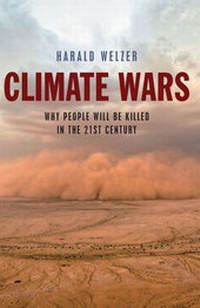
Climate Wars
Description

Reviews / Votes
"Welzer's thinking, like his writing, is fast, fresh and incisive. His book is a warning thatwarrants reading; it does not need tobe a forecast." European Voice "An absolutely essential read." Morning Star "An engaging and thought-provoking contribution to current conflict analysis." International Affairs "A thought-provoking if uncomfortable read." Irish Times "Should be considered mandatory reading for anyone with concerns over the impact of climate change upon their lives, their families, their communities, their country." Midwest Book Review "Should be considered mandatory reading for anyone with concerns over the impact of climate change upon their lives, their families, their communities, their country." Library Bookwatch "If you have pondered what climate change means for humanity, here's a book for you ... A fascinating tome." A-Men Magazine "Welzer combines analytical insight with passionate conviction in calling on all of us to help stem the violence that flows from climate change." Martin Albrow, University of Wales "Rampant climate change will redraw the geopolitical map of the 21st century. This book asks the uncomfortable but important questions that we will face in the future." Robert Falkner, London School of Economics and Political ScienceMore details
Other editions
Additional editions
Persons
Content
2
CLIMATE CONFLICTS
THE WEST - I
In 2005 a 'European Agency for the Management of Operational Cooperation at the External Borders of the Member States of the European Union' was brought into being. Behind this cumbersome, bureaucratic-sounding name lies a highly dynamic institution, which is supposed to make the EU's external border controls more robust and effective. At present it has a staff roughly a hundred strong and is planning for a pool of 500 to 600 border police, drawn from the member states and - a legal novelty - empowered to take on functions outside the EU. The agency also has at its disposal more than twenty aircraft, thirty helicopters and over a hundred ships, as well as elaborate equipment such as night vision devices and state-of-the-art laptops.
Since the official name is obviously too unwieldy, a catchier and evocative abbreviation has now been agreed upon: Frontex (from the French frontières extérieures). It works closely with other agencies such as Europol, advises local border police at key areas of illegal migration, and assists in 'joint removal operations of third-country nationals illegally present in the Member States'.1 Such persons are those who, having somehow reached an EU/Schengen country and been refused asylum, are liable to be shipped back or, in official parlance, 'repatriated' to their country of origin.2
The Schengen Agreement, which came into force on 26 March 1995, has concentrated the frontier problem in states on the outer edges of the EU, passport-free travel now being the rule within the Schengen area. The 'country of origin regulation', however, requires asylum-seekers to give proof of political persecution if they come from a country classified as 'safe'; and the 'third country regulation' provides that individuals who have, for example, managed to reach southern Spain from Sierra Leone and then moved on to Germany may be summarily sent back to Spain and refused the right ever to apply for asylum in Germany. Not surprisingly this has stepped up the pressure on the EU's Spanish and Portuguese as well as East European frontiers, while applications for asylum in Germany have fallen by a quarter since 1995. But it also raises the question whether, in view of the rising numbers of refugees (set to rise even more as a result of future climate change), it will be possible to secure the EU's external frontiers as effectively as this is done at present.
Frontex, established by a decree of the European Council, chalked up some early successes - for example, a major cut in the number of refugee boats landing in the Canary Isles. The refugees who make the 1,200-kilometre journey, mostly by dinghy, across the open sea from West Africa to Gran Canaria or Tenerife come from countries where the existing conditions make life virtually impossible. Displaced by dam projects or civil war, they have drifted into megacities like Lagos, where 3 million people live in slums and there is neither running water nor a sewage system. There they pay smuggling gangs an exorbitant sum for a place on an overcrowded, barely seaworthy boat, with no return ticket and a high risk of not surviving the trip.3 Even so, some 30,000 made it alive to the Canaries in 2006, posing considerable problems for the authorities and the tourism industry there.
Other refugees try the Straits of Gibraltar, which, though only 13 kilometres across, have strong currents and dense traffic that make them no less hazardous. Many fail to reach the shores of Spain or Portugal, and those who do are usually shipped straight back; it is estimated that some 3,000 drowned in the attempt in 2006 alone. Frontex takes account of this, by defining one of its important tasks as 'preventing illegal entry in life-threatening conditions'.4
Since the reasons why refugees want to reach Europe at any price remain the same, and since their routes become more dangerous as Frontex increases its efficiency, the ideal form of control is to project the EU's borders outwards, preventing refugees from ever leaving the African continent. As long ago as October 2004 Otto Schilly, then German interior minister, suggested building reception camps in Africa and verifying there whether an asylum application was valid or not.5 Most other EU interior ministers were not at all keen on the idea, and it also ran into protests from human rights organizations. The search for other solutions has been tough, as have negotiations with the African Union, so that there is still no alternative to the further tightening of border controls if such people are to be kept out of Europe. The situation in the Spanish exclaves of Ceuta and Melilla perfectly symbolizes the problem: border installations are continually being reinforced there, while refugees take ever more desperate measures to climb the fences; a mass storming in September 2005 involved approximately 800 people.
In the medium term, innovative technologies have given affected countries some relief: for example, a $2 billon system on the US border with Mexico will make it possible to locate intruders by GPS and to livestream the information to the next police patrol, dramatically reducing the number of illegal entrants. In 2006 no fewer than 1.1 million people were arrested in this frontier zone. In September 2006, the House of Representatives approved a plan to build a 1,125-kilometre high-tech fence to bolster security further. It is true that the total length of the frontier is 3,360 kilometres, but it is assumed that such measures will deter many potential violators, since the remaining areas consist of barely negotiable desert or mountain; the shortest distance across on foot is 80 kilometres. Between 1998 and 2004, a total of 1,954 people died along the US-Mexican border.
America and Europe will have to do more in future to protect themselves from the inrush of the millions of refugees who are expected to follow climate change. Hunger, water problems, wars and desertification will exert incalculable pressure on the islands of West European and North American prosperity. The German government's Scientific Advisory Committee on Global Climate Change (WGBU) has pointed out that '1.1 billion people currently lack secure access to drinking water in sufficient quantity and quality'. This situation 'may grow worse in some parts of the world, because climate change may lead to great variations in precipitation and water availability.'6
In addition, some 850 million people around the world are under-nourished - a figure which experts think will grow considerably in the wake of climate-induced shrinkage of farmland. The ensuing distribution conflicts point to a greater risk of violent escalation, since further population movements will increase the number of so-called migration 'hot spots'. In this light, the WGBU urges, the promotion of development should be understood as a form of 'preventive security'.
Such trends give a foretaste of what will happen when climate change boosts the flow of refugees. Space and resource conflicts due to global warming will fundamentally alter the shape of Western societies in the next few decades; Frontex is a nugatory harbinger of things to come. Climate change is therefore not only an extremely urgent issue for environmental policy; it will also be the greatest social challenge of the modern age, threatening the very existence of millions of people and forcing them into mass migration. The question of how to cope with such flows will become inescapable as refugees of whatever provenance seek to enhance their survival chances by moving to better-off countries.
THE OTHERS
Over the past forty years, the desert in northern Sudan has moved 100 kilometres towards the once fertile south. The causes are, on the one hand, steadily decreasing rainfall and, on the other, the overgrazing of grassland, deforestation and ensuing soil erosion that makes the land infertile. Forty per cent of Sudan's forest has been lost since the country became independent, and at present a further 1.3 per cent is vanishing each year. For many regions, the United Nations Environmental Programme foresees total deforestation within the next ten years.
Climate models for Sudan point to a temperature rise of 0.5 degrees Celsius by 2030 and 1.5 degrees by 2060, while at the same time rainfall will decrease by an annual average of a further 5 per cent. This would mean a decline of 70 per cent in the grain harvest. Some 30 million people live in northern Sudan, and to appreciate what these figures mean we need to bear in mind that the country is already one of the poorest in the world; it also faces major ecological dangers, and a civil war has been simmering for the past half-century. There are 5 million so-called Internal Displaced Persons (IDPs), who have been systematically driven out of their native villages. Hostile militias not only kill people but also burn villages and forest, in order to prevent the return of those they 'displace'.
Most IDPs live in camps with virtually no infrastructure: no electricity, no sewer system, no running water, no medical care. The food supply is largely provided by international aid agencies. In order to cook, people there have already cut down all the forest for as much as 10 kilometres around. The bare land is dangerous: many women are raped and killed on their...
