

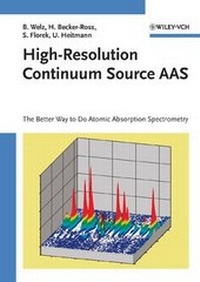
High-Resolution Continuum Source AAS
The Better Way to Do Atomic Absorption Spectrometry
1st Edition
Published on 6. March 2006
XII, 284 pages
978-3-527-60637-5 (ISBN)
Description

High-resolution continuum source atomic absorption spectrometry (HR-CS AAS) is the most revolutionary innovation since the introduction of AAS in 1955. Here, the authors provide the first complete and comprehensive discussion of HR-CS AAS and its application to the analysis of a variety of difficult matrices. Published just in time with the first commercial instrument available for this new technique, the book is a must for all those who want to know more about HR-CS AAS, and in particular for all future users.
The advantages of the new technique over conventional line-source AAS are clearly demonstrated using practical examples and numerous figures, many in full color. HR-CS AAS is overcoming essentially all the remaining limitations of established AAS, particularly the notorious problem of accurate background measurement and correction. Using a continuum radiation source and a CCD array detector makes the spectral environment visible to several tenths of a nanometer on both sides of the analytical line, tremendously facilitating method development and elimination of interferences.
Conceived as a supplement to the standard reference work on AAS by B. Welz and M. Sperling, this book does not repeat such fundamentals as the principles of atomizers or atomization mechanisms. Instead, it is strictly focused on new and additional information required to profit from HR-CS AAS. It presents characteristic concentration for flame atomization and characteristic mass data for electrothermal atomization for all elements, as well as listing numerous secondary lines of lower sensitivity for the determination of higher analyte concentrations. The highly resolved molecular absorption spectra of nitric, sulfuric and phosphoric acids, observed in an air-acetylene flame, which are depicted together with the atomic lines of all elements, make it possible to predict potential spectral interferences.
The advantages of the new technique over conventional line-source AAS are clearly demonstrated using practical examples and numerous figures, many in full color. HR-CS AAS is overcoming essentially all the remaining limitations of established AAS, particularly the notorious problem of accurate background measurement and correction. Using a continuum radiation source and a CCD array detector makes the spectral environment visible to several tenths of a nanometer on both sides of the analytical line, tremendously facilitating method development and elimination of interferences.
Conceived as a supplement to the standard reference work on AAS by B. Welz and M. Sperling, this book does not repeat such fundamentals as the principles of atomizers or atomization mechanisms. Instead, it is strictly focused on new and additional information required to profit from HR-CS AAS. It presents characteristic concentration for flame atomization and characteristic mass data for electrothermal atomization for all elements, as well as listing numerous secondary lines of lower sensitivity for the determination of higher analyte concentrations. The highly resolved molecular absorption spectra of nitric, sulfuric and phosphoric acids, observed in an air-acetylene flame, which are depicted together with the atomic lines of all elements, make it possible to predict potential spectral interferences.
Reviews / Votes
"...excellent science...and clear presentation offered in this volume. I highly recommended it for readers who are involved in fundamental research using atomic spectroscopy..." Journal of the American Chemical Society"Given the likelihood that the future of atomic absorption spectrometry lies with CS AAS, it would be highly desirable for any collection serving researchers who use atomic absorption spectrometry." E-STREAMS
More details
Other editions
Additional editions
Bernhard Welz | Helmut Becker-Ross | Stefan Florek
High-Resolution Continuum Source AAS - The Better Way to Do Atomic Absorption Spectrometry
Software
01/2006
Wiley-VCH
€256.09
No shipping information available
Bernhard Welz | Helmut Becker-Ross | Stefan Florek
High-Resolution Continuum Source AAS
The Better Way to Do Atomic Absorption Spectrometry
Book
02/2005
1st Edition
Wiley-VCH
€185.00
Article exhausted; check different version
Persons
Since 1999 Bernhard Welz is Professor of Analytical Chemistry at the Universidade Federal de Santa Catarina, Florianópolis, SC, Brazil, where he teaches instrumental analytical chemistry and atomic spectroscopy. Previously he worked with Perkin-Elmer for 32 years in various positions, the last 16 years as Director of Applied Research Atomic Spectrometry.
Helmut Becker-Roß is scientific project leader at the ISAS - Institute for Analytical Sciences, Dept. Berlin. From 1971 to 1980 he worked at the Central Institute for Optics and Spectroscopy on the development of infrared Fourier-spectrometers. Since 1981 (from 1992 at ISAS) he has been working with his team on the development and application of echelle spectrometers from vacuum-UV to near-IR. Together with companies in Berlin, Jena and Überlingen he has brought several spectroscopic instruments to market.
Stefan Florek is a senior scientist at the ISAS, Dept. Berlin. From 1976 onwards, he worked at the Academy of Sciences in Berlin in the field of optical design and development of instrumentation for applications in atomic spectroscopy. He has designed several instruments successfully launched on the market. Since 1992 he has been continuing his work at ISAS. Dr. Florek's main interest focuses on the use of high-resolution spectroscopy with solid-state detectors for analytical sciences and laser spectroscopy.
Uwe Heitmann is a scientist at the ISAS, Dept. Berlin. He studied physics at the Technical University in Berlin and took his PhD with a thesis on laser-excited atomic fluorescence spectrometry in the visible to vacuum-UV range.From 1994 to 2001 he worked for the GOS Berlin in different research projects on the development of high-resolution spectrometers. Since 2002 he has been in the group led by Helmut Becker-Ross at the ISAS. His main research field is the setup and further development of the novel analytical method of continuum source AAS as well as its transfer into the commercial market.
All authors cooperate with the major instrument manufacturer Analytik Jena.
Helmut Becker-Roß is scientific project leader at the ISAS - Institute for Analytical Sciences, Dept. Berlin. From 1971 to 1980 he worked at the Central Institute for Optics and Spectroscopy on the development of infrared Fourier-spectrometers. Since 1981 (from 1992 at ISAS) he has been working with his team on the development and application of echelle spectrometers from vacuum-UV to near-IR. Together with companies in Berlin, Jena and Überlingen he has brought several spectroscopic instruments to market.
Stefan Florek is a senior scientist at the ISAS, Dept. Berlin. From 1976 onwards, he worked at the Academy of Sciences in Berlin in the field of optical design and development of instrumentation for applications in atomic spectroscopy. He has designed several instruments successfully launched on the market. Since 1992 he has been continuing his work at ISAS. Dr. Florek's main interest focuses on the use of high-resolution spectroscopy with solid-state detectors for analytical sciences and laser spectroscopy.
Uwe Heitmann is a scientist at the ISAS, Dept. Berlin. He studied physics at the Technical University in Berlin and took his PhD with a thesis on laser-excited atomic fluorescence spectrometry in the visible to vacuum-UV range.From 1994 to 2001 he worked for the GOS Berlin in different research projects on the development of high-resolution spectrometers. Since 2002 he has been in the group led by Helmut Becker-Ross at the ISAS. His main research field is the setup and further development of the novel analytical method of continuum source AAS as well as its transfer into the commercial market.
All authors cooperate with the major instrument manufacturer Analytik Jena.
Content
HISTORICAL DEVELOPMENT OF CONTINUUM SOURCE AAS
THEORETICAL CONCEPTS
Spectral Line profiles
Atomic Absorption with a Continuum Source
Structure of Molecular Spectra
INSTRUMENTATION FOR HR-CS AAS
Radiation Source
Research Spectrometers with Active Wavelength Stabilization
Detector
The contrAA 300 from Analytik Jena AG
SPECIAL FEATURES OF HR-CS AAS
The Modulation Principle
Simultaneous Double-beam Concept
Selection of Analytical Lines
Sensitivity and Working Range
Signal-to-Noise Ratio, Precision and Limit of Detection
Multi-element Atomic Absorption Spectrometry
Absolute Analysis
MEASUREMENT PRINCIPLE IN HR-CS AAS
General Considerations
Background Measurement and Correction
THE INDIVIDUAL ELEMENTS
Al, Sb, As, Ba, Be, Bi, B, Cd, Ca, Cs, Cr, Co, Cu, Eu, Ga, Ge, Au, In, Ir, Fe, La, Pb, Li, Mg, Mn, Hg, Mo, Ni, Pd, Pd, P, Pt, K, Rh, Rb, Ru, Se, Si, Ag, Na, Sr, S, Te, Tl, Sn, Ti, W, V, Zn
ELECTRON EXCITATION SPECTRA OF DIATOMIC MOLECULES
General Considerations
Individual Overview Spectra
SPECIFIC APPLICATIONS
Flame Measurements
OUTLOOK
THEORETICAL CONCEPTS
Spectral Line profiles
Atomic Absorption with a Continuum Source
Structure of Molecular Spectra
INSTRUMENTATION FOR HR-CS AAS
Radiation Source
Research Spectrometers with Active Wavelength Stabilization
Detector
The contrAA 300 from Analytik Jena AG
SPECIAL FEATURES OF HR-CS AAS
The Modulation Principle
Simultaneous Double-beam Concept
Selection of Analytical Lines
Sensitivity and Working Range
Signal-to-Noise Ratio, Precision and Limit of Detection
Multi-element Atomic Absorption Spectrometry
Absolute Analysis
MEASUREMENT PRINCIPLE IN HR-CS AAS
General Considerations
Background Measurement and Correction
THE INDIVIDUAL ELEMENTS
Al, Sb, As, Ba, Be, Bi, B, Cd, Ca, Cs, Cr, Co, Cu, Eu, Ga, Ge, Au, In, Ir, Fe, La, Pb, Li, Mg, Mn, Hg, Mo, Ni, Pd, Pd, P, Pt, K, Rh, Rb, Ru, Se, Si, Ag, Na, Sr, S, Te, Tl, Sn, Ti, W, V, Zn
ELECTRON EXCITATION SPECTRA OF DIATOMIC MOLECULES
General Considerations
Individual Overview Spectra
SPECIFIC APPLICATIONS
Flame Measurements
OUTLOOK
