

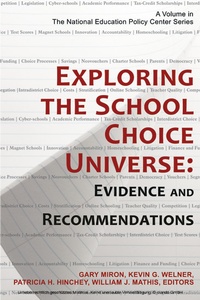
Exploring the School Choice Universe
Evidence and Recommendations
1st Edition
Published on 2. January 2013
367 pages
978-1-62396-045-2 (ISBN)
Description

Exploring the School Choice Universe: Evidence and Recommendations gives readers a comprehensive, complete picture of choice policies and issues. In doing so, it offers cross-cutting insights that are obscured when one looks only at single issue or a single approach to choice. The book examines choice in its various forms: charter schools, home schooling, online schooling, voucher plans that allow students to use taxpayer funds to attend private schools, tuition tax credit plans that provide a public subsidy for private school tuition, and magnet schools and other forms of public school intra- and interdistrict choice. It brings together some of the top researchers in the field, presenting a comprehensive overview of the best current knowledge of these important policies.The questions addressed in Exploring the School Choice Universe are of most importance to researchers and policy makers. What do choice programs actually do? What forms do they take? Who participates, and why? What are the funding implications? What are the results of different forms of school choice on outcomes that matter, like student performance, segregation, and competition effects? Do they affect teachers' working conditions? Do they drive innovation?The contents of this book offer reason to believe that choice policies can further some educational goals. But they also suggest many reasons for caution. If choice policies are to be evidence-based, a re-examination is in order. The information, insights and recommendations facilitate a more nuanced understanding of school choice and provide the basis for designing sensible school choice reforms that can pursue a range of desirable outcomes.
All prices
More details
Other editions
Additional editions
Gary Miron | Kevin G. Welner | Patricia H. Hinchey
Exploring the School Choice Universe
Evidence and Recommendations
Book
08/2012
Information Age Publishing
€75.90
Shipment within 3-4 weeks
Content
- Front Cover
- Exploring the School Choice Universe
- Evidence and Recommendations
- A Volume in The National Education Policy Center Series
- Series Editors: Kevin G. Welner and Alex Molnar, University of Colorado Boulder
- CONTENTS
- 1. Introduction
- 2. Negotiating Public and Private: Philosophical Frameworks for School Choice
- 3. How Legislation and Litigation Shape School Choice
- 4. Who Chooses Schools, and Why? The Characteristics and Motivations of Families who Actively Choose Schools
- 5. School Choice and Accountability
- 6. Funding Formulas, School Choice, and Inherent Incentives
- 7. Teacher Qualifications and Work Environments Across School Choice Types
- 8. Educational Innovation and Diversification in School Choice Plans
- 9. School Choice and Segregation by Race, Ethnicity, Class, and Achievement
- 10. The Competitive Effect of School Choice Policies on Public School Performance
- 11. The Impact of School Choice Reforms on Student Achievement
- 12. Conclusions and Recommendations
- The National Education Policy Center Series
- Exploring the School Choice Universe
- Evidence and Recommendations
- Edited by
- Gary Miron Western Michigan University
- Kevin G. Welner University of Colorado Boulder
- Patricia H. Hinchey Pennsylvania State University
- and
- William J. Mathis University of Colorado Boulder
- Information Age Publishing, Inc.
- Charlotte, North Carolina www.infoagepub.com
- A publication of
- National Education Policy Center University of Colorado Boulder
- Acknowledgments
- Figure 1. 1. Comparison of conventional voucher and tuition tax credit systems.
- CHAPTER 1
- Introduction
- Gary Miron and Kevin G. Welner
- DIVERSE FORMS OF SCHOOL CHOICE
- Vouchers and Tuition Tax Credits
- Charter Schools
- Homeschooling
- Interdistrict and Intradistrict Choice
- Virtual Schools
- Summary of School Choice Options
- SCHOOL CHOICE IN THE UNITED STATES COMPARED WITH OTHER INDUSTRIALIZED NATIONS
- OVERVIEW OF CONTENTS
- Figure 1. 2. Estimated trends in growth of voucher and tuition tax credits (neovouchers).
- Figure 1. 3. Estimated numbers of students receiving vouchers plus tuition tax credits in the United States.
- Figure 1. 4. Estimated enrollment trends in charter schools.
- Figure 1. 5. Estimated enrollment trends in homeschooling.
- Figure 1. 6. Estimated enrollment trends in inter- and intradistrict choice programs.
- Figure 1. 7. Estimated enrollment trends in virtual schools.
- Figure 1. 8. Estimated enrollment trends in diverse choice options in the United States, 1991 to 2010.
- Table 2.1. Arguments for Education as a Public and Private Good
- CHAPTER 2
- Negotiating Public and Private
- Philosophical Frameworks for School Choice
- Terri S. Wilson
- PUBLIC AND PRIVATE IN SCHOOL CHOICE
- Development of the "Public School"
- Development of "School Choice"
- Redefining Public Education
- FRAMEWORKS
- Liberty24
- Equity
- Justice
- Pluralism
- Democracy
- Defining Public and Private
- RECOMMENDATIONS
- Interpreting Consequences
- Clarifying Assumptions
- Framing Policy and Practice
- Table 3.1. Legislation That Defines and Governs Forms of School Choice
- CHAPTER 3
- How Legislation and Litigation Shape School Choice
- Julie F. Mead
- PARENS PATRIAE AND THE HISTORY OF SCHOOL CHOICE LEGISLATION
- Parens Patriae
- Modern School Choice Develops
- LITIGATION SHAPES SCHOOL CHOICE
- 1. Whether the school choice program violates the establishment or free exercise of religion clauses, or both, in state and federal constitutions.
- 2. Whether the operation of school choice programs results in discrimination on the basis of race.
- 3. Whether the regulation of choices impinges on parents' rights without adequate due process in violation of state and federal constitutions.
- 4. Whether the school choice program is consistent with the state's constitutional obligation to offer a public education under each state constitution.
- 5. Whether school choice programs must provide access and programming to allow children with disabilities to participate in the program.
- 6. Whether the choice program operates in a manner consistent with statutory requirements.
- Religion Clause Cases
- Discrimination Cases
- Due Process
- Education Clause Cases
- Special Education Cases
- 1. All publicly funded choice programs must be accessible to children with disabilities.68
- 2. Parents and children cannot be required to waive needed services in order to participate in the choice program.69
- 3. A student's right to "free appropriate public education" must be preserved in any choice program delivered in public schools.70
- 4. States need to determine which entity (the sending district, receiving school or district, a combination, or some other entity) will serve as the responsible "local education agency" for purposes of IDEA.71
- Statutory Construction Cases
- RECENT DEVELOPMENTS
- The Expansion of Charter Schools
- NCLB's Choice Provisions
- The Impact of Parents Involved
- The Impact of Arizona Christian School Tuition Organization v. Winn
- DISCUSSION
- RECOMMENDATIONS
- Table 3.2. Issues Raised in Litigation of School Choice Options
- CHAPTER 4
- Who Chooses Schools, and Why?
- The Characteristics and Motivations of Families Who Actively Choose Schools
- Natalie Lacireno-Paquet With Charleen Brantley
- The Logic Behind School Choice
- REVIEW OF RESEARCH: CHARACTERISTICS OF CHOOSERS
- Characteristics of Private School Students
- Characteristics of Voucher Participants
- Characteristics of Charter School Students
- Who Makes Other Choices?
- Summary of the Characteristics of Choosers
- REVIEW OF RESEARCH: MOTIVATIONS FOR CHOICE
- Motivations of Active Choosers
- Overview of the Research
- Use of Information and Searching Behavior
- Stated Reasons for Choice and Motivations of Active Choosers
- Behavior as Indicative of Motivations
- Homeschooling
- DISCUSSION AND ANALYSIS
- RECOMMENDATIONS
- Table 5.1. The Proposed Relationship Between Types of Accountability and School Choice Programs
- CHAPTER 5
- School Choice and Accountability
- Gregg Garn and Casey Cobb
- CLARIFYING ACCOUNTABILITY: A TYPOLOGY
- 1. There were no commonly agreed upon definitions.
- 2. Accountability needed conceptual refinement. With no common framework, confusion abounded among such terms as general accountability, institutional accountability and technological accountability.
- 3. Accountability had become highly politicized. Various groups who might be held accountable attacked the concept and pounced on malfunctions in order to discredit it.2
- ACCOUNTABILITY IN POPULAR SCHOOL CHOICE PROGRAMS
- Vouchers and Tax Credits
- Charter Schools
- Cyber/Virtual/Internet Schools
- Homeschooling
- Interdistrict Choice
- Intradistrict Choice
- School Choice Programs across the Accountability Typology
- Accountability Constituents for School Choice Programs
- Extending Notions of Accountability
- IMPACT ON TRADITIONAL PUBLIC SCHOOL DISTRICTS
- CONCLUSIONS AND RECOMMENDATIONS
- Table 5.2. School Choice Accountability Strength by Constituency
- Table 6.1. Financing System for Charter Schools: Great Lakes States
- CHAPTER 6
- Funding Formulas, School Choice, and Inherent Incentives
- Clive Belfield
- FUNDING SYSTEMS FOR EDUCATION
- Basic Principles
- Challenges to Setting Funding Formulas
- FUNDING SYSTEMS FOR CHARTER SCHOOLS
- Funding Mechanisms
- Evidence on Optimal Funding for Charter Schools
- FUNDING AND INCENTIVES FOR OTHER FORMS OF SCHOOL CHOICE
- Vouchers and Private Schooling
- Homeschooling
- Interdistrict and Intradistrict School Choice
- CONCLUSION
- Table 6.2. Charter School Regulations
- Table 7.1. Percent Teachers With Certification or at Least a Master's Degree
- CHAPTER 7
- Teacher Qualifications and Work Environments Across School Choice Types
- Marisa Cannata
- METHODS AND DATA SOURCES
- Types of School Choice
- HOW DO TEACHER QUALIFICATIONS COMPARE ACROSS SCHOOLS OF CHOICE AND TRADITIONAL PUBLIC SCHOOLS?
- Certification and Education
- Teaching Experience
- College Selectivity
- ARE SCHOOLS OF CHOICE CREATING ATTRACTIVE WORK ENVIRONMENTS FOR TEACHERS?
- Working Conditions
- Salary and Satisfaction
- DO SCHOOLS OF CHOICE USE DIFFERENT HIRING PRACTICES THAN TRADITIONAL PUBLIC SCHOOLS?
- WHAT IS THE IMPACT OF INCREASING SCHOOL CHOICE ON THE TEACHER LABOR MARKET?
- Teacher Attrition and Retention
- The Impact of School Choice on Traditional Public Schools
- DISCUSSION
- CONCLUSION AND RECOMMENDATION
- APPENDIX: MEASURES OF TEACHER QUALIFICATIONS AND WORK ENVIRONMENTS
- Table 7.2. Average Years of Total Teaching Experience and Percentage of Teachers With More Than 3 years of Experience
- Table 7.3. Percentage of Teachers who Graduated From Highly Selective and Less Selective Colleges
- Table 7.4. Average Class Size and Average Hours Worked per Week
- Table 7.5. Average School-Related Earnings
- Table 7.6. Average Overall Satisfaction
- CHAPTER 8
- Educational Innovation and Diversification in School Choice Plans
- Christopher Lubienski
- The Logic of Innovation in School Choice
- Conceptual Issues Regarding Innovation and School Choice
- A Typology of Innovation for Examining School Choice
- Levels of Innovation
- Nature of Changes
- Diversification and Innovation
- Assessing Innovation in School Choice Models
- Factors that Inhibit or Encourage Innovation
- How Innovations Emerge
- Impediments to Innovation
- Conclusion: The Potential for Innovation in School Choice
- CHAPTER 9
- School Choice and Segregation by Race, Ethnicity, Class, and Achievement
- Roslyn Arlin Mickelson, Martha Bottia, and Stephanie Southworth
- Choice, Desegregation, and Segregation
- Definitions and Methods
- SEGREGATION BY RACE, ETHNICITY, AND SOCIOECONOMIC STATUS
- History and Background
- Choice Options and Segregation by Race, Ethnicity, and Socioeconomic Status
- Race, Ethnicity, and Socioeconomic Status Enrollment Patterns in Choice Schools
- Which Choice Designs Promote Race and Socioeconomic Status Segregation?
- SEGREGATION BY ABILITY AND ACHIEVEMENT
- History and Background
- Choice Options and Segregation by Ability and Achievement
- Enrollment Patterns by Ability and Achievement in Choice Schools
- Which Choice Designs Promote Segregation by Ability and Achievement?
- DISCUSSION AND POLICY ANALYSIS
- Discussion: Does Choice Foster Diversity?
- RECOMMENDATIONS
- Redesign Current Choice Policies to Ensure Diversity
- Provide Transportation to Students and Enhanced Information to Parents
- Increase and Enforce Accountability Among Choice Schools
- Redesign Public/Private Sector Relationships to Foster Diversity
- Table 9.1. Summary of Research Findings on Effects of Various Forms of Choice on Race, Ethnicity, SES, and Achievement Diversity Within Choice Schools and Between Choice Schools and Local Conventional Schools
- Table 9.1. (Continued)
- CHAPTER 10
- The Competitive Effect of School Choice Policies on Public School Performance
- David Arsen and Yongmei Ni
- CONCEPTUAL BACKGROUND
- CONDITIONING FACTORS
- Financial Arrangements
- Regulations
- Policy Implementation
- Local Setting
- METHODOLOGICAL CHALLENGES IN ASSESSING COMPETITIVE EFFECTS
- EVIDENCE ON THE EFFECTS OF CHOICE COMPETITION
- Competitive Effects of Vouchers
- Competitive Effects of Charter Schools
- International Experience
- Case Studies of Public School Responses to Competition
- SUMMARY, IMPLICATIONS, AND RECOMMENDATIONS
- Table 11.1. Scale for Impact Ratings of Studies of Student Achievement in Diverse Forms of School Choice
- CHAPTER 11
- The Impact of School Choice Reforms on Student Achievement
- Gary Miron and Jessica L. Urschel
- METHODS
- Selecting Studies
- 1. Presence of a technical report offering a clear account of analytical procedures used.
- 2. Presence of aggregate analysis and conclusions. That is, we chose to exclude studies that would have required us to conduct our own analysis and draw our own conclusions based on others' data.
- 3. Use of standardized tests to measure student achievement. Standardized test results, for example, often provide the only way to compare achievement across a wide range of charter and noncharter schools.
- 4. Use of comparison groups. Any attempt to assess a given school's achievement impact requires some understanding of how choice students might have performed in the absence of choice schools. While randomized experiments with control groups are on...
- 5. Exclusion of duplicated studies. Only findings from the most recent study were included in cases where a particular author or group issued an update of earlier work using the same study design within the same location(s).
- 6. Exclusion of case studies or single school studies. These were excluded because it is unlikely findings can be reasonably generalized to the larger population of schools.
- 7. Exclusion of studies on school choice outside the United States of America. Although we recognize the importance of lessons that can be drawn from the experiences of other countries, we were concerned that we could not identify and consider a repr...
- Impact Ratings
- Assessing the Quality of the Studies
- Combining Impact Scores and Study Quality Scores
- Limitations
- STUDENT ACHIEVEMENT FOR VOUCHERS PROGRAMS
- STUDENT ACHIEVEMENT FOR HOMESCHOOLING
- STUDENT ACHIEVEMENT FOR INTERDISTRICT, INTRADISTRICT, AND MAGNET SCHOOL PROGRAMS
- STUDENT ACHIEVEMENT FOR CHARTER SCHOOLS
- STUDENT ACHIEVEMENT FOR VIRTUAL SCHOOLS
- SUMMARY OF FINDINGS
- Vouchers and Tax Credits
- Charter Schools
- Homeschooling
- Inter- and Intradistrict Choice Programs and Magnet Schools
- Virtual Schools
- Some Observations on the Findings
- A Cautionary Word on the Role of Advocacy Research
- RECOMMENDATIONS
- Improve Research on School Choice
- Improve the Interpretation of Research on School Choice
- Table 11.2. Weighting Scheme for Quality Ratings of School Choice Studies on Student Achievement
- Figure 11. 1. Quality and impact ratings for 15 studies of student achievement in voucher programs.
- Figure 11. 2. Quality and impact ratings for studies of student achievement in homeschooling.
- Figure 11. 3. Quality and impact ratings for studies of student achievement in magnet or interdistrict choice schools.
- Figure 11. 4. Quality and impact ratings for studies of student achievement in charter schools.
- Table 11.3. Mean Quality and Impact Ratings Across Diverse Forms of School Choice Research
- Figure 11. 5. Illustration of the overall findings across diverse forms of school choice.
- CHAPTER 12
- Conclusion
- William J. Mathis and Patricia H. Hinchey
- Issue 1: Conflicting Purposes of Education
- Issue 2: Advancing Equity
- Issue 3: Competition, School Quality, and Innovation
- Issue 4: Funding
- Issue 5: Teaching and Teachers
- Issue 6: Effects on Achievement
- A ROADMAP GOING FORWARD
- Notes and References
- Chapter 1: Introduction
- Chapter 2: Negotiating Public and Private: Philosophical Frameworks for School Choice
- Chapter 3: How Legislation and Litigation Shape School Choice
- Chapter 4: Who Chooses Schools, and Why? The Characteristics and Motivations of Families Who Actively Choose Schools
- Chapter 5: School Choice and Accountability
- Chapter 6: Funding Formulas, School Choice, and Inherent Incentives
- Chapter 7: Teacher Qualifications and Work Environments Across School Choice Types
- Chapter 8: Educational Innovation and Diversification in School Choice Plans
- Chapter 9: School Choice and Segregation by Race, Ethnicity, Class, and Achievement
- Chapter 10: The Competitive Effect of School Choice Policies on Public School Performance
- Chapter 11: The Impact of School Choice Reforms on Student Achievement
- Chapter 12: Conclusion
- About the Authors
- Back Cover

