
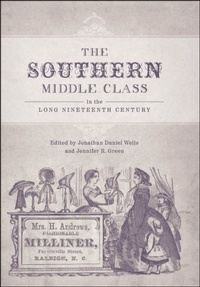
The Southern Middle Class in the Long Nineteenth Century
Description
Alles über E-Books | Antworten auf Fragen rund um E-Books, Kopierschutz und Dateiformate finden Sie in unserem Info- & Hilfebereich.
Jonathan Daniel Wells and Jennifer R. Green provide a series of provocative essays reflecting innovative, original research on professional and commercial interests in the nineteenth-century South, a place often seen as being composed of just two classes-planters and slaves. Rather, an active middle class, made up of men and women devoted to the cultural and economic modernization of Dixie, worked with each other-and occasionally their northern counterparts-to bring reforms to the region.
With a balance of established and younger authors, of antebellum and postbellum analyses, and of narrative and quantitative methodologies, these essays offer new ways to think about politics, society, gender, and culture during this exciting era of southern history. The contributors show that many like-minded southerners sought to create a "New South" with a society similar to that of the North. They supported the creation of public schools and an end to dueling, but less progressive reform was also endorsed, such as building factories using slave labor rather than white wage earners. The Southern Middle Class in the Long Nineteenth Century significantly influences thought on the social structure of the South, the centrality of class in history, and the events prior to and after the Civil War.
All prices
More details
Other editions
Additional editions
Persons
Jonathan Daniel Wells, associate professor of history at Temple University, is the author of The Origins of the Southern Middle Class, 1800-1861.
Jennifer R. Green is a professor of history at Central Michigan University. Her book Military Education and the Emerging Middle Class of the Old South won the New Scholar Book Award of the American Educational Research Association.

System requirements
File format: ePUB
Copy protection: Adobe-DRM (Digital Rights Management)
System requirements:
- Computer (Windows; MacOS X; Linux): Install the free reader Adobe Digital Editions prior to download (see eBook Help).
- Tablet/smartphone (Android; iOS): Install the free app Adobe Digital Editions or the app PocketBook before downloading (see eBook Help).
- E-reader: Bookeen, Kobo, Pocketbook, Sony, Tolino and many more (not Kindle).
The file format ePub works well for novels and non-fiction books – i.e., „flowing” text without complex layout. On an e-reader or smartphone, line and page breaks automatically adjust to fit the small displays.
This eBook uses Adobe-DRM, a „hard” copy protection. If the necessary requirements are not met, unfortunately you will not be able to open the eBook. You will therefore need to prepare your reading hardware before downloading.
Please note: We strongly recommend that you authorise using your personal Adobe ID after installation of any reading software.
For more information, see our ebook Help page.
File format: ePUB
Copy protection: Watermark-DRM (Digital Rights Management)
System requirements:
- Computer (Windows; MacOS X; Linux): Use a reading software that can process the file format ePUB: e.g., Adobe Digital Editions or FBReader – both free (see eBook Help).
- Tablet/Smartphone (Android; iOS): Before downloading, install the free app Adobe Digital Editions (see eBook Help).
- E-reader: Bookeen, Kobo, Pocketbook, Sony, Tolino and many more (not Kindle).
The file format ePUB works well for novels and non-fiction books – i.e., „flowing” text without complex layout. On an e-reader or smartphone, line and page breaks automatically adjust to fit the small displays.
This eBook uses Watermark-DRM, a „soft” copy protection. This means that there are no technical restrictions to prevent illegal distribution. However, there is a personalised watermark embedded in the eBook that can be used to identify the purchaser of the eBook in the event of misuse and to provide evidence for legal purposes.
For more information, see our eBook Help page.