

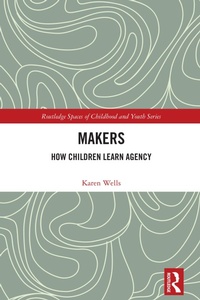
Makers
How Children Learn Agency
1st Edition
Will be published approx. on 9. July 2026
136 pages
978-1-040-63922-1 (ISBN)
Description

This book is about how children become competent people who understand and can act on and even transform the world. Its novel framework of 4A agency shows how children participate in making as audience, assistant, apprentice and artisan in makerspaces and in make-believe, music-making and toy-making.
The book explains why it is important that children are provided with opportunities for self-directed making. It substantiates many of the claims of 4E cognition, that action precedes and is the ground for thought. It provides a new
theoretical framework of 4A agency that practices of making are critical to how children's knowledge, skill and self-confidence are developed. It does this through the description and analysis of children's making in different zones of agency: mimetic, ludic, collective and design agency, as well as the agency afforded by makerspaces and by the materials themselves.
Makers: How Children Learn Agency is relevant to childhood studies, sociologists of education, and 4E cognition theorists. It will also be of interest to makers and anyone interested in children's agency and makerspaces.
The book explains why it is important that children are provided with opportunities for self-directed making. It substantiates many of the claims of 4E cognition, that action precedes and is the ground for thought. It provides a new
theoretical framework of 4A agency that practices of making are critical to how children's knowledge, skill and self-confidence are developed. It does this through the description and analysis of children's making in different zones of agency: mimetic, ludic, collective and design agency, as well as the agency afforded by makerspaces and by the materials themselves.
Makers: How Children Learn Agency is relevant to childhood studies, sociologists of education, and 4E cognition theorists. It will also be of interest to makers and anyone interested in children's agency and makerspaces.
More details
Series
Edition
1. Auflage
Language
English
Place of publication
London
United Kingdom
Publishing group
Taylor & Francis Ltd
Target group
College/higher education
Professional and scholarly
Product notice
Reflowable
Illustrations
2 Tables, black and white
File size
0,93 MB
ISBN-13
978-1-040-63922-1 (9781040639221)
Copyright in bibliographic data and cover images is held by Nielsen Book Services Limited or by the publishers or by their respective licensors: all rights reserved.
Schweitzer Classification
Other editions
Additional editions
Book
approx. 07/2026
1st Edition
Routledge
€191.50
Not yet published
Person
Karen Wells is Professor of International Development and Childhood Studies at Birkbeck, University of London, UK, and Director of the Birkbeck Institute for Social Research. She is the author of Childhood in a Global Perspective, Childhood Studies: Making Young Subjects and Visual Cultures of Childhood.
Content
1. The child as Homo faber 2. Cognition And Agency 3. Making And Mimesis 4. Ludic Agency 5. Design Agency 6. Collective Agency And Music-Making 7. Makerspaces And Weaving Knowledge 8. Material Agency 9. Conclusion
