

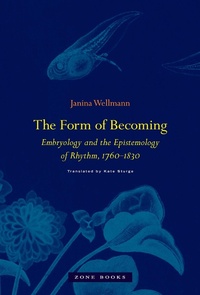
The Form of Becoming
Description

The Form of Becoming offers an innovative understanding of the emergence around 1800 of the science of embryology and a new notion of development, one based on the epistemology of rhythm. It argues that between 1760 and 1830, the concept of rhythm became crucial to many fields of knowledge, including the study of life and living processes.
The book juxtaposes the history of rhythm in music theory, literary theory, and philosophy with the concurrent turn in biology to understanding the living world in terms of rhythmic patterns, rhythmic movement, and rhythmic representations. Common to all these fields was their view of rhythm as a means of organizing time - and of ordering the development of organisms.
Janina Wellmann, a historian of science, has written the first systematic study of visualization in embryology. Embryological development circa 1800 was imagined through the pictorial technique of the series, still prevalent in the field today. Tracing the origins of the developmental series back to seventeenth-century instructional graphics for military maneuvers, dance, and craft work, The Form of Becoming reveals the constitutive role of rhythm and movement in the visualization of developing life.
More details
Other editions
Additional editions
Persons
Content
- Intro
- Contents
- Acknowledgments
- Introduction: The Form of Becoming
- Part One: A New Epistemology of Rhythm
- 1 Literary Form
- 1.1 Poetry as a Form of Thought: Klopstock
- 1.2 The Alternation of Tones: Hölderlin
- 1.3 The Prosody of Development: Karl Philipp Moritz
- 1.4 Being Is a Rhythmical Relation: Novalis
- 1.5 The Physiological Origins of Language: August Wilhelm Schlegel
- 2 Epigenetic Music
- 2.1 Musical Rhythm as a Physiological Principle
- 2.2 The Theory of Accents
- 2.3 The "Natural Inclination" to Rhythm
- 3 Rhythmical Productivity in Schelling's Philosophy of Nature and Art
- 3.1 Absolute and Finite in the Play of Rhythm
- 3.2 The Rhythm of the Absolute
- 3.3 Necessary Succession
- Part Two: Biological Rhythm
- 4 Forms Out of Formlessness
- 4.1 What Is Epigenesis? A Historiographical Problem
- 4.2 Repetition, Pulse, Spiral: Wolff's Theory of Epigenesis
- 4.3 Describing Constant Change
- 5 Sense and Verse: Goethe's Metamorphosis of Plants
- 5.1 Continual Transformation
- 5.2 The Alternation of Expansion and Contraction
- 5.3 "Going Backward or Forward in the Selfsame Way"
- 5.4 A Brief Cultural History of Metamorphosis
- 5.5 Metamorphosis in Distichs
- 6 The Rhythm of the Living World: Physiology circa 1800
- 6.1 The Temper of the Life Force
- 6.2 Physiological Times
- 6.3 The Formations of Flow
- Part Three: Serial Iconography
- 7 The Iconography of Motion
- 7.1 The Beginnings of Instructional Graphics
- 7.2 Military Drill
- 7.3 Pose and Series
- 7.4 The Law of Rhythm
- 7.5 Eighteenth-Century Drill
- 7.6 Vaulting, Dancing, Gymnastics: Beauty in Movement
- 7.7 Dance, Formation, Evolution: The Choreography of Motion
- 7.8 Handiwork
- 8 Epigenetic Iconography
- 8.1 Malpighi
- 8.2 The Image as an Aid to Seeing
- 8.3 Painted Tables
- 8.4 Soemmerring's Icones embryonum humanorum
- 8.5 The Image as Argument
- 8.6 Outline and Series: Tredern and Herold
- 8.7 Döllinger's Circle
- 9 Folding into Being: Christian Heinrich Pander
- 9.1 To Form Is to Fold
- 9.2 A New Observational Regime
- 9.3 "So We Selected": Constructing the Developmental Series
- 9.4 An "Assemblage of Embryos": Pander's Plates
- 10 Karl Ernst von Baer and the Choreography of Development
- 10.1 Folding Layers into Tubes
- 10.2 From Fundamental Organs to Tissues
- 10.3 From Line to Surface
- 10.4 Rhythmical Choreography
- 10.5 From Word to Image
- 10.6 "The Rhythm of Their Organization"
- Conclusion
- Notes
- Credits
- Index
