

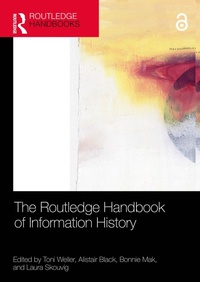
The Routledge Handbook of Information History
1st Edition
Published on 2. July 2025
638 pages
978-1-040-34965-6 (ISBN)
Description

The Routledge Handbook of Information History offers a definitive, inclusive, and far-reaching study of how information practices have influenced-and have been influenced by-society, politics, culture, and technology over millennia.
Information is often considered a defining characteristic of modern society, but it is far from a modern phenomenon. In the last decades, historians have started to ask new questions about how information was understood in the past, suggesting that it has a history which is long, complex, and multifaceted. This influential volume is the first large-scale collection to use the term Information History as its titular focus, situating "information" within the historiography of the field. The book showcases a diverse assembly of over forty international contributors who explore information practices from antiquity to the contemporary world, with geographical coverage ranging across Europe, Africa, Asia, as well as North and South America.
Including overview chapters alongside a wide range of in-depth empirical studies, this ground-breaking collection will appeal to scholars and students across the arts, humanities, and social sciences, offering readers unique insights into how historical practices have influenced the understanding and role of information in our modern world.
Chapters 1 and 37 of this book are freely available as a downloadable Open Access PDF at http://www.taylorfrancis.com under a Creative Commons Attribution (CC BY-NC) 4.0 license.
PDF of Chapter 1.
PDF of Chapter 37.
Chapters 28 and 34 of this book are freely available as a downloadable Open Access PDF at http://www.taylorfrancis.com under a Creative Commons Attribution (CC BY) 4.0 license.
Information is often considered a defining characteristic of modern society, but it is far from a modern phenomenon. In the last decades, historians have started to ask new questions about how information was understood in the past, suggesting that it has a history which is long, complex, and multifaceted. This influential volume is the first large-scale collection to use the term Information History as its titular focus, situating "information" within the historiography of the field. The book showcases a diverse assembly of over forty international contributors who explore information practices from antiquity to the contemporary world, with geographical coverage ranging across Europe, Africa, Asia, as well as North and South America.
Including overview chapters alongside a wide range of in-depth empirical studies, this ground-breaking collection will appeal to scholars and students across the arts, humanities, and social sciences, offering readers unique insights into how historical practices have influenced the understanding and role of information in our modern world.
Chapters 1 and 37 of this book are freely available as a downloadable Open Access PDF at http://www.taylorfrancis.com under a Creative Commons Attribution (CC BY-NC) 4.0 license.
PDF of Chapter 1.
PDF of Chapter 37.
Chapters 28 and 34 of this book are freely available as a downloadable Open Access PDF at http://www.taylorfrancis.com under a Creative Commons Attribution (CC BY) 4.0 license.
Reviews / Votes
"Information always has a modern ring to it, but as we enter the AI revolution, we would do well to remember that many of the basic challenges we face today have roots that lead back to antiquity. This essential book shows just how deeply the origins of the modern information revolution are rooted in the past."Jacob Soll, University Professor and Professor of Philosophy, History, and Accounting, University of Southern California, USA
"This is a refreshingly broad compilation, one which offers a provocative look across information-related practices, delving into cultural and historical specificities as a way to ensure that information history emerges at large as a vital area of study."
Lisa Gitelman, Professor of English and Media, Culture, and Communication, New York University, USA
More details
Edition
1. Auflage
Language
English
Place of publication
London
United Kingdom
Publishing group
Taylor & Francis Ltd
Target group
College/higher education
Illustrations
1 Tables, black and white; 1 Line drawings, black and white; 43 Halftones, black and white; 44 Illustrations, black and white
File size
16,81 MB
ISBN-13
978-1-040-34965-6 (9781040349656)
Copyright in bibliographic data and cover images is held by Nielsen Book Services Limited or by the publishers or by their respective licensors: all rights reserved.
Schweitzer Classification
Other editions
Additional editions
Toni Weller | Alistair Black | Bonnie Mak
The Routledge Handbook of Information History
Book
07/2025
1st Edition
Routledge
€335.70
Shipment within 10-20 days

Book
05/2025
Routledge
Unfortunately, price unknown
Available (delivery time upon request)
Persons
Toni Weller is visiting research fellow in history at De Montfort University, UK. For the past twenty years she has authored numerous books, articles, and book chapters on the theory of information history, women and information, Victorian information culture, as well as the history of the surveillance state.
Alistair Black is professor emeritus in the School of Information Sciences, University of Illinois Urbana-Champaign, USA, but lives and researches in the UK. He has published extensively, over many years, on the history of information management and libraries.
Bonnie Mak is a historian of ancient, medieval, and modern information practices. She is associate professor in the School of Information Sciences at the University of Illinois Urbana-Champaign, USA, and the author of How the Page Matters (2011).
Laura Skouvig is associate professor in the Department of Communication at the University of Copenhagen, Denmark. She has co-edited Histories of Surveillance from Antiquity to the Digital Era. The Eyes and Ears of Power (2021) and has written about information and surveillance in eighteenth-century Denmark.
Alistair Black is professor emeritus in the School of Information Sciences, University of Illinois Urbana-Champaign, USA, but lives and researches in the UK. He has published extensively, over many years, on the history of information management and libraries.
Bonnie Mak is a historian of ancient, medieval, and modern information practices. She is associate professor in the School of Information Sciences at the University of Illinois Urbana-Champaign, USA, and the author of How the Page Matters (2011).
Laura Skouvig is associate professor in the Department of Communication at the University of Copenhagen, Denmark. She has co-edited Histories of Surveillance from Antiquity to the Digital Era. The Eyes and Ears of Power (2021) and has written about information and surveillance in eighteenth-century Denmark.
Content
Part I: Introduction
1. Situating Information History: The History and Historiography of Information and Its Practices
Alistair Black, Bonnie Mak, Laura Skouvig, and Toni Weller
PDF
Part II: Visualising, Describing, Expressing
2. Information in the Roman Empire
Andrew Riggsby
3. Information and Its Forms: Documentary Practices in the Medieval West (Mid-Ninth to Mid-Thirteenth Centuries)
Brigitte Miriam Bedos-Rezak
4. The Andean Khipus: An Information System Made of String
Lucrezia Milillo and Sabine Hyland
5. Racialised Language in Colonial Newspaper Advertisements During the Eighteenth and Nineteenth Centuries
Natalia da Silva Perez
6. "There Must be Something Vicious in the Data": Thomas Jefferson's Techniques of Racialisation in the Production of Data, Facts, and Information
Melissa Adler
7. Encyclopaedias as Cultural Carriers of Information: A Scandinavian Perspective
Maria Simonsen
8. Paul Otlet's Experiments with Knowledge Organisation and Explorations of a Future Semantic Web
Charles van den Heuvel
9. Information as Instruction: A Short History of Attack Journalism
Bethany Usher
10. The Fault Lines of Knowledge: An Examination of the History of Wikipedia's "Neutral Point of View" (NPOV) Information Policy and Its Implications for a Polarised World
Brendan Luyt
11. Facial AIs and Information Systems in Historical Context
Edward Higgs
Part III: Managing, Ordering, Classifying
12. "Those Who Help His Sight and Hearing Are Many": Information and the State in Early China
Rebecca Robinson
13. Creativity in Classification: Phrasing and Presenting the Aristotelian Categories in the Middle Ages
Irene O'Daly
14. Trading Factories as Information Factories: Aspects of Information Management in the Dutch East India Company's Japanese Factory, 1609-1623
Gabor Szommer
15. The Female Body as an Object of Information: Britain during the Late Victorian and Edwardian Period
Toni Weller
16. Information, Topography, and War: Information Management in Britain's Inter-Service Topographical Department (ISTD) in the Second World War
Alistair Black
17. The Wartime Social Survey as Information History
Henry Irving
18. Sensitive Information: Knowing and Preparing for Nuclear War during the Cold War
Rosanna Farbol and Casper Sylvest
19. "Men are Engineers, Women Are Computers": Women and the Information Technology Interregnum
Antony Bryant
20. Central and Local: A History of Archives in Twentieth-Century England
Elizabeth Shepherd
21. Representing Information in the Western World: Classification, Cataloguing, and the Library Context since Industrialisation
Karen Attar
22. The History of Computing: The Development of an Information History Field
William Aspray
23. Smart Cities and Informatic Governance: The Management of Information and People in Postcolonial Singapore
Hallam Stevens and Manoj Harjani
Part IV: Circulating, Networking, Controlling
24. The Politics of Communication in the Early Modern City: Istanbul and Venice
Filippo de Vivo
25. Recipes, Gold, and Information Exchange: Workshop Cultures in the Early Modern Metropolis
Jasmine Kilburn-Toppin
26. Colonial Political Economies of Information: The East India Company and the Growth of Science in Britain
Jessica Ratcliff
27. In-Between Writing and Orality: The Circulation of Information in the Black Spanish Caribbean during the Age of Revolutions, 1789-1808
Cristina Soriano
28. Information and Mobility: Migrants and Roma as Historical Cases
Eve Rosenhaft
29. Emotions as Commodities: Street Ballads and the Commercialisation of Information
Laura Skouvig
30. How Information Changed Between the Late Nineteenth Century and World War II
James W. Cortada
31. Factual Fictions and Fictionalised Facts in the Reports of the Romanian Secret Police
Valentina Glajar and Corina L. Petrescu
32. Families as Communities of Information. Or: The Importance of Knowing Your Relatives
Markus Friedrich
33. Feathers and Formats: Information, Technology, and Homing Pigeons in War
Frank A. Blazich, Jr.
34. Information and Communication Theories: A Global History of the (Con)fusion
Gabriele Balbi, Gianluigi Negro, Maria Rikitianskaia, Carlos A. Scolari, and Dominique Trudel
35. Decolonisation and Information in Postcolonial Egypt, 1952-1967
Zoe LeBlanc
36. Dynamics of the Human Element in South Africa's Information History
Archie L. Dick
Part V: Afterword
37. What Is Information History For?
Bonnie Mak
PDF
1. Situating Information History: The History and Historiography of Information and Its Practices
Alistair Black, Bonnie Mak, Laura Skouvig, and Toni Weller
Part II: Visualising, Describing, Expressing
2. Information in the Roman Empire
Andrew Riggsby
3. Information and Its Forms: Documentary Practices in the Medieval West (Mid-Ninth to Mid-Thirteenth Centuries)
Brigitte Miriam Bedos-Rezak
4. The Andean Khipus: An Information System Made of String
Lucrezia Milillo and Sabine Hyland
5. Racialised Language in Colonial Newspaper Advertisements During the Eighteenth and Nineteenth Centuries
Natalia da Silva Perez
6. "There Must be Something Vicious in the Data": Thomas Jefferson's Techniques of Racialisation in the Production of Data, Facts, and Information
Melissa Adler
7. Encyclopaedias as Cultural Carriers of Information: A Scandinavian Perspective
Maria Simonsen
8. Paul Otlet's Experiments with Knowledge Organisation and Explorations of a Future Semantic Web
Charles van den Heuvel
9. Information as Instruction: A Short History of Attack Journalism
Bethany Usher
10. The Fault Lines of Knowledge: An Examination of the History of Wikipedia's "Neutral Point of View" (NPOV) Information Policy and Its Implications for a Polarised World
Brendan Luyt
11. Facial AIs and Information Systems in Historical Context
Edward Higgs
Part III: Managing, Ordering, Classifying
12. "Those Who Help His Sight and Hearing Are Many": Information and the State in Early China
Rebecca Robinson
13. Creativity in Classification: Phrasing and Presenting the Aristotelian Categories in the Middle Ages
Irene O'Daly
14. Trading Factories as Information Factories: Aspects of Information Management in the Dutch East India Company's Japanese Factory, 1609-1623
Gabor Szommer
15. The Female Body as an Object of Information: Britain during the Late Victorian and Edwardian Period
Toni Weller
16. Information, Topography, and War: Information Management in Britain's Inter-Service Topographical Department (ISTD) in the Second World War
Alistair Black
17. The Wartime Social Survey as Information History
Henry Irving
18. Sensitive Information: Knowing and Preparing for Nuclear War during the Cold War
Rosanna Farbol and Casper Sylvest
19. "Men are Engineers, Women Are Computers": Women and the Information Technology Interregnum
Antony Bryant
20. Central and Local: A History of Archives in Twentieth-Century England
Elizabeth Shepherd
21. Representing Information in the Western World: Classification, Cataloguing, and the Library Context since Industrialisation
Karen Attar
22. The History of Computing: The Development of an Information History Field
William Aspray
23. Smart Cities and Informatic Governance: The Management of Information and People in Postcolonial Singapore
Hallam Stevens and Manoj Harjani
Part IV: Circulating, Networking, Controlling
24. The Politics of Communication in the Early Modern City: Istanbul and Venice
Filippo de Vivo
25. Recipes, Gold, and Information Exchange: Workshop Cultures in the Early Modern Metropolis
Jasmine Kilburn-Toppin
26. Colonial Political Economies of Information: The East India Company and the Growth of Science in Britain
Jessica Ratcliff
27. In-Between Writing and Orality: The Circulation of Information in the Black Spanish Caribbean during the Age of Revolutions, 1789-1808
Cristina Soriano
28. Information and Mobility: Migrants and Roma as Historical Cases
Eve Rosenhaft
29. Emotions as Commodities: Street Ballads and the Commercialisation of Information
Laura Skouvig
30. How Information Changed Between the Late Nineteenth Century and World War II
James W. Cortada
31. Factual Fictions and Fictionalised Facts in the Reports of the Romanian Secret Police
Valentina Glajar and Corina L. Petrescu
32. Families as Communities of Information. Or: The Importance of Knowing Your Relatives
Markus Friedrich
33. Feathers and Formats: Information, Technology, and Homing Pigeons in War
Frank A. Blazich, Jr.
34. Information and Communication Theories: A Global History of the (Con)fusion
Gabriele Balbi, Gianluigi Negro, Maria Rikitianskaia, Carlos A. Scolari, and Dominique Trudel
35. Decolonisation and Information in Postcolonial Egypt, 1952-1967
Zoe LeBlanc
36. Dynamics of the Human Element in South Africa's Information History
Archie L. Dick
Part V: Afterword
37. What Is Information History For?
Bonnie Mak
