

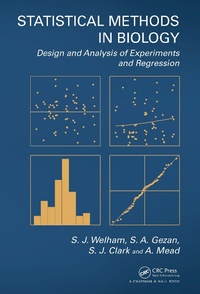
Statistical Methods in Biology
Design and Analysis of Experiments and Regression
1st Edition
Published on 22. August 2014
602 pages
978-1-040-06232-6 (ISBN)
Description

Written in simple language with relevant examples, this illustrative introductory book presents best practices in experimental design and simple data analysis. Taking a practical and intuitive approach, it only uses mathematical formulae to formalize the methods where necessary and appropriate. The text features extended discussions of examples that include real data sets arising from research. The authors analyze data in detail to illustrate the use of basic formulae for simple examples while using the GenStat statistical package for more complex examples. Each chapter offers instructions on how to obtain the example analyses in GenStat and R.
Reviews / Votes
"...This is absolutely a traditional statistics textbook, with a strong basis in classical approaches such as blocking, crossed, and nested designs. ... There is much the volume does well. It provides one of the most lucid descriptions of ANOVA that I have come across, and the strong emphasis on coupling experimental design with appropriately planned analysis (often described as important but rarely covered in detail in other statistical publications) make this a textbook that would be useful to those setting up controlled experiments, particularly in the field. Additionally, the provision of plenty of online material and exercises (at http://www.stats4biol.info) for use with GenStat, SAS, and R packages is a useful practical resource. ... [T]o those who might be looking for a new statistics textbook to work through systematically, it does provide a good reference for anyone who wishes to dissect specific topics in more depth."-Matthew R.E. Symonds in The Quarterly Review of Biology, June 2017
"This book is the first serious and successful attempt to teach the general principles underlying sound experimental design and analysis to an audience of students and researchers in biology. The book is written from a strongly applied perspective with lots of real-life examples, but enough mathematical details are given to allow the reader to tailor design and analysis principles to new problems.
The leading principle for analysis of experimental data is the multi-stratum analysis of variance. This powerful principle is part of the Rothamsted tradition of applied statistics to which the authors belong. This book makes statistical highlights from that tradition accessible to life scientists without demanding excessive mathematical skills."
-Fred van Eeuwijk, Wageningen University and Research Centre
"This book is easy to read. I am very happy to recommend this book to both scientists as a reference, and to students in the area of agricultural and biological plant sciences as a textbook. It covers most aspects of planning experiments and the steps necessary for analyzing the resulting data, bringing the authors' experience to the reader with real examples. It is obvious that the authors have taken great care in framing their conclusions and the possible interpretations of the results."
-Clarice G.B. Demetrio, Professor of Experimental Statistics, Escola Superior de Agricultura "Luiz de Queiroz," University of Sao Paulo
"This book connects the underlying principles of design and statistics to good practice in data analysis. It also gives a solid account of the most commonly used and needed statistical methods in experimental biology. It explains concepts in clear, practical, and accessible ways, using real data to illustrate throughout. Mathematical notation is used when necessary but the explanations of key points are in common language.
I would particularly recommend this book for research students. It provides a no-nonsense, gimmick-free account of the key statistical concepts and practices that will allow you to do valid and useful analyses and understand the results from statistical software."
-Richard Coe, Principal Scientist-Research Methods, World Agroforestry Centre (ICRAF) and Statistical Services Centre
"This book will be invaluable to plant scientists who want to develop their knowledge of statistics. Based on courses developed by the authors, the aim is to provide a deep understanding of the most commonly used experimental designs and their analysis, along with linear regression, and to emphasize the connections between these areas. A background in basic statistics, to the level of t-tests, would be helpful, though a revision chapter is provided. Additional chapters introduce linear mixed models and generalised linear models for counts and proportions.
The authors' extensive practical experience is apparent throughout, particularly in the many interesting examples that pervade the book. A companion website provides associated data and code in GenStat, R, and (soon) SAS. This in itself is a terrific resource, with 50 well-commented programs covering basic analyses and extensions. Each chapter has exercises; these are often challenging and solutions will be provided on the website.
Most of the examples stem from Rothamsted, where all of the authors work or have worked, and the book has something of a Rothamsted 'feel' to it, for example with a strong emphasis on multi-stratum ANOVA to incorporate blocking and other experimental structure even when this is not strictly essential; the benefits of this approach for clarifying more complex designs become apparent as the book progresses.
Everything is here for the plant scientist to develop a really solid understanding of the subject and it is difficult to see how the authors could have done a better job of delivering the book that they set out to write."
-Martin Ridout, Professor of Applied Statistics, University of Kent
More details
Edition
1. Auflage
Language
English
Place of publication
London
United Kingdom
Publishing group
Taylor & Francis Ltd
Target group
College/higher education
ISBN-13
978-1-040-06232-6 (9781040062326)
Copyright in bibliographic data and cover images is held by Nielsen Book Services Limited or by the publishers or by their respective licensors: all rights reserved.
Schweitzer Classification
Other editions
Additional editions
S.J. Welham | S.A. Gezan | S.J. Clark
Statistical Methods in Biology
Design and Analysis of Experiments and Regression
Book
10/2024
1st Edition
Chapman & Hall/CRC
€67.30
Shipment within 10-20 days
S.J. Welham | S.A. Gezan | S.J. Clark
Statistical Methods in Biology
Design and Analysis of Experiments and Regression
Book
08/2014
1st Edition
Chapman & Hall/CRC
€131.50
Shipment within 15-20 days
Persons
Suzanne Jane Welham obtained an MSc in statistical sciences from University College London in 1987 and worked as an applied statistician at Rothamsted Research from 1987 to 2000, collaborating with scientists and developing statistical software. She pursued a PhD from 2000 to 2003 at the London School of Hygiene and Tropical Medicine and then returned to Rothamsted, during which time she coauthored the in-house statistics courses that motivated the writing of this book. She is a coauthor of about 60 published papers and currently works for VSN International Ltd on the development of statistical software for analysis of linear mixed models and presents training courses on their use in R and GenStat.
Salvador Alejandro Gezan, PhD, is an assistant professor at the School of Forest Resources and Conservation at the University of Florida since 2011. Salvador obtained his bachelor's from the Universidad of Chile in forestry and his PhD from the University of Florida in statistics-genetics. He then worked as an applied statistician at Rothamsted Research, collaborating on the production and development of the in-house courses that formed the basis for this book. Currently, he teaches courses in linear and mixed model effects, quantitative genetics and forest mensuration. He carries out research and consulting in statistical application to biological sciences with emphasis on genetic improvement of plants and animals. Salvador is a long-time user of SAS, which he combines with GenStat, R and MATLAB as required.
Suzanne Jane Clark has worked at Rothamsted Research as an applied statistician since 1981. She primarily collaborates with ecologists and entomologists at Rothamsted, providing and implementing advice on statistical issues ranging from planning and design of experiments through to data analysis and presentation of results, and has coauthored over 130 scientific papers. Suzanne coauthored and presents several of the in-house st
Salvador Alejandro Gezan, PhD, is an assistant professor at the School of Forest Resources and Conservation at the University of Florida since 2011. Salvador obtained his bachelor's from the Universidad of Chile in forestry and his PhD from the University of Florida in statistics-genetics. He then worked as an applied statistician at Rothamsted Research, collaborating on the production and development of the in-house courses that formed the basis for this book. Currently, he teaches courses in linear and mixed model effects, quantitative genetics and forest mensuration. He carries out research and consulting in statistical application to biological sciences with emphasis on genetic improvement of plants and animals. Salvador is a long-time user of SAS, which he combines with GenStat, R and MATLAB as required.
Suzanne Jane Clark has worked at Rothamsted Research as an applied statistician since 1981. She primarily collaborates with ecologists and entomologists at Rothamsted, providing and implementing advice on statistical issues ranging from planning and design of experiments through to data analysis and presentation of results, and has coauthored over 130 scientific papers. Suzanne coauthored and presents several of the in-house st
Content
Introduction. A Review of Basic Statistics. Principles for Designing Experiments. Models for a Single Factor. Checking Model Assumptions. Transformations of the Response. Models with Simple Blocking Structure. Extracting Information about Treatments. Models with Complex Blocking Structure. Replication and Power. Dealing with Non-Orthogonality. Models for a Single Variate: Simple Linear Regression. Checking Model Fit. Models for Several Variates: Multiple Linear Regression. Models for Variates and Factors. Incorporating Structure: Mixed Models. Models for Curved Relationships. Models for Non-Normal Responses: Generalized Linear Models. Practical Design and Data Analysis for Real Studies. References. Appendices.
