

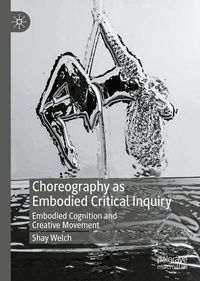
Choreography as Embodied Critical Inquiry
Description

In this book, Shay Welch expands on the contemporary cognitive thinking-in-movement framework, which has its roots in the work of Maxine Sheets-Johnstone but extends and develops within contemporary embodied cognition theory. Welch believes that dance can be used to ask questions, and this book offers a method of how critical inquiry can be embodied. First, she presents the theoretical underpinnings of what this process is and how it can work; second, she introduces the empirical method as a tool that can be used by movers for the purpose of doing embodied inquiry. Exploring the role of embodied cognition and embodied metaphors in mining the body for questions, Welch demonstrates how to utilize movement to explore embodied practices of knowing. She argues that our creative embodied movements facilitate our ability to bodily engage in critical analysis about the world.
Reviews / Votes
"How might we come to understand and 'know' the meaning of our inchoate thoughts, emotions, and memories that lie within us? This remarkable book provides answers to this question and others with a rigorous, academic philosophy of embodied mind and cognition that bears fruit through the 'jubilant shenanigan' of choreographed and improvisational movement experiments. Thus, theory meets praxis in a way that suggestively expands the boundaries of philosophic thought and knowledge beyond the borders of our conscious brains and into our breathing, moving, attuned, aware, and feeling bodies." (Aili Bresnahan, Associate Professor, University of Dayton, USA)"Taking the embodied sciences of thinking a tremendous step forward, this book presents the intriguing and deeply intuitive possibility of inquiry-in-movement, detailing how, in dancing, people tap into procedural knowledges that belong to our bodies, importantly including the know-how of dialogue and of discovery. Shay Welch shares her original method of embodied critical inquiry in fascinating final demonstrations, but first, her writing enacts this practice in its own dynamic construction. Readers will be drawn swiftly into the text's energetic, cogent momentum, as Welch nimbly pulls every philosophical approach to meaning, language, and body-minds that I have ever held dear into an intricate, lucid performance that enlivens and freshly illuminates the foundational work on which it builds. Against this vibrant backdrop Welch's direct, accessible interpretations gleam with insight, and we catch our breath and behold the visionary promise that dancing and improvising hold for enactive and embodied cognitive science." (Elena Clare Cuffari, Professor of Psychology and Scientific and Philosophical Studies of Mind at Franklin and Marshall College, and co-author [with Ezequiel A. Di Paolo and Hanne De Jaegher] of Linguistic Bodies : The Continuity between Life andLanguage [2018])
"Building on her previous scholarship, Shay Welch amasses a wealth of resources to demonstrate why and how the action of dancing deserves attention within philosophical circles as a mode of embodied critical inquiry. Not only does Welch make a sophisticated intellectual argument, she offers readers the results of her own bold empirical experimentation as evidence and as inspiration." (Kimerer L LaMothe, author of Why We Dance: A Philosophy of Bodily Becoming)
More details
Other editions
Additional editions
Person
Shay Welch is Associate Professor of Philosophy at Spelman College, the 2020-2021 Carnegie and Rockefeller Foundation Distinguished Research/Creative Scholar, and Chair of the Association for Feminist Ethics and Social Theory.
Content
Chapter 1: Dancing: Phenomenology and Embodied Cognition.- Chapter 2: Critical Inquiry: Creative Movement and Embodied.- Chapter 3: Movement-Knowings: Affect and Embodied Intuition.- Chapter 4: Somatics: Improvisation and Feeling-Practices.- Chapter 5: Embodied Critical Inquiry: A Theory.- Chapter 6: Enactivism and Embodied Critical Inquiry.- Chapter 7: Embodied Critical Inquiry: A Method.- Chapter 8: The Movers: Results
