

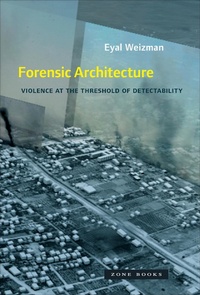
Forensic Architecture
Description

In recent years, a little-known research group named Forensic Architecture began using novel research methods to undertake a series of investigations into human rights abuses. Today, the group provides crucial evidence for international courts and works with a wide range of activist groups, NGOs, Amnesty International, and the UN.
Beyond shedding new light on human rights violations and state crimes across the globe, Forensic Architecture has also created a new form of investigative practice that bears its name. The group uses architecture as an optical device to investigate armed conflicts and environmental destruction, as well as to cross-reference a variety of evidence sources, such as new media, remote sensing, material analysis, witness testimony, and crowd-sourcing.
In Forensic Architecture, Eyal Weizman, the group's founder, provides, for the first time, an in-depth introduction to the history, practice, assumptions, potentials, and double binds of this practice. The book includes an extensive array of images, maps, and detailed documentation that records the intricate work the group has performed.
Included in this volume are case studies that traverse multiple scales and durations, ranging from the analysis of the shrapnel fragments in a room struck by drones in Pakistan, the reconstruction of a contested shooting in the West Bank, the architectural recreation of a secret Syrian detention center from the memory of its survivors, a blow-by-blow account of a day-long battle in Gaza, and an investigation of environmental violence and climate change in the Guatemalan highlands and elsewhere.
Weizman's Forensic Architecture, stunning and shocking in its critical narrative, powerful images, and daring investigations, presents a new form of public truth, technologically, architecturally, and aesthetically produced. Their practice calls for a transformative politics in which architecture as a field of knowledge and a mode of interpretation exposes and confronts ever-new forms of state violence and secrecy.
More details
Other editions
Additional editions
Person
Content
- Intro
- Contents
- Preface
- Introduction: At the Threshold of Detectability
- Negative Positivism
- Toward a Forensic Architecture
- Drone Vision
- Visual Extraterritorialization
- Pattern of Drone Strikes
- Under the Veil of Resolution
- The Architecture of Memory
- Part One: What is Forensic Architecture
- Cracks: Lines of Least Resistance
- Conflict Surveyors
- Staro Sajmiste: The Inverted Horizon
- Forensis
- Counterforensics
- A Knock on the Roof
- Engaged Objectivity
- White Phosphorous
- The Forensic Turn
- The Era of Witness
- Saydnaya: Inside a Syrian Torture Prison
- Forensic Aesthetics
- Image Space
- Before and After
- Locating Air Strikes in Syria
- Abu Rahma: From Video to Virtual Modeling
- Patterns
- Counterpatterns
- Field Causality
- Guatemala: Environmental Violence
- The Landscape Against the State
- The Truth in Ruins
- Part Two: Counterforensics in Palestine
- The Forensic Dilemma
- Architecture Against Architects
- Political Forms and Forces
- Counter-Cartography"
- Precedents
- The Pyramids of Gaza
- Ruins in Inverse
- Lawfare
- The Nakba Day Killing
- Intersections
- Hannibal in Rafah
- Rafah, Black Friday, August 1, 2014
- The Timeline
- The Prisoner's Dilemma
- Hannibal Unleashed
- Image Space
- Air: Nephanalysis of Bomb Clouds
- Subsoil: The Underground Manhunt
- To Kill a Dead Man
- Meanwhile . . .
- Postscript: Trial as Denial
- Part Three: Ground Truths
- A Tribe Against a State
- The Aridity Line
- The Conflict Shoreline
- Meteorological Traces
- Negev Settlements, Vegetations, and Precipitation
- The Bedouin Nakba
- The Politics of Drought
- Plant Vigor As A Political Sensor
- the Area of Al-'araqı¯b in 1998, 2002, 2008, and 2014
- Colonialism and Climate Change
- The Climate of the Naqab's History
- The Testimony of the Weather
- Orientalist Meteorology
- The Earth Photograph
- Military Archaeology
- Life at the Threshold of Detectability
- Postscript: The Slow Violence of the "Split Second
- Acknowledgments
- Notes
