

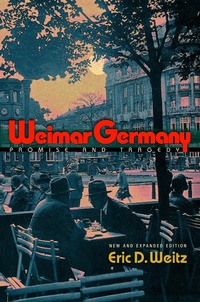
Weimar Germany
Description

Weimar Germany still fascinates us, and now this complex and remarkably creative period and place has the history it deserves. Eric Weitz's Weimar Germany reveals the Weimar era as a time of strikingly progressive achievements--and even greater promise. With a rich thematic narrative and detailed portraits of some of Weimar's greatest figures, this comprehensive history recaptures the excitement and drama as it unfolded, viewing Weimar in its own right--and not as a mere prelude to the Nazi era.
Weimar Germany tells how Germans rose from the defeat of World War I and the turbulence of revolution to forge democratic institutions and make Berlin a world capital of avant-garde art. Setting the stage for this story, Weitz takes the reader on a walking tour of Berlin to see and feel what life was like there in the 1920s, when modernity and the modern city--with its bright lights, cinemas, "new women," cabarets, and sleek department stores--were new. We learn how Germans enjoyed better working conditions and new social benefits and listened to the utopian prophets of everything from radical socialism to communal housing to nudism. Weimar Germany also explores the period's revolutionary cultural creativity, from the new architecture of Erich Mendelsohn, Bruno Taut, and Walter Gropius to Hannah Höch's photomontages and Bertolt Brecht and Kurt Weill's theater. Other chapters assess the period's turbulent politics and economy, and the recipes for fulfilling sex lives propounded by new "sexologists." Yet Weimar Germany also shows that beneath this glossy veneer lay political turmoil that ultimately led to the demise of the republic and the rise of the radical Right.
Thoroughly up-to-date, skillfully written, and strikingly illustrated, Weimar Germany brings to life as never before an era of creativity unmatched in the twentieth century-one whose influence and inspiration we still feel today. In a new chapter, Weitz depicts Weimar's global impact in the decades after the destruction of the republic, when so many of its key cultural and political figures fled Nazi Germany. The Weimar style they carried with them has powerfully influenced art, urban design, and intellectual life from Tokyo to Ankara, Brasilia to New York. They made Weimar an example of all that is liberating, and all that can go wrong, in a democracy.
More details
Other editions
Additional editions
Person
Content
Introduction 1
1. A Troubled Beginning 7
2. Walking the City 41
3. Political Worlds 81
4. A Turbulent Economy and an Anxious Society 129
5. Building a New Germany 169
6. Sound and Image 207
7. Culture and Mass Society 251
8. Bodies and Sex 297
9. Revolution and Counterrevolution from the Right 331
10. The Weimar Legacy: A Global Perspective 361
Conclusion 401
Notes 409
Bibliographic Essay 447
Acknowledgments 453
Index 455
