

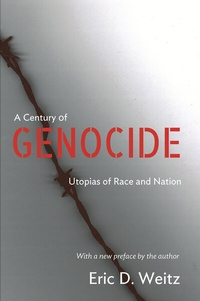
A Century of Genocide
Utopias of Race and Nation - Updated Edition
1st Edition
Published on 28. July 2015
384 pages
978-1-4008-6622-9 (ISBN)
Description

Why did the twentieth century witness unprecedented organized genocide? Can we learn why genocide is perpetrated by comparing different cases of genocide? Is the Holocaust unique, or does it share causes and features with other cases of state-sponsored mass murder? Can genocide be prevented?
Blending gripping narrative with trenchant analysis, Eric Weitz investigates four of the twentieth century's major eruptions of genocide: the Soviet Union under Stalin, Nazi Germany, Cambodia under the Khmer Rouge, and the former Yugoslavia. Drawing on historical sources as well as trial records, memoirs, novels, and poems, Weitz explains the prevalence of genocide in the twentieth century--and shows how and why it became so systematic and deadly.
Weitz depicts the searing brutality of each genocide and traces its origins back to those most powerful categories of the modern world: race and nation. He demonstrates how, in each of the cases, a strong state pursuing utopia promoted a particular mix of extreme national and racial ideologies. In moments of intense crisis, these states targeted certain national and racial groups, believing that only the annihilation of these "enemies" would enable the dominant group to flourish. And in each instance, large segments of the population were enticed to join in the often ritualistic actions that destroyed their neighbors.
This book offers some of the most absorbing accounts ever written of the population purges forever associated with the names Stalin, Hitler, Pol Pot, and Milosevic. A controversial and richly textured comparison of these four modern cases, it identifies the social and political forces that produce genocide.
Blending gripping narrative with trenchant analysis, Eric Weitz investigates four of the twentieth century's major eruptions of genocide: the Soviet Union under Stalin, Nazi Germany, Cambodia under the Khmer Rouge, and the former Yugoslavia. Drawing on historical sources as well as trial records, memoirs, novels, and poems, Weitz explains the prevalence of genocide in the twentieth century--and shows how and why it became so systematic and deadly.
Weitz depicts the searing brutality of each genocide and traces its origins back to those most powerful categories of the modern world: race and nation. He demonstrates how, in each of the cases, a strong state pursuing utopia promoted a particular mix of extreme national and racial ideologies. In moments of intense crisis, these states targeted certain national and racial groups, believing that only the annihilation of these "enemies" would enable the dominant group to flourish. And in each instance, large segments of the population were enticed to join in the often ritualistic actions that destroyed their neighbors.
This book offers some of the most absorbing accounts ever written of the population purges forever associated with the names Stalin, Hitler, Pol Pot, and Milosevic. A controversial and richly textured comparison of these four modern cases, it identifies the social and political forces that produce genocide.
All prices
More details
Other editions
Additional editions
Book
04/2015
Princeton University Press
€29.50
Shipment within 10-20 days
Persons
Eric D. Weitz (1953-2021) was Distinguished Professor of History at City College and the Graduate Center, City University of New York. He was also the author of A World Divided: The Global Struggle for Human Rights in the Age of Nation-States; Weimar Germany: Promise and Tragedy, which was named a New York Times Book Review Editor's Choice; and Creating German Communism, 1890-1990: From Popular Protests to Socialist State (all Princeton).
Content
Abbreviations vii
Preface to the New Paperback Edition ix
An Armenian Prelude 1
Introduction: Genocides in the Twentieth Century 8
Chapter 1 Race and Nation: An Intellectual History 16
Chapter 2 Nation, Race, and State Socialism: The Soviet Union under Lenin and Stalin 53
Chapter 3 The Primacy of Race: Nazi Germany 102
Chapter 4 Racial Communism: Cambodia under the Khmer Rouge 144
Chapter 5 National Communism: Serbia and the Bosnian War 190
Conclusion 236
Notes 255
Bibliography 311
Acknowledgments 339
Index 343
Preface to the New Paperback Edition ix
An Armenian Prelude 1
Introduction: Genocides in the Twentieth Century 8
Chapter 1 Race and Nation: An Intellectual History 16
Chapter 2 Nation, Race, and State Socialism: The Soviet Union under Lenin and Stalin 53
Chapter 3 The Primacy of Race: Nazi Germany 102
Chapter 4 Racial Communism: Cambodia under the Khmer Rouge 144
Chapter 5 National Communism: Serbia and the Bosnian War 190
Conclusion 236
Notes 255
Bibliography 311
Acknowledgments 339
Index 343

