

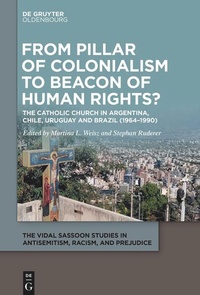
From Pillar of Colonialism to Beacon of Human Rights?
Description

In the Southern Cone and Brazil the democratization processes that began in the mid-1980s led to numerous investigations into the most complex and dire episodes in the region's history. This process followed the dismantling of brutal dictatorial regimes and was aided by the declassification of new documents, opening new paths for historians to understand the recent past.
The role played by the Catholic Church in this period is crucial, given the fact that since the 15th century, when it stood as one of the pillars of the colonial order in Latin America, it remained a key player in Latin American culture and politics, through a successful adaptation to the spirit of the times. Hence, its study is key to assess the impact that the values of democratization and human rights had in this part of the world during the Cold War, and to understand the continuities in the patterns of inequality, violence and racism inherited from colonial times.
In this volume, we seek to shed light on the challenges and dilemmas faced by the Catholic Church in the Southern Cone and Brazil between ca. 1964 and 1990, using new archival work. The year 1964 is the year where the dictatorial wave in the region began in Brazil, and 1990 is the year that sealed the period, with the fall of the Pinochet government in Chile.
More details
Other editions
Additional editions
Persons
Martina L. Weisz , The Hebrew University of Jerusalem, Israel; Stephan Ruderer , Pontificia Universidad Católica de Chile, Santiago.
Content
- Intro
- Acknowledgments
- Contents
- From Pillar of Colonialism to Beacon of Human Rights?: The Catholic Church in Latin America. An Introduction
- Catholicism, Empire and the Construction of Race
- The Latin American Republics and the Catholic Church
- Catholicism, Democracies and Dictatorships
- The Contributions of this Book
- The Church as Accomplice to Dictatorship
- The Church as Resistance to Dictatorship
- References
- The Church as Accomplice to Dictatorship
- Extreme Right Opposition to the Latin American Progressive Church (1967-1980)
- Introduction
- The Impact of the Second Vatican Council in Latin America
- Rightist Catholics Opposed to the Council and Rome
- The WACL, the CAL and the Plan Banzer
- Conclusions
- References
- The Shadow of Pius XII: Catholic Traditionalism and State Terrorism in Argentina (1976-1983)
- Introduction
- From the 'Secular Pact' to the 'Catholic Revival'
- The Shadow of Pius XII
- Epilogue
- References
- Claretian Missionaries, the 'New Evangelization' and Political Persecution at Mina El Aguilar, Argentina
- Coloniality in Argentina
- The Claretian Mission and the Prelature of Humahuaca
- Persecution
- The Catholic Clergy: a Guide for the Perplexed
- The Missionary Work of the Claretians under State Terrorism
- Concluding Remarks
- References
- Primary Sources
- The Anti-communist and Persecutory Convergence of the Brazilian Military Government and the Tradition, Family and Property Civil Association (1964-1979)
- Introduction
- The Pre-coup Period and the Establishment of Dictatorship in Brazil
- The Catholic Church and the Initial Support for the Dictatorship
- The TFP's Integrism and its Endorsement of Dictatorial Anti-Communism
- The TFP`s Public Actions in the Dictatorial Context
- Final Considerations
- References
- The Catholic Church in Chile and an Unrestricted Defense of the Dictatorship. The "Private Report" of the Episcopal Conference of Christmas 1973
- Introduction
- The Attitude of the Chilean Church According to Historiography
- The "Private Report" of the Chilean Episcopal Conference
- The vision of Allende's government
- The Bishops During the UP Government
- Explanations for the Coup
- The Armed Forces
- The Church after the Coup
- The Current Situation and the Task of the Church
- Conclusions
- References
- The Church as Resistance to Dictatorship
- Forbidden to be a Christian: The Dictatorship's Harassment of the Chilean Catholic Church from the Coup d'état to the Riobamba Incident (1973-1976)
- Catholicism and Politics in Chile before September 11, 1973
- Hostiles
- It is forbidden to be a Christian
- Conclusions
- References
- The Catholic Progressivism in the Face of Poverty and Inequality During the Chilean Dictatorship
- Introduction
- The Church under the Dictatorship
- Comunidades cristianas de base
- The Popular Church Reflected in No Podemos Callar and Policarpo
- The Popular Church Committed to Workers and Peasants
- Final Words and Conclusions
- References
- Women, the Church of Liberation, and the Struggle Against Pinochet: Perspectives from No Podemos Callar and Policarpo
- From Victims to Protagonists: Women in the Resistance Movements against the Dictatorship
- Christian Liberationists and Feminists against Pinochet: Was There a Dialogue?
- Conclusions
- References
- Meeting the Gospel of the Poor. The Insertion of Sister Yvonne Pierron in Argentina (1955-1975)
- Introduction
- Hurlingham: a 'little nest' in the 'Missionary Homeland'
- The Military Hospital of Curuzú Cuatiá (Corrientes)
- Aggiornamento and Mission in Patagonia
- Return to Corrientes and Commitment to the Agrarian Leagues
- References
- Unpublished Sources
- Published texts
- Website
- The Archives of the National Information Service (SNI), the Intelligence Agency of the Brazilian Military Dictatorship, on the Catholic Left in the Interior of Paraná (1975-1985)
- Introduction
- Catholic Libertarian Left in Paraná
- Liberation Theology, Puebla and the Catholic Left in Paraná
- 1982 State-level Elections: Contradictions on the Catholic Left
- Final Remarks
- References
- Published Sources
- Primary Sources
- Ecumenism and Collective Action in Uruguay: Religious and Political Transformations (1960-1980)
- Introduction
- Natives and Self-Employed
- The Ecumenical Group: Catholics and Protestants
- Secular Ecumenism: Collective Action against Injustice
- Final Reflections
- Epilogue
- The Contributors
- Index
