

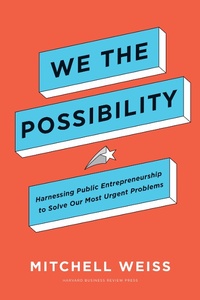
We the Possibility
Description

Can we solve big public problems anymore? Yes, we can. This provocative and inspiring book points the way.
The huge challenges we face are daunting indeed: climate change, crumbling infrastructure, declining public education and social services. At the same time, we've come to accept the sad notion that government can't do new things or solve tough problems—it's too big, too slow, and mired in bureaucracy.
Not so, says former public official, now Harvard Business School professor, Mitchell Weiss. The truth is, entrepreneurial spirit and savvy in government are growing, transforming the public sector's response to big problems at all levels. The key, Weiss argues, is a shift from a mindset of Probability Government—overly focused on safe solutions and mimicking so-called best practices—to Possibility Government. This means public leadership and management that's willing to boldly imagine new possibilities and to experiment.
Weiss shares the three basic tenets of this new way of governing:
- Government that can imagine: Seeing problems as opportunities and involving citizens in designing solutions
- Government that can try new things: Testing and experimentation as a regular part of solving public problems
- Government that can scale: Harnessing platform techniques for innovation and growth
The lessons unfold in the timely episodes Weiss has seen and studied: the US Special Operations Command prototyping of a hoverboard for chasing pirates; a heroin hackathon in opioid-ravaged Cincinnati; a series of experiments in Singapore to rein in Covid-19; among many others.
At a crucial moment in the evolution of government's role in our society, We the Possibility provides inspiration and a positive model, along with crucial guardrails, to help shape progress for generations to come.
More details
Other editions
Additional editions
Person
Mitchell Weiss is a Professor of Management Practice and the Richard L. Menschel Faculty Fellow at Harvard Business School. He created and teaches the school's course on public entrepreneurship. Prior to joining HBS in 2014, Weiss was chief of staff to Boston's Mayor Thomas Menino. During this time, he cofounded the Mayor's Office of New Urban Mechanics.
You can find Mitchell Weiss at:
hbs.edu/faculty/Pages/profile.aspx?facId=183463
Twitter: twitter.com/mitchwei?lang=en
LinkedIn: linkedin.com/in/mitchellbweiss/
Content
- Intro
- Contents
- Introduction
- Part 1: Govenment That Can Imagine
- Ch. 1: Problems as Opportunities
- Ch. 2: Reach Out to Reach Up
- Revisiting Part 1: Government That Can Imagine
- Part 2: Government That Can Try New Things
- Ch. 3: Experimenting in Public
- Ch. 4: Regulating the Future
- Revisiting Part 2: Government That Can Try New Things
- Part 3: Governemnt That Can Scale
- Ch. 5: Government as a Platform
- Ch. 6: Trisector Entrepreneurs
- Ch. 7: Inventing Democracy
- Revisiting Part 3: Government That Can Scale
- Part 4: We Get the Government We Invent
- Ch. 8: Possibility or Delusion
- Ch. 9: Helping Time
- Notes
- Index
- Acknowledgments
- About the Author
