

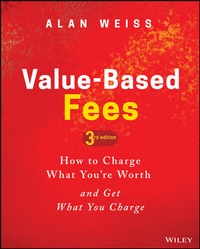
Value-Based Fees
Description

In the newly revised Third Edition of Value-Based Fees: How to Charge - and Get - What You're Worth, best-selling author, speaker and renowned consultant Dr. Alan Weiss delivers a thoroughly updated guide to proposing, and receiving, consistently high fees that are based on the value you deliver to each client you serve.
The author walks you through the many reasons that time-and-materials pricing models are outdated and inadequate and how to convert existing clients to your new value-based fee model. He also discusses fundamental new developments in consulting, including the remote delivery of services, the waning market power of the consulting giants, economic globalization, and the shift from project work to advisory work.
Among the step-by-step techniques and strategies provided in the book, you'll find:
* How to establish value-based fees, including determining your unique value and creating a "good deal" dynamic
* How to create, capitalize on, and market to trusted advisor relationships
* How to implement fee increases immediately, prevent and rebut fee objections, create consulting products, and explore lucrative new fields
Perfect for newcomers to the consulting field as well as time-tested veterans, Value-Based Fees is an indispensable guide for every solo consultant, entrepreneur, and small consulting firm.
More details
Other editions
Additional editions
Person
ALAN WEISS, PHD, the "Rock Star of Consulting," is one of the world's most successful solo consultants. A bestselling author and speaker, he runs Summit Consulting Group, Inc., which serves some of the most recognizable brands in the world, including Merck, Hewlett-Packard, GE, and Mercedes-Benz.
Content
Introduction
Acknowledgments
About the Author
add space here
CHAPTER 1 The Origins of Value
What People Want Is Not as Important as What They Need
Abundance Agriculture and the Arts
The Abundance Mind-Set
Why Your Presence Isn't Required
The Importance of Buyer Commitment, Not Compliance
Critical Steps for Buyer Commitment
The Buoyancy of Brands: How Brands Help Fees
Creating Shared Success
Chapter ROI
CHAPTER 2 The Lunacy of Time-and-Materials Models
Who Wants to Be as Dumb as a Lawyer?
Supply-and-Demand Illogic
Ethical Conflicts of Interest and Other Minor Matters
Limiting Profits, or Why Not Just Forget Domani?
Why Lawyers and CPAs Do So Poorly
Educating the Buyer Incorrectly
The Mercedes-Benz Syndrome
Chapter ROI
CHAPTER 3 The Basics of Value-Based Fees
It's Better to Be an Artist Than to Be an Engineer
Focusing on Outcomes, Not Inputs
The Fallacy and Subversive Nature of "Deliverables"
Quantitative and Qualitative Measures and Criteria
Measuring the Unmeasurable
Serving the Client's Self-Interest
The Subtle Transformation: Consultant Past to Client Future
Perpetual Motion, Perpetual Progress
Chapter ROI
CHAPTER 4 How to Establish Value-Based Fees
If You Read Only One Chapter . . .
Conceptual Agreement: The Foundation of Value
Establishing Your Unique Value
Creating the "Good Deal" Dynamic
The Incredibly Powerful "Choice of Yeses"
Some Formulas for the Faint of Heart
Chapter ROI
CHAPTER 5 How to Convert Existing Clients
Be Passionate, Not Zealous
The Litmus Test-Setting Priorities
Offering New Value
Finding New Buyers Within Existing Clients
Finding New Circumstances
The Resistance
Abandoning Business
Chapter ROI
Interlude: The Case of the Loaded Loading Dock
CHAPTER 6 The Sublime Nature of Trusted Advisor Relationships
It's Just the Smarts, Stupid
Optimal Conditions for Trusted Advisor Relationships
Choosing Time Frames and Creating Realistic Expectations
Organizing the Scope and Managing Projects Concurrent with the Retainer
Capitalizing on Trusted Advisor Relationships
Aggressively Marketing trusted advisor Relationships
Chapter ROI
Ethics and Fees, Fees and Ethics: A Mid-Book Practicum
CHAPTER 7 Seventy Ways to Raise Fees and/or Increase Profits Immediately
Act Today and Receive a Second Bass-o-Matic Free of Charge!
Chapter ROI
CHAPTER 8 How to Prevent and Rebut Fee Objections
Since You've Heard Them All Before, How Can You Not Know All the Answers?
The Four Fundamental Areas of Resistance
Maintaining the Focus on Value
Boring In on the Subject
Offering Discounts
Full Payment in Advance
Using "Smack to the Head" Comparisons
Chapter ROI
CHAPTER 9 Setting Fees for Everything Else
How to Make Money While You Sleep, Eat, Play, and Make Money Elsewhere
Keynote Speaking: Don't Charge for Your Spoken Words
Products
Exploring New, Lucrative Fields
And Now for Some Perspective
Chapter ROI
CHAPTER 10 Fee Progression Strategies
Why You Fall Behind When You Stand Still
Entry-Level Fees
Transition to a "Going Concern"
Transition to Peer-Level Referral
Transition to the Brand Phase
Transition to Thought Leader and Icon
Alan's Axioms for the "Good Deal"
CHAPTER 11 Volatility Opportunity
Value-Based Fees in Times of Turmoil and Crisis
Value Doesn't Dissipate Due to Distance
We Don't Have Time, We Don't Have Money
How Can I Help You?
I Need Your Guidance
APPENDIX A: Questions for Qualifying the Economic Buyer
APPENDIX B: Questions for Establishing Business Objectives
APPENDIX C: Questions for Establishing Measures of Success
APPENDIX D: Questions for Establishing Value
APPENDIX E: Questions for Assessing Personal Value Contribution
APPENDIX F: The Difference Between Inputs and Business Outputs
Index
CHAPTER 1
The Origins of Value: What People Want Is Not as Important as What They Need
ABUNDANCE AGRICULTURE AND THE ARTS
Somewhere in the mid-eighteenth century, agricultural production exceeded population growth, meaning that surplus farming could replace subsistence farming in many places. The farmer could therefore barter crops in exchange for someone to repair fences, tutor the children, or sing in the evening.
Thus, "value" became highly important. Was someone who planted crops more valuable than someone who tended the animals? Was a plow horse more valuable than a new roof? Could some of the children be released from sunup-to-sundown chores by employing others, perhaps even sending them to school, or the priesthood, or the military, or a convent?
And I'm quite sure that about 200,000 years ago one of our forebears exchanged some flints or arrowheads he had prepared in exchange for a mastodon steak or some hide for clothing. The two parties involved somehow reached an agreement about the value of the transaction and the worth of the services or products.
"Value" represents worth, usefulness, importance, good stuff like that. A "fee" is equitable compensation paid in return for a desired service or product.
Questions? Simple, right?
I was the keynoter at a convention once where a participant in the audience told me that he could make more by billing hourly for his time than anyone could basing fees on value. I laughed and walked away. This isn't a shade of grey, or a debate, or philosophic point. He was denying the existence of gravity or oxygen.
Alanism: Logic encourages thought, emotion urges action.
When retailers find sales declining, the smarter ones raise prices, they don't engage in desperation sales. Buyers are willing to pay the higher prices when they perceive those prices denote higher value.
People believe they get what they pay for; otherwise no one would buy a Brioni suit, or a Bentley car, or a Breitling watch. Now, you don't need Brioni, Bentley, or Breitling for attire, transportation, or the time of day. But they do fulfill certain ego needs, certain emotional desires. Nothing wrong with that.
Logic makes people think, but emotion makes them act. When I was confronted with the need for a wrench, sending me to the unfamiliar hardware store, I found three wrenches, all alike, at three different prices. I chose the most expensive on the "emotional" basis that it was probably made from better materials (I had zero evidence of that). Some people will buy a brand name they recognize on that same basis, which is why we'll focus on the relationship between fees and brands later in the book.
When a woman asked me in 1985 if I'd like to have one of the very first car phones in New England (the last four digits were 2468 at my request), I didn't do a cost analysis or ask for references; I told her to get over to my place and I'd cancel my afternoon appointments. Ego needs are quite legitimate and very powerful buying catalysts. Today I carry the latest iPhone in my pocket; it works through my car's sound system (but I wouldn't mind looking into a mastodon steak if possible).
At some point, of course, there was the question of how many days, how much time, how much presence was required, and time became a measurement of value. Yet it's interesting that a field hand might have been paid by the day or a teacher by the lesson, but the great artists were paid by results. Michelangelo, da Vinci, Beethoven, and Mozart were commissioned to create works of art, not to work by the day or to be "present." Some of these works took years and there were vast gaps between the commission and the fulfillment thereof. Da Vinci was famous for lugging works around with him that were in various stages of completion, including the Mona Lisa. Michelangelo required four years to complete the ceiling of the Sistine Chapel, despite the imprecations of Pope Julius who, understandably, wanted to see it in his lifetime.
For our purposes here, and for your purposes in terms of future success, "value" pertains to the quality and power of the results delivered. There is no value in a training program, a book, a focus group, a strategy session, a coaching engagement, unless there is a demonstrable tangible and/or intangible result of quality and pragmatic application. By "intangible" I refer to ego fulfillment, aesthetics, comfort, security, and so forth. Not all value is monetized, and in fact some of the greatest value is intangible, such as an improvement in self-esteem or closer relationships and intimacy.
As we continue, please bear in mind that this type of thinking is a question of "mind-set." You have to believe that the result is the key, and not arbitrary "deliverables," those darlings of the human resource crowd, or the time required. Cole Porter, Salvatore Dali, Thomas Alva Edison never worried about the time required to create value.
However, there is a second aspect about this mind-set that is overarching: Charging by a time unit is unethical.
I mean that as harshly as it's written. I read a piece on social media while writing this book from an Australian accountant who pointed out that if you charge by the hour (as most accountants still do) you "run the risk of cheating yourself of greater income." What he meant is that if you're good and fast, an advantage to your client, you get paid less. If you're slow and inept, a disadvantage to your client, you can make a lot more money.
This is the inherent unequivocal problem with fees based on time units or "showing up": They abuse your client relationship or they undermine your ability to earn money. Every client deserves fast and quality results, and every professional services provider deserves equitable compensation based on the results they create.
I don't believe anyone ever asked Picasso how long it took to paint Guernica. Some expert valuations place it at a worth of $200 million. That is not a typo. At a $1,000 an hour, an incalculable fortune in Picasso's time, he'd need 200,000 hours to equal the $200 million price by the hour. That's about 22 years. He lived to 91, so perhaps working round-the-clock he might have done it.
That agricultural transformation, as well as ego fulfillment and including great results not based on time, are a function of an abundance mind-set.
THE ABUNDANCE MIND-SET
It's insufficient to possess abundance. One must be willing to use it. We must move from a poverty and scarcity mentality to an abundance mentality. If the farmer with a surplus decided it was best to keep it and protect it for that proverbial "rainy day," there would be nothing with which to pay for a tutor or fence repair. And some people, no matter what their income or savings or prospects, act as if they're poor.
You've all seen this: the otherwise successful people who never pick up a check, who take modest vacations, who have ten-year-old cars, whose houses need maintenance. These are people continually asking if they "really" need something as an excuse not to spend money on an acquisition. We've all seen elderly people who have ardently saved through their lives only to lose it all in a health crisis or scam.1
I once asked a group of coaching clients at an event what they would do if they unexpectedly gained $600,000 via a client request for work, or a lottery winning, or an inheritance. Most spoke of partial savings, some philanthropy, some personal acquisitions, vacations, and so on. But one woman said to me, "I wouldn't touch a cent of it, it would sit in the bank!"2
Thus, we experience people with significant growth and prosperity who continue to act as if they were desperately trying to gain a foothold, to keep their heads above water. I call the need to change based on true prosperity securing the "watertight doors."
Figure 1.1 The Watertight Doors
In Figure 1.1 you can see the progression from trying to survive, to being "alive," to having "arrived," and finally to thrive. Survival takes pressure off, then "alive" means you have a "going concern," as the accountants like to say. "Arrive" denotes a brand and recognition within your field, with unsolicited referrals coming your way. And "thrive" is the expert and thought leader, one who sets the paces and is used as a reference point for excellence.
The problem is that many people to the right of my chart still act as though they're on the left, never having been able to abandon old habits and old friends. To transit from left to right, we must be willing to change our beliefs, friends, image, self-talk, expectations, affiliations, and so forth. That's the only way to create "watertight" doors that don't permit us to slide back.
I talk to people too often who tell me in the same sentence that they're having their best year ever but can't afford to invest in their own self-development, or give to charity, or take an unexpected vacation. You may see this as hypocrisy, but I see it as an inability to leave a poverty mentality that enabled them to survive but not enjoy...
