

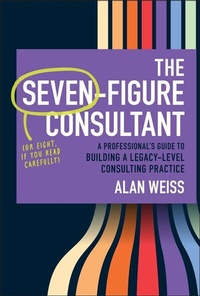
The Seven-Figure Consultant
Description

A proven, step-by-step guide to building a lucrative consulting practice and the mindset that goes with it
In The Seven-Figure Consultant: A Professional's Guide to Building a Legacy-Level Consulting Practice, rockstar of consulting and renowned author Alan Weiss, delivers a hyper-focused, step-by-step guide to using your consulting skillset to build the lifestyle you've always wanted. Weiss walks you through his eye-opening perspective on what it really means to be "wealthy" (spoiler: it's about time, not dollars and cents) and how to achieve that wealth.
The book explains the on-the-ground realities of building a consulting service that grows sustainably and brings in the fees you need to live your life to its fullest. You'll learn how to frame your value proposition, how to sell yourself as a true expert, and how to walk the tightrope that lies between arrogance and confidence. You'll also find practical tools for how to engage with the latest AI tech, how to write a proposal that gets accepted every time, and how to track your most important metric: labor intensity.
Inside the book:
- Key strategies on marketing your practice, including the six options for exponential growth that work at any level
- A revealing collection of interviews and commentary from seven-figure solo consultants who have mastered their industries
- The proper place of social media within your consulting practice, its benefits, and its unavoidable limitations
The Seven-Figure Consultant is a granular, first-hand look at building a successful consulting practice by an author who has done it himself. But it's also a mindset, one that correctly identifies "real wealth" as the time you're able to make for-and spend on-yourself, and the people you care about the most. Weiss explains how to build both, one step at a time.
More details
Other editions
Additional editions
Person
ALAN WEISS, PHD, is a bestselling author, speaker, and independent consultant. He has advised clients such as Merck, Hewlett-Packard, GE, and Mercedes-Benz. He's a frequent keynote speaker at major conferences and former visiting faculty member at several universities and has written more than 500 articles and 54 books. Weiss's work appears in the curricula of major universities and has been translated into 15 languages.
Content
Preface xi
other Works by Alan Weiss xiii
Introduction: The "Ancients" xvii
1 The No Normal ® 1
Being patient until there is a "return to normal" or a "new normal" is like waiting for Godot. We have to act based on constant change created by a seismic shift in demographics, a historical tectonic change in technology, and constant change in social mores. Beside, "normal" means "average" or "typical." Is that who you want to be?
Gaining Conceptual Agreement 3
Lean and Mean: Don't Feed the "Chicks" 6
Scalability 9
The Remote (Seven-Figure) Consultant 13
2 The Reality of "Wealth" 17
A "million dollars" is a metaphor. Discretionary time is a reality. Too many people are refugees from corporate work who have "gone out on their own" and now have a tyrannical, tougher boss. Using money as a metric will only make you want more and more while working harder and harder. Is your idle really Scrooge McDuck?
Value-Based Fees 19
Fee Formulas (Clients, Collaborators, Referrals) 22
Advisory Work Is the Future 30
Legal, Financial, Administration (yada yada yada) 33
3 Whom Do You Want to Be? 37
Ask a hundred people who they want to be in a year and 100 percent will tell you what they want to be doing. The real issue is what you want to be contributing, how to continually raise your value, and how to manifest it.
No Wind Is a Good Wind Without a Destination 39
Your Value Proposition 42
The Power of Solo 45
Who's Pushing Your Buttons? 49
4 You're an Expert Now, So Act Like One 53
Eschew the "consultant/coach/trainer/speaker" commodity traps and position yourself as an expert who can help others in a wide variety of ways. People may "want" a coach, but what they "need" is improved behavior. They may "want" strategy, but what they really seek is market domination.
Thought Leadership 55
Process vs. Content 58
Critical Thinking Skills 62
You're Not Selling, You're Giving 66
5 If You Don't Blow Your Own Horn, There Is No Music 71
A brand is how people think about you when you're not around. Your most potent brand is your name. You need to identify your particular "public square" and become the person who must be seen by others to move forward.
How to Build and Sustain Your Business Community 73
How to Maximize Referrals and Reduce Costs of Acquisition 76
Skating Up to the Confidence/ Arrogance Boundary 79
6 Naisbitt Was Right 87
AI won't take over the world but you'll be lost in the world if you don't intelligently utilize it and learn to employ it to help your clients. The "high tech/high touch" equation is more important than ever, and YOU are the high touch who must understand the high tech.
Consulting Isn't Advising, Which Isn't Coaching, Either 89
The Uses and Limits of Social Media 92
How Executives and Business Owners
Really Make Decisions 95
Better Practices in AI and Technology 99
7 Watch Your Metrics 103
Growth isn't the point. Profitable growth is the point. Higher revenues are pointless unless you also strive for reduced labor intensity. It doesn't matter what others are doing, what matters is whether you are achieving your life goals.
TDTC (Total Days to Cash) 105
How to Write a Proposal That's Accepted Every Time 108
Letters of Agreement 113
How to Reduce Labor Intensity 115
8 Marketing 601 119
The six options for exponential growth at any level (one is mandatory, the other five represent options you select). How to use disruption and volatility as offensive weapons to dominate your field. Generalizing vs. specializing: Do you want to dig with an excavator or a pair of tweezers?
My Unified Field Theory of Marketing 121
Passive Income 126
Collaborations 130
9 The Esteem Machine 141
How to constantly build resilience and momentum and avoid guilt, fear, and stress. Why social media, and people telling you how good you are, will sink you. How to see daily opportunity and not a long, slowcrawl through enemy territory.
Self-Worth 143
Servant Leadership Is Ridiculous 146
Peter Drucker Didn't Debate, Neither Should You 150
Maybe There Was a Monster Under the Bed 154
10 Eight-Figure Consulting 157
Establishing what you really need to become who you want to be. Picasso's advice on the matter. What's beyond "success" and what happens when you exceed your own aspirations. Join six of my all- stars and me who will tell you what we know.
Cutting the Gordian Knot 159
From Those Who Have Been There and Done That 161
Appendix 169
Acknowledgment 201
About the Author 203
Index 207
Chapter 1
The No Normal®
Being patient until there is a "return to normal" or a "new normal" is like waiting for Godot. It's a long play with no point. We have to act based on constant change created by a seismic shift in demographics, a historical tectonic change in technology, and constant adjustments in social mores. Besides, "normal" means "average" or "typical." Is that who you want to be?
Gaining Conceptual Agreement
We often make the mistake of charging ahead looking for a "sale" instead of taking our time and creating agreement on value.
Alanism: Don't try to "increase fees." If you want higher fees, increase value.
Conceptual agreement is the focus on gaining buy-in-commitment-from an economic buyer by establishing:
- Objectives: What business outcomes are to be gained by this relationship? This is never strictly internal, such as:
- Create alignment between departments
- Enhance communications flow
- Raise levels of empathy
- Maintain cordial relationships and avoid confrontation
These are all "HR"1 kinds of objectives, which serve no business interest. Note that they can all be achieved without any demonstrable improvement in the business, and perhaps with actual declines in performance.
Business-oriented outcomes would include:
- Decrease involuntary attrition
- Increase referral business
- Decrease labor intensity
- Improve cross-selling of products and services
All of those can be measured and can have monetized value attached to them. We'll get to that in a few minutes. For now, understand that something like "improve profit" has copious potential, because if you improve profit you can:
- Increase salaries and bonuses
- Retire debt
- Provide better investor ROI (return on investment)
- Improve facilities
- Make more hires
- Increase technology and automation
You get the idea. True business outcomes leave the business in far better shape if met, and exceeded. The "no normal" means that getting one's "ticket stamped" by attending training programs with no measurable effect on productivity or performance is gone with the dodo birds.
The next step in conceptual agreement is "metrics." These are measures of success along the way, and/or at completion. The buyer may have existing devices (turnover reports, monthly income, sales by product, average price or fee, and so forth). The buyer may not have such resources, and will ask your opinion as to how to measure progress. This is still more value that you're providing (as well as the metrics for your own success).
Finally, we have "value." This is the actual benefit to the buyer. There are qualitative values (I no longer will have to play the role of "referee" for warring teams) and quantitative values (reducing attrition by five percent would save us an average of $120,000 per person, five percent of 100 is five, times $120,000 is $600,000).
Guidelines for conceptual agreement:
- Must be done with involvement of, and agreement from, the economic buyer.
- Try to create three items of value for each objective to be met.
- Try to monetize two-thirds of the total value statements.
Since you'll be assuring the buyer of a 10:1 ROI, you want to make the monetized value as significant as possible, but still conservative. If the buyer says the saving will be $250,000-$350,000, or five percent to eight percent, cite the $250,000 and five percent to demonstrate you've taken the more conservative estimate each time.
Finally, on qualitative objectives, just ask, without a monetization attempt, about the value of getting home at dinner time, or seeing the kids' sports events, or alleviating stress, or better relationships with board members.
Alanism: Behind every professional objective is one or more personal objectives.
The No Normal means not discussing deliverables, or programs, or methodology, but rather what you create to improve the buyer's position.
Lean and Mean: Don't Feed the "Chicks"
Counterintuitively, if you want to move toward (and even beyond) seven figures, you want to be careful about not adding unnecessary overhead. Since I first began in the early 1990s writing about high-growth consulting strategies it's become apparent that adding staff tends to decrease revenues and margins.
Alanism: "Growth" is not the point, PROFITABLE growth is the point.
One of my all-star clients, who eventually sold her boutique consulting firm and is now playing golf, said in one of our small group meetings that she dreaded returning from traveling and finding all the "chicks" in the corporate nest chirping and waiting for her to regurgitate food. That was a visual never lost on anyone who heard it!
Even with the boutique firm owners I've coached, we focused on reducing staff, both professionally and personally. I've never known why someone who is making $250,000 a year requires a $30,000 virtual assistant! Have they failed to learn how to use a smartphone or a Filofax®? In most cases I've reduced staff for my clients from 30 to under 10, and often to zero.
But what about most of you, who are solo practitioners? How do you keep control of overhead, which kills small practices?
Vignette
When I was fired from the presidency of a consulting firm I told my wife I would never work for any moron who could fire me again. She said, "Okay, but you'd better get serious! What's the first thing you're going to do?"
"Rent an office," I said.
"Why?" she asked, "you're going to visit prospects to sell and clients to implement; they're not going to be coming to you. If I'm wrong about that, then we should discuss an office."
Forty years later, I've never had an office. My two kids went through private schools from pre-school through undergraduate.2 Those two 17-year experiences cost about $450,000, in total, which I paid out of cash flow. I calculated that a single office over that period, with rent, insurance, utilities, taxes, a secretary, repairs and so forth, would have cost, wait for it . about $450,000!
Lean and mean is the way to go, right into and through seven figures in revenue. That's how you create profitable growth.
Here are some items and resources you don't need or should have on a "pay for play" (outsourced) basis:
- Bookkeeper paid by the hour
- Tax accountants paid by the hour
- Legal help paid by the hour
- Answering service rather than part-time assistants
- Use American Express as your travel agent
- Use a franchise printer who prints on demand
- Use AI or a student to create your art work
- Use automated schedulers
- Keep your software and hardware simple-you don't need three cameras and seven lights for Zoom
- Don't chase shiny objects; you don't need every new iPhone
Don't allow your ego to determine your overhead. One mistake I made was to call my legal structure "Summit Consulting Group, Inc." with the intent of demonstrating "heft." When people asked how many were in the "group," I tap danced inanely talking about subcontractors and part-timers, which is like telling GM you know the auto business because you drive a car.
Don't rationalize growth with numbers of people. What really matters is your brand power, which we'll talk about later.
Vignette
I had a client named Phil who had four employees whom he strived to keep busy delivering projects. Phil traveled 80 percent of the time, often on weekends. He was the rainmaker for the implementers, and taking far less out of his company for his family than he should have.
At one point I hadn't heard from him in a month, so I called, and his wife told me that he had died of a heart attack alone in a Marriott Hotel in another city.
You won't get rich working for someone else and you won't get rich with people working for you.
Alanism: True wealth is discretionary time.
Scalability
One of the most significant advantages of the internet and AI is the ability to quickly scale your operation, without resorting to more people and expense. For our purposes, let's define "scalability" as the capacity to leverage more contacts with more buyers.
For most of you reading this, your key marketing challenge isn't lack of market need, or competence, or passion, which are illustrated in Figure 1.1:
- Market Need: Our ability to identify or, even better, create need and not merely satisfy "wants" for clients and prospects.
- Competence: Our ability to meet those needs and fulfill client expectations.
Figure 1.1 Three Dynamics in...
