

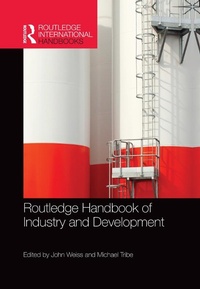
Routledge Handbook of Industry and Development
Published on 16. September 2015
446 pages
978-1-136-69885-9 (ISBN)
Description

The Routledge Handbook of Industry and Development is a global overview of industrialisation. Each chapter will provide readers with contemporary insights into this this essential aspect of economic development.
Industrialisation has been at the forefront of discussion on economic development since the earliest days of development economics. But over the last fifty years, the manufacturing sectors of different countries and regions have grown at strikingly different rates. In 1960 developing countries took a very small share of global manufacturing production. Today the position had changed radically with fast growth of manufacturing in many parts of what was originally the developing world, particularly in China and the rest of East Asia. On the other hand, countries in Africa and parts of Latin America have been largely left behind by this process of industrialisation. This volume aims to illuminate this uneven development and takes stock of the current issues that hinder and support industrialisation in low and middle income economies.
This Handbook is a collection of chapters on different aspects of industrialisation experience in a range of countries. Key themes include, the role of manufacturing in growth, the nature of structural change at different stages of development, the role of manufacturing in employment creation, alternative options for trade and industrial policy, the key role of technology and technical change, and the impact of globalisation and the spread of global value chains and foreign direct investment on prospects for industrialisation. Several chapters discuss individual country experiences with examples from India, Mexico, South Africa and Tanzania, as well as an overview of African industrialisation.
This authoritative Handbook will be a key reference source for those studying or wishing to understand contemporary economic development. Offering inspiration and direction for future research, this landmark volume will be of crucial importance to all development economics scholars and researchers.
Industrialisation has been at the forefront of discussion on economic development since the earliest days of development economics. But over the last fifty years, the manufacturing sectors of different countries and regions have grown at strikingly different rates. In 1960 developing countries took a very small share of global manufacturing production. Today the position had changed radically with fast growth of manufacturing in many parts of what was originally the developing world, particularly in China and the rest of East Asia. On the other hand, countries in Africa and parts of Latin America have been largely left behind by this process of industrialisation. This volume aims to illuminate this uneven development and takes stock of the current issues that hinder and support industrialisation in low and middle income economies.
This Handbook is a collection of chapters on different aspects of industrialisation experience in a range of countries. Key themes include, the role of manufacturing in growth, the nature of structural change at different stages of development, the role of manufacturing in employment creation, alternative options for trade and industrial policy, the key role of technology and technical change, and the impact of globalisation and the spread of global value chains and foreign direct investment on prospects for industrialisation. Several chapters discuss individual country experiences with examples from India, Mexico, South Africa and Tanzania, as well as an overview of African industrialisation.
This authoritative Handbook will be a key reference source for those studying or wishing to understand contemporary economic development. Offering inspiration and direction for future research, this landmark volume will be of crucial importance to all development economics scholars and researchers.
Reviews / Votes
'It is good news that Michael Tribe and John Weiss, both noted experts on the subject of Industrialization, have edited a wide-ranging handbook of contributions on the topic. They have supplemented the papers with a splendid Introduction that adds further to the value of the book. I recommend it highly.' - Professor John Toye, Chair of the Advisory Panel of the Department of International Development, University of Oxford, UK'This handbook is an invaluable resource for researchers and policy makers with an interest in industrialization and economic development. It provides a comprehensive overview of the relevant issues and debates, with contributions written by some of the best authors in the field.' - Adam Szirmai, UNU-MERIT/Maastricht University, The Netherlands
More details
Series
Language
English
Place of publication
London
United Kingdom
Publishing group
Taylor & Francis Ltd
Target group
College/higher education
Illustrations
62 s/w Abbildungen, 64 s/w Tabellen, 62 s/w Zeichnungen
64 Tables, black and white; 62 Line drawings, black and white; 62 Illustrations, black and white
File size
5,38 MB
ISBN-13
978-1-136-69885-9 (9781136698859)
Copyright in bibliographic data and cover images is held by Nielsen Book Services Limited or by the publishers or by their respective licensors: all rights reserved.
Schweitzer Classification
Other editions
Additional editions
John Weiss | Michael Tribe
Routledge Handbook of Industry and Development
Book
12/2019
1st Edition
Routledge
€56.98
Shipment within 15-20 days
John Weiss | Michael Tribe
Routledge Handbook of Industry and Development
Book
09/2015
1st Edition
Routledge
€327.10
Shipment within 15-20 days
Persons
John Weiss is Emeritus Professor of Development Economics, University of Bradford, UK.
Michael Tribe is Honorary Lecturer, Department of Economics, University of Strathclyde, UK.
Michael Tribe is Honorary Lecturer, Department of Economics, University of Strathclyde, UK.
Content
Editorial Introduction 2. Manufacturing as an Engine of Growth 3. Patterns of Structural Change and Manufacturing Development 4. Patterns of Structural Change in Developing Countries 5. Industry, Employment and Poverty 6. Deindustrialisation: An Issue for both Developed and Developing Countries 7. What Role for Small Enterprises? Industrial Clusters, Industrial Policy and Poverty Reduction 8. Industrial Policy: Back on the Agenda 9. Import Substituting Industrialisation (ISI): Can or Should We Divorce Industrialisation and Trade Strategies? 10. New Directions of Foreign Direct Investment and Industrial Development 11. Global Value Chains in Manufacturing Industry: Where they came from, Where they are going and Why this is important 12. Electronics and Global Value Chains 13. Global Value Chains in Apparel: Still a Path for Industrial Development? 14. The Role of Special Economic Zones in Manufacturing Development in sub-Saharan Africa: Structural Transformation and Employment Creation 15. International Competitiveness in Manufacturing and the China effect 16. Is the choice of technique debate still relevant? 17. Technological Learning in Developing Counties 18. Mexico's New Industrial Organisation since the 1980s: Glocal Challenges from Export-orientation and Polarisation 19. Industrial development in India 20. Is there an Africa problem? 21. Industrial development in Tanzania 22. Manufacturing in Post-Apartheid South Africa: Performance and Policy
