

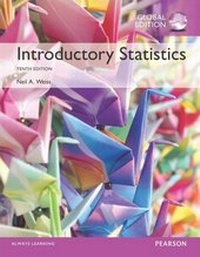
Introductory Statistics, eBook, Global Edition
Description

For one- or two-semester courses in Introductory Statistics.
Statistically significant
Introductory Statistics MyLab Revision, 10th Edition, Global Edition is ideal for introductory statistics classes that emphasize statistical reasoning and critical thinking. Weiss's meticulous and comprehensive coverage includes careful, detailed explanations to ease the learning process. With more than 1,000 data sets and over 3,000 exercises, this text takes a data-driven approach that encourages students to apply their knowledge and develop statistical understanding.
Weiss offers a parallel presentation of critical-value and P-value approaches to hypothesis testing. This unique design allows the flexibility to concentrate on one approach or the opportunity for greater depth in comparing the two.
All prices
More details
Other editions
Additional editions
Person
The late Neil A. Weiss received his Ph.D. from UCLA and subsequently accepted an assistant professor position at Arizona State University (ASU), where he was ultimately promoted to the rank of full professor. Dr. Weiss taught statistics, probability, and mathematics, from the freshman level to the advanced graduate level, for more than 30 years.
In recognition of his excellence in teaching, Dr. Weiss received the Dean's Quality Teaching Award from the ASU College of Liberal Arts and Sciences. He also was runner-up twice for the Charles Wexler Teaching Award in the ASU School of Mathematical and Statistical Sciences. Dr. Weiss's comprehensive knowledge and experience ensure that his texts are mathematically and statistically accurate, as well as pedagogically sound.
In addition to his numerous research publications, Dr. Weiss was the author of A Course in Probability (Addison-Wesley, 2006). He also authored or coauthored books in finite mathematics, statistics and real analysis. His texts, well known for their precision, readability and pedagogical excellence, are used worldwide.
Dr. Weiss was a pioneer of the integration of statistical software into textbooks and the classroom, first providing such integration in the book Introductory Statistics (AddisonWesley,1982). Since this first publication, Neil Weiss's work continues to inspire future statisticians and current students of statistics alike.
Content
* Indicates optional material.
** Indicates optional material on the WeissStats site.
PART I: INTRODUCTION- 1. The Nature of Statistics
- Case Study: Top Films of All Time
- 1.1 Statistics Basics
- 1.2 Simple Random Sampling
- 1.3 Other Sampling Designs*
- 1.4 Experimental Designs*
- Chapter in Review
- Review Problems
- Focusing on Data Analysis
- Case Study Discussion
- Biography
- 2. Organizing Data
- Case Study: World's Richest People
- 2.1 Variables and Data
- 2.2 Organizing Qualitative Data
- 2.3 Organizing Quantitative Data
- 2.4 Distribution Shapes
- 2.5 Misleading Graphs*
- Chapter in Review
- Review Problems
- Focusing on Data Analysis
- Case Study Discussion
- Biography
- 3. Descriptive Measures
- Case Study: The Beatles' Song Length
- 3.1 Measures of Center
- 3.2 Measures of Variation
- 3.3 Chebyshev's Rule and the Empirical Rule*
- 3.4 The Five-Number Summary; Boxplots
- 3.5 Descriptive Measures for Populations; Use of Samples
- Chapter in Review
- Review Problems
- Focusing on Data
- Analysis
- Case Study Discussion
- Biography
- 4. Probability Concepts
- Case Study: Texas Hold'em
- 4.1 Probability Basics
- 4.2 Events
- 4.3 Some Rules of Probability
- 4.4 Contingency Tables; Joint and Marginal Probabilities*
- 4.5 Conditional Probability*
- 4.6 The Multiplication Rule; Independence*
- 4.7 Bayes's Rule*
- 4.8 Counting Rules*
- Chapter in Review
- Review Problems
- Focusing on Data Analysis
- Case Study Discussion
- Biography
- 5. Discrete Random Variables*
- Case Study: Aces Wild on the Sixth at Oak Hill
- 5.1 Discrete Random Variables and Probability Distributions*
- 5.2 The Mean and Standard Deviation of a Discrete Random Variable*
- 5.3 The Binomial Distribution*
- 5.4 The Poisson Distribution*
- Chapter in Review
- Review Problems
- Focusing on Data Analysis
- Case Study Discussion
- Biography
- 6. The Normal Distribution
- Case Study: Chest Sizes of Scottish Militiamen
- 6.1 Introducing Normally Distributed Variables
- 6.2 Areas under the Standard Normal Curve
- 6.3 Working with Normally Distributed Variables
- 6.4 Assessing Normality; Normal Probability Plots
- 6.5 Normal Approximation to the Binomial Distribution*
- Chapter in Review
- Review Problems
- Focusing on Data Analysis
- Case Study Discussion
- Biography
- 7. The Sampling Distribution of the Sample Mean
- Case Study: The Chesapeake and Ohio Freight Study
- 7.1 Sampling Error; the Need for Sampling Distributions
- 7.2 The Mean and Standard Deviation of the Sample Mean
- 7.3 The Sampling Distribution of the Sample Mean
- Chapter in Review
- Review Problems
- Focusing on Data Analysis
- Case Study Discussion
- Biography
- 8. Confidence Intervals for One Population Mean
- Case Study: Bank Robberies: A Statistical Analysis
- 8.1 Estimating a Population Mean
- 8.2 Confidence Intervals for One Population Mean When s Is Known
- 8.3 Confidence Intervals for One Population Mean When s Is Unknown
- Chapter in Review
- Review Problems
- Focusing on Data Analysis
- Case Study Discussion
- Biography
- 9. Hypothesis Tests for One Population Mean
- Case Study: Gender and Sense of Direction
- 9.1 The Nature of Hypothesis Testing
- 9.2 Critical-Value Approach to Hypothesis Testing
- 9.3 P-Value Approach to Hypothesis Testing
- 9.4 Hypothesis Tests for One Population Mean When s Is Known
- 9.5 Hypothesis Tests for One Population Mean When s Is Unknown
- 9.6 The Wilcoxon Signed-Rank Test*
- 9.7 Type II Error Probabilities; Power*
- 9.8 Which Procedure Should Be Used?**
- Chapter in Review
- Review Problems
- Focusing on Data Analysis
- Case Study Discussion
- Biography
- 10. Inferences for Two Population Means
- Case Study: Dexamethasone Therapy and IQ
- 10.1 The Sampling Distribution of the Difference between Two Sample Means for Independent Samples
- 10.2 Inferences for Two Population Means, Using Independent Samples: Standard Deviations Assumed Equal
- 10.3 Inferences for Two Population Means, Using Independent Samples: Standard Deviations Not Assumed Equal
- 10.4 The Mann - Whitney Test*
- 10.5 Inferences for Two Population Means, Using Paired Samples
- 10.6 The Paired Wilcoxon Signed-Rank Test*
- 10.7 Which Procedure Should Be Used?**
- Chapter in Review
- Review Problems
- Focusing on Data Analysis
- Case Study Discussion
- Biography
- 11. Inferences for Population Standard Deviations*
- Case Study: Speaker Woofer Driver Manufacturing
- 11.1 Inferences for One Population Standard Deviation*
- 11.2 Inferences for Two Population Standard Deviations, Using Independent Samples*
- Chapter in Review
- Review Problems
- Focusing on Data Analysis
- Case Study Discussion
- Biography
- 12. Inferences for Population Proportions
- Case Study: Arrested Youths
- 12.1 Confidence Intervals for One Population Proportion
- 12.2 Hypothesis Tests for One Population Proportion
- 12.3 Inferences for Two Population Proportions
- Chapter in Review
- Review Problems
- Focusing on Data Analysis
- Case Study Discussion
- Biography
- 13. Chi-Square Procedures
- Case Study: Eye and Hair Color
- 13.1 The Chi-Square Distribution
- 13.2 Chi-Square Goodness-of-Fit Test
- 13.3 Contingency Tables; Association
- 13.4 Chi-Square Independence Test
- 13.5 Chi-Square Homogeneity Test
- Chapter in Review
- Review Problems
- Focusing on Data Analysis
- Case Study Discussion
- Biography
- 14. Descriptive Methods in Regression and Correlation
- Case Study: Healthcare: Spending and Outcomes
- 14.1 Linear Equations with One Independent Variable
- 14.2 The Regression Equation
- 14.3 The Coefficient of Determination
- 14.4 Linear Correlation
- Chapter in Review
- Review Problems
- Focusing on Data Analysis
- Case Study Discussion
- Biography
- 15. Inferential Methods in Regression and Correlation
- Case Study: Shoe Size and Height
- 15.1 The Regression Model; Analysis of Residuals
- 15.2 Inferences for the Slope of the Population Regression Line
- 15.3 Estimation and Prediction
- 15.4 Inferences in Correlation
- 15.5 Testing for Normality**
- Chapter in Review
- Review Problems
- Focusing on Data Analysis
- Case Study Discussion
- Biography
- 16. Analysis of Variance (ANOVA)
- Case Study: Self-Perception and Physical Activity
- 16.1 The F-Distribution
- 16.2 One-Way ANOVA: The Logic
- 16.3 One-Way ANOVA: The Procedure
- 16.4 Multiple Comparisons*
- 16.5 The Kruskal - Wallis Test*
- Chapter in Review
- Review Problems
- Focusing on Data Analysis
- Case Study Discussion
- Biography
- MODULE A: Multiple Regression Analysis
- Case Study: Automobile Insurance Rates
- A.1 The Multiple Linear Regression Model
- A.2 Estimation of the Regression Parameters
- A.3 Inferences Concerning the Utility of the Regression Model
- A.4 Inferences Concerning the Utility of Particular Predictor Variables
- A.5 Confidence Intervals for Mean Response; Prediction Intervals for Response
- A.6 Checking Model Assumptions and Residual Analysis
- Module in Review
- Review Problems
- Focusing on Data Analysis
- Case Study Discussion
- Answers to Selected Exercises
- Index
- MODULE B: Model Building in Regression
- Case Study: Automobile Insurance Rates Revisited
- B.1 Transformations to Remedy Model Violations
- B.2 Polynomial Regression Model
- B.3 Qualitative Predictor
- B.4 Multicollinearity
- B.5 Model Selection: Stepwise Regression
- B.6 Model Selection: All-Subsets Regression
- B.7 Pitfalls and Warnings
- Module in Review
- Review Problems
- Focusing on Data Analysis
- Case Study Discussion
- Answers to Selected Exercises
- Index
- MODULE C: Design of Experiments and Analysis of Variance
- Case Study: Dental Hygiene: Which Toothbrush?
- C.1 Factorial Designs
- C.2 Two-Way ANOVA: The Logic
- C.3 Two-Way ANOVA: The Procedure
- C.4 Two-Way ANOVA: Multiple Comparisons
- C.5 Randomized Block Designs
- C.6 Randomized Block ANOVA: The Logic
- C.7 Randomized Block ANOVA: The Procedure
- C.8 Randomized Block ANOVA: Multiple Comparisons
- C.9 Friedman's Nonparametric Test for the Randomized Block Design
- Module in Review
- Review Problems
- Focusing on Data Analysis
- Case Study Discussion
- A: Statistical Tables
- B: Answers to Selected Exercises
* Indicates optional material.
** Indicates optional material on the WeissStats site.
