

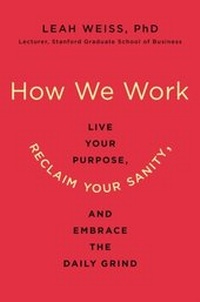
How We Work
Description

?I have long thought that what the Buddha taught can be seen as a highly developed science of mind which, if made more accessible to a lay audience, could benefit many people. I believe that Dr. Weiss's book, in combining such insights with science and good business practice, offers an effective mindfulness based program that many will find helpful.? --His Holiness, the Dalai Lama
A practical guide to bringing our whole selves to our professional work, based on the author's overwhelmingly popular course at the Stanford Graduate School of Business.
In today's workplace, the traditional boundaries between "work" and "personal" are neither realistic nor relevant. From millennials seeking employment in the sharing economy to Gen Xers telecommuting to Baby Boomers creating a meaningful second act, the line that separates who we are from the work we do is blurrier than ever.
The truth is, we don't show up for our jobs as a portion of ourselves?by necessity, we bring both our hearts and our minds to everything we do. In How We Work, mindfulness expert and creator of the perennially-waitlisted Stanford Business School course "Leading with Mindfulness and Compassion" Dr. Leah Weiss explains why this false dichotomy can be destructive to both our mental health and our professional success.
The bad news, says Weiss, is that nothing provides more opportunities for negative emotions?anxiety, anger, envy, fear, and paranoia, to name a few?than the dynamics of the workplace. But the good news is that these feelings matter. How we feel at and about work matters?to ourselves, to the quality of our work, and ultimately to the success of the organizations for which we work.
The path to productivity and success, says Weiss, is not to change jobs, to compartmentalize our feelings, or to create a false "professional" identity?but rather to listen to the wisdom our feelings offer. Using mindfulness techniques, we can learn how to attend to difficult feelings without becoming subsumed by them; we can develop an awareness of our bigger picture goals that orients us and allows us to see purpose in even the most menial tasks. In How We Work, Weiss offers a set of practical, evidence-based strategies for practicing mindfulness in the real world, showing readers not just how to survive another day, but how to use ancient wisdom traditions to sharpen their abilities, enhance their leadership and interpersonal skills, and improve their satisfaction.
Based on years of research and a legendary Stanford course, this guide reveals proven strategies to reclaim your work life:
- Mindfulness at Work: Learn to attend to difficult feelings like anxiety and anger without becoming subsumed by them, turning workplace pressure into a source of strength.
- Purpose in the Workplace: Discover how to find meaning and motivation in every task, connecting your daily efforts to your bigger-picture goals for a more satisfying career.
- Compassionate Leadership: Go beyond the false dichotomy of "work" vs. "personal" to lead with your whole self, enhancing your interpersonal skills and building stronger, more effective teams.
- Soft Skills Development: Move from theory to practice with actionable exercises and techniques developed for the perennially-waitlisted Stanford Business School course.
- Overcoming Burnout: Develop the resilience to handle setbacks, accept negative feedback, and grow from mistakes without the destructive inner critic.
All prices
More details
Other editions
Additional editions
Person
Leah Weiss, PhD, is a researcher, professor, consultant, and author. She teaches courses on compassionate leadership at the Stanford Graduate School of Business and is principal teacher and founding faculty for Stanford's Compassion Cultivation Program, conceived by the Dalai Lama. She also directs Compassion Education and Scholarship at HopeLab, an Omidyar Group research and development nonprofit focused on resilience. She lives in Palo Alto, California with her husband and three children.
