

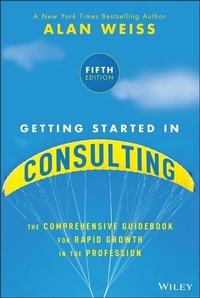
Getting Started in Consulting
Description

The aspiring consultant's blueprint for earning six, seven, or eight figures each year
The Fifth Edition of Getting Started in Consulting is an in-depth guide to succeed as a consultant in today's rapidly changing world and earn six, seven, or eight figures annually. Written by legendary author Alan Weiss, this book provides a roadmap to develop essential personal traits to excel in the industry-high self-esteem, resilience, agility, fearlessness, innovation, language ability, accountability, discipline, and success over perfection-and delivers the marketing and implementation techniques you'll need for rapid success.
The book is divided into three parts-Past, Present, and Future-to enable readers to set a foundation for growth, get the most out of their day-to-day, and anticipate and plan for bigger and better things to come. Readers will find expert insights on how to:
- Talk to anyone at any time (the L-D-R-B method)
- Apply "marketing gravity," close a sale, set fees, and create proposals that are accepted every time
- Create intellectual property and leverage your intellectual capital
- Engage in "shameless self-promotion" effectively and extricate yourself from the crowd and social media
With over 90% new material, this Fifth Edition of Getting Started in Consulting is the lift ticket to get up the mountain-an essential guide for all new consultants looking to learn from one of the greatest minds in the history of the profession.
More details
Other editions
Additional editions
Person
ALAN WEISS, PhD, is a consultant, speaker, and bestselling author. He has the strongest independent consulting brand in the world and he has worked with clients such as Merck, Hewlett-Packard, GE, Mercedes-Benz, and over 500 other leading organizations.
Content
Introduction xi
Other Works by Alan Weiss xiii
Part One The Past 1
Chapter 1 Getting Started Mentally and Emotionally 3
How to Prepare Yourself: What You Know and Don't Know 3
How to Prepare and Embrace Resilience and Agility 6
How to Build and Sustain High Levels of Self- Esteem 10
How to Talk to Anyone at Any Time (L- D- R- B) 12
Chapter 2 Getting Started with Relationships and Support 17
How to Involve Your Family and Friends 17
How to Create an Ideal Business Structure 20
How to Create Support Mechanisms and Groups 25
How to Remain "Grounded" 28
Part Two The Present 33
Chapter 3 Getting Started in Marketing and Sales 35
How to Apply "Marketing Gravity" 35
How to Close a Sale 41
How to Set Fees 45
How to Create Proposals That Are Accepted Every Time 49
How to Continually Build Your Brand 57
Chapter 4 Getting Started in Methodology 61
How to Be Diagnostic and Prescriptive at the Right Times 61
How to Apply a "Unified Field Theory" of Consulting 64
How to Protect Your IP 69
How to Evaluate and Apply Artificial Intelligence 72
Chapter 5 Getting Started in Innovation and Intellectual Capital 77
How to Create Intellectual Property Daily 77
How to Understand and Apply the Three Kinds of Innovation 80
How to Embrace Critical Thinking Skills 84
How to Leverage Your Intellectual Capital 87
Chapter 6 Getting Started in Implementation 91
How to Become a Director and Not a Performer 91
How to Resolve Implementation Obstacles 94
How to Truly Partner with the Client 97
How to Become a Trusted Advisor 100
Contents ix
Part Three The Future 105
Chapter 7 Getting Started in Financial Security 107
How to Master Total Days to Cash (TDTC) 107
How to Maximize and Meet Your Future Monetary Requirements 109
How to Create Global Income 112
How to Create Passive Income 116
Chapter 8 Getting Started Again If You Stall 121
How to Overcome Environmental Challenges 121
How to Overcome Personal Challenges 124
How to Change Your Thrust and Focus When Needed 128
How to Create Successful Marketing (Not Business) Plans 131
Chapter 9 Getting Started in Being THE Expert 135
How to Identify and Dominate Your "Public Square" 135
How to Engage in "Shameless Self- Promotion" Effectively 138
How to Extricate Yourself from the Crowd and Social Media 141
How to Publish a Book a Year (or More) 145
Chapter 10 Getting Started on the Next Phase 149
How to Initiate Trends and New Practices 149
How to Practice "Win/Win" Philanthropy 153
How to Anticipate Realistic Futures 155
How to Answer the Question: "Whom Do I Want to Be?" 158
Appendix 161
If You're a Current or Retired Executive Considering Solo Consulting 161
Sample Letters of Agreement 164
Letter of Agreement 167
Sample Proposal 169
101 Questions for Any Sales Situation 175
Seventy Ways to Increase Fees 185
Acknowledgments 189
About the Author 191
Index 193
Chapter 2
Getting Started with Relationships and Support
How to Involve Your Family and Friends
Before we actually hit the "launch" button, and now that you have an idea of your own necessary traits and accountabilities, let's make sure you're not regarded as crazy or delusional, and that you have a support network. We'll start with those closest to you.
Your family and friends know you well, but that is a negative as well as a positive. They will tend to view your past performance as indicative of your future performance: "Look, remember when you opened up that lemonade stand as a kid, and you thought you'd make $100 a day . ." or "You thought college would be an extension of high school, but you didn't make a single team you tried out for."
We all change. The maturation process is not about perpetuating old habits, it's about learning how to adapt new and more productive ones. Neither family nor friends can tell what's going on in our own heads, nor what "calling" lurks in our own hearts.
Alan's Path
I was excellent with language and a great debater and convincer in grammar school and high school. I became president of the high school student council, and editor of the newspaper. Everyone told me I ought to be a lawyer (a prestigious profession, back then). In college, I naturally pursued political science as a precursor to law and became editor of the Rutgers student newspaper, winning awards. I naturally took the LSATs (Law School Admission Tests) and killed them-I was offered a full scholarship ($45,000, equal to $415,000 today) and damn near became a lawyer.
That summer I realized nothing about the law was of interest to me as a profession, and instead I became who I am today. People with the best intentions often provide the worst advice. The path to misery is paved with them.
Your family and friends will also "project," which is the psychological habit of transferring their own strengths and weaknesses to you! If someone was a lousy beginning skier, they'll tell others, "Don't try the blue hills the first time, you'll never get down without hurting yourself." That's because they couldn't and assumed that you can't have a better affinity for skiing than they had.
Conversely, we're all invited to do things (scuba dive, sky dive, dive bar) with the invitation, "Come on, it's easy!" from someone for whom it was easy, which doesn't mean it will be for us.
Projection can project you right into a wall.
Then there will be financial concerns. There is no guaranteed income (salary) in solo consulting; you'll have no resources as you did when employed by others; what if a working spouse can no longer work for a period of time? And, of course, there's the travel, although lessened today with remote interventions. Will you miss the kids' games because of an illness or accident-or business meeting? (It was interesting during my early, heavy travels prior to the internet that, while I traveled a lot, I was often the only father on hand for a game, or school play, or trip, because I could arrange my own schedule.)
You'll need strong support from friends and family, so here are some guidelines you should embrace right from the outset:
- Never ask for, borrow, or otherwise accept money. This is always a bad idea. Don't allow family "investors" or loans. Such support justifies inquiries into your affairs and practices.
- Therefore, have a minimum reserve of six months of routine expenses in cash when you start out and don't plan on or make any extraordinary commitments (vacations, new car, investments in moon dust and so forth).
- If you have a spouse, partner, significant other, or whatever the proper terms are when you read this, keep that person intimately involved in what you're facing and the decisions you have to make. Do not "hide" any failures or financial problems or uncertainty. A lack of trust and weakened relationship is always a huge obstacle and often hard to resolve.
Alan's Path
When I was fired after 15 months as CEO of a boutique consulting firm because the owner and I couldn't stand each other, my wife asked what I would now do. I explained that I'd go out on my own and never be fired again.
"Okay," she said, "what's your first move?"
"Get an office," I said easily.
"Why?" she asked. "People won't come to see you, you're going to visit them. Work from home, see if it works, and if for some reason it doesn't then get an office."
I've never had an office, still don't outside of my home, and for a period of 17 years an office would have cost me-in rent, utilities, secretary, repairs, insurance, taxes-about $450,000. Why did I choose 17 years? Because both of my kids went to private schools from kindergarten through undergraduate and their combined tuition was . $450,000.
Are you understanding my point?
- Don't accept friends as being on an "advisory board" or helping to set your strategy. They won't understand your business. (But do use them for referrals.)
- Other than your spouse (significant other, etc.), don't feel constrained to share your business progress. Tell everyone it's going just fine. Otherwise, you'll be besieged with irrelevant advice. (If you have a parent who's a successful consultant, I'll make an exception here.)
You will need help, of course, in setting up a structure for the most successful business model possible, and we'll talk about that, next. And as your friends shouldn't become your business advisors, your business advisors shouldn't become your "friends"!
There is a story told by Picasso that his mother told him he was an exception, a prodigy. "If you enter the army," she said, "you will become a great general. If you enter the church, you will become Pope."
"But I was interested in art," he said, "and so I became Picasso."
How to Create an Ideal Business Structure1
In the United States, you should create either a subchapter S corporation or an LLC (limited liability corporation). These enable your business income to flow through your personal income, necessitating a single tax return, and avoiding taxation on both your business and personal income. This can be done at any time, including well before you actually launch your solo practice. The requirements will vary by the state in which you incorporate. (Check with your attorney; as I pointed out, I am happily not one.)
Since the most powerful brand will be your name, you may well call yourself Pat Jones, Inc. instead of Intergalactic Consulting Monolith, Inc. If I were to do it all over again, I wouldn't use my present framework, Summit Consulting Group, Inc., because it was a silly attempt to imply a larger company by using "group." ("Summit" was the city I was living in at the time.) Today, of course, my brand is my own name.
You'll need a business checking account and personal checking account, and probably savings accounts for each entity as well. Once you pay taxes on the combined earnings the business account is no longer "business money" and that amount can be used by you for any purposes at all. Your accountant will call this a "disbursement account" and you're well advised to keep it separate. It's quite legal to loan money to your business and your business to loan money to you, so long as you keep clear records and have repayment terms and proof of doing so.
The bylaws for your incorporation are important, and should be created with your attorney. Some of the benefits, enabling you to use "pre-tax" rather than "after-tax" money may be
- All non-insurance-reimbursed medical costs are paid by the company
- Directors' fees are paid by the company
- Directors' meetings are paid by the company
- Certain, qualified insurance is paid by the company
If you are married, it's very helpful to have your spouse as an officer and on the payroll. You'll need a payroll company such as Paychex® to provide you with pay checks and electronic taxes withheld. (Do not attempt to do this yourself.) You'll need a bookkeeper for your monthly general ledger and banking reconciliation who will work with your tax accountants at year-end.
I repeat, do not attempt to do this yourself, all the available software notwithstanding. It takes a mountain of time and you will make what may be very costly mistakes. For your expenses I suggest apps such as XpenseTrackerPro® that will produce reports you can share with your bookkeeper.
While you always will need people who can refer business to you, what you do not need at this time is any kind of advisory board or external directors.
Thus, the structure to support your new enterprise should include:
Legal:
- An estate attorney for your wills, trusts, and so forth.
- A trademark attorney for protecting your intellectual property.
- A litigator who...
