

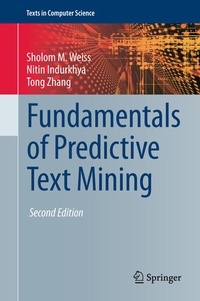
Fundamentals of Predictive Text Mining
Description

Reviews / Votes
"Fundamentals of predictive text mining is a second edition that is designed as a textbook, with questions and exercises in each chapter. . The book can be used with data mining software for hands-on experience for students. . The book will be very useful for people planning to go into this field or to learn techniques that could be used in a big data environment." (S. Srinivasan, Computing Reviews, February, 2016)
More details
Other editions
Additional editions
Previous edition
Persons
Dr. Sholom M. Weiss is a Professor Emeritus of Computer Science at Rutgers University, a Fellow of the Association for the Advancement of Artificial Intelligence, and co-founder of AI Data-Miner LLC, New York.
Dr. Nitin Indurkhya is faculty member at the School of Computer Science and Engineering, University of New South Wales, Australia, and the Institute of Statistical Education, Arlington, VA, USA. He is also a co-founder of AI Data-Miner LLC, New York.
Dr. Tong Zhang is a Professor of Statistics and Biostatistics at Rutgers University.
Content
Overview of Text Mining.- From Textual Information to Numerical Vectors.- Using Text for Prediction.- Information Retrieval and Text Mining.- Finding Structure in a Document Collection.- Looking for Information in Documents.- Data Sources for Prediction: Databases, Hybrid Data and the Web.- Case Studies.- Emerging Directions.
