

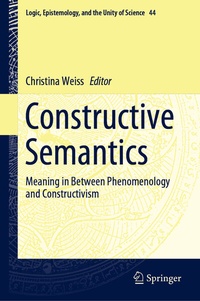
Constructive Semantics
Description

This edited book brings together research work in the field of constructive semantics with scholarship on the phenomenological foundations of logic and mathematics. It addresses one of the central issues in the epistemology and philosophy of mathematics, namely the relationship between phenomenological meaning constitution and constructive semantics. Contributing authors explore deep structural connections and fundamental differences between phenomenology and constructivism. Papers are drawn from contributions to a prestigious workshop held at the University of Friedrichshafen.
Readers will discover insight into structural connections between the phenomenological concept of meaning constitution and constructivist concepts of meaning. Discussion ranges from more specific conceptualizations in the philosophy of logic and mathematics to more general considerations in epistemology, inferential semantics and phenomenology. Questions such as a possible phenomenological understandingof the relationship between structural rules and particle rules in dialogical logic are explored. Significant aspects of both phenomenology and dialectics, and dialectics and constructivism emerge.Graduates and researchers of philosophy, especially logic, as well as scholars of mathematics will all find something of interest in the expert insights presented in this volume.
More details
Other editions
Additional editions
Person
Dr. phil. Christina Weiss, born in 1973, is a philosopher interested in foundational questions concerning the relationship between Phenomenology and Constructivism, in dialectical and dialogical logics, German Idealism and its relationship to constructive logics in particular, philosophical semantics in general. Throughout her work in the different fields of research she seeks to expatiate on the foundations of an epistemology of schematization. She currently works on her habilitation treatise and teaches as a lecturer at the Institute of Philosophy at the Technical University of Darmstadt, Germany.
Content
Introduction (Christina Weiss).- Part I: Integrating Transcendental Phenomenology into the Dialogical Framework.- Chapter 1. Dialogues, Reasons and Endorsement (Shahid Rahman).- Chapter 2. A Phenomenological Analysis of the Distinction between Structural Rules and Particle Rules in Dialogical Logic (Mohammad Shafiei).- Chapter 3. A Dialogical Account of the Intersubjectivity of Intuitionism (Clément Lion).- Part II: Critical Positions Towards Integrating Transcendental Phenomenology and Constructivism.- Chapter 4. Constitution and Construction (Mirja Hartimo).- Chapter 5. Husserl's Purely Logical Chastity Belt (Claire Ortiz Hill).- Part III: Phenomenology and Constructivism as a Dialectical Relation.- Chapter 6. The Truth of Proof: A Hegelian Perspective on Constructivism (Vojtech Kolman).- Chapter 7. Constructive Semantics: On the Necessity of an Appropriate Concept of Schematization (Christina Weiss).
