

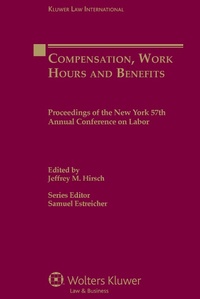
Compensation, Work Hours and Benefits
Proceedings of the New York 57th Annual Conference on Labor
Published on 12. May 2009
652 pages
978-90-411-4479-9 (ISBN)
Description

Each year, the New York University Annual Conference on Labor calls on outstanding scholars and practitioners in the field to come together to survey and analyse new developments and trends in U.S. labor law and practice. Reproduced here are papers delivered at the 2004 conference, the 57th in this venerable and highly influential series, with other articles either reprinted from earlier publications or written for this volume. The theme of the 2004 Conference was "Compensation, Work Hours, and Benefits." The broad range of contexts in which compensation, work hours, and benefits issues and disputes arise is clearly on display in the many relevant aspects with which the authors engage. These issues are gathered into nine categories as follows: problems in ensuring acceptable compensation and work conditions in a global economy; attempts by states and municipalities to implement living wage measures and the potential conflict between such attempts and the doctrine of private labor law preemption; the possible demise of traditional pension benefits; recent workplace developments arising in response to the Fair Labor Standards Act (FLSA); the legality of policies surrounding attempts to keep workers' pay secret; special compensation claims typically found in securities industry arbitration; state protections for non-salary forms of compensation; regulation of multiemployer benefit plans by the Employee Retirement Income Security Act (ERISA); and compensation, work hours and benefits issues with regard to multinational organizations. As always, this important annual publication offers definitive current scholarship in its theme area of labor and employment law. As such, it will be of inestimable value to practitioners, government officials, academics, and others interested in developments in U.S. employment and labor relations law and practice.
More details
Other editions
Additional editions
J. Hirsch | Samuel Estreicher
Compensation, Work Hours and Benefits
Proceedings of the New York 57th Annual Conference on Labor
Book
05/2009
Kluwer Law International
€274.84
Shipment within 10-20 days
Content
- Intro
- Title Page
- Copyright Page
- Summary of Contents
- Contents
- Center for Labor and Employment Law at New York University School of Law
- Introduction: Compensation, Work Hours, and Benefits
- Part I: Trade and Labor Rights
- Chapter 1: Appendix A of Section 301 Petition of American Federation of Labor and Congress of Industrial Organizations, U.S. Representative Benjamin L. Cardin, and U.S. Representative Christopher H. Smith Trade Remedies to Enforce Workers' Rights in China Are Required by U.S. Law and Do Not Violate WTO Rules
- 1. Introduction and Summary
- 2. The Constitution Requires the Executive Branch to Faithfully Execute Section 301(d) of the Trade Act and to Defend the WTO-Consistency of Trade Remedies Designed to Enforce Workers' Rights: Regardless Whether the Chinese Government May Later Challenge U.S. Law under WTO Rules
- 3. The WTO Has Never Ruled against the Use of Section 301 to Induce Our Trading Partners to Enforce Workers' Rights
- 4. Trade Sanctions against the Chinese Government to Enforce Workers' Rights Do Not Violate WTO Rules
- Chapter 2: The Growing Significance of International Labor Standards on the Global Economy
- 1. Introduction
- 2. Taking Labor Standards Out of Competition
- 3. The Adoption of International Labor Standards
- 4. The Leveling Effect of ILO Standards is Incomplete
- 5. The Changing Global Context for Labor Standards
- 6. ILO Declaration on Fundamental Principles and Rights at Work
- 7. The Impact of U.S. Trade Policy
- 8. The Increasing ILO Role in the Context of U.S. Trade Agreements
- 9. Corporate Social Responsibility
- 10. Secondary Boycotts and International Labor Standards
- 11. Alien Tort Statute
- 12. Sosa v. Alvarez-Machain: A Brake on ATS Lawsuits?
- 13. Implications of International Labor Standards on U.S. Domestic Workplace Law
- 14. Conclusion
- Chapter 3: Legitimacy and Capacity in Private Labor Monitoring: Two Case Studies
- 1. Introduction
- 2. "Managerialist" and "Participatory" Models of Labor Monitoring
- 3. Kukdong
- 3.1. Intervention by a Private Monitor on Behalf of Freedom of Association
- 3.2. Remediation - Transparency, Legal Competence, and Economic Leverage
- 3.3. Long-Term Accountability - Local Monitoring Capacity and Transnational Media Politics
- 4. PT Dada: Organizational Intervention and Interaction
- 4.1. Evolving Forms of Participatory Monitoring and Remediation
- 4.2. Private Monitoring of Fluid Public Rights of Association
- 4.3. Remediation - Promoting Private and Public Capacity
- 5. Conclusion
- Part II: Minimum Wage versus Living Wage?
- Chapter 4: The Potential for State Labor Law: The New York Greengrocer Code of Conduct
- 1. Introduction
- 2. A Brief Overview of State Labor and Employment Law
- 3. The Greengrocer Code of Conduct
- 3.1. Background
- 3.2. The Greengrocer Code Requirements
- 3.2.1. Terms of Employment
- 3.2.2. Educational Provisions
- 3.2.3. Monitoring Process
- 3.2.4. Retaliation Protection
- 3.2.5. Nonbinding "Recognitions"
- 3.2.6. Forbearance for Prior Violations
- 3.2.7. Seal of Good Standing
- 3.2.8. Expiration Date
- 3.3. The First Year of the Code
- 4. The Greengrocer Code of Conduct as a Model for State Labor Law
- 4.1. The Code as State Labor Law
- 4.2. The Code as a Model for Future Action
- 4.2.1. Factors Needed for Future Codes
- 4.2.1.1. Widespread Employment Law Violations
- 4.2.1.2. A Core of Cooperating Employees
- 4.2.1.3. Similar Working Conditions Across the Industry
- 4.2.1.4. Willing and Able Negotiating Representatives
- 4.2.1.5. Consumer Support
- 4.2.1.6. Government Action
- 4.2.2. Scenarios for Future Codes
- 4.2.2.1. New York Laundry Business
- 4.2.2.2. New York Restaurants
- 4.2.2.3. Produce Providers
- 5. Conclusion
- Chapter 5: Living Wage Ordinances and Traditional Labor Law: An Uneasy Conjunction
- 1. Introduction
- 2. Living Wage Laws and NLRA Preemption
- 2.1. Union Neutrality Laws
- 2.2. Comprehensive Wage and Benefit Laws
- 2.3. Pure Wage Laws
- 2.4. Nonmandatory Measures and Laws Affecting Employees Excluded from Federal Law
- 3. Conclusion
- Part III: Decline of the Traditional Pension Benefit?
- Chapter 6: The Shift from Defined Benefit Plans to Defined Contribution Plans
- Part IV: Fair Labor Standards Act Litigation and Compliance: The "White Collar" Exemptions, "Off-the-Clock" Claims, and Conducting Internal FLSA Audits
- Chapter 7: The White Collar Exemptions: Where Were We, Where Are We Going, and Where Should We Be
- 1. Introduction
- 2. Where Were We
- 2.1. The Salary Basis Test
- 2.1.1. Deductions Generally
- 2.1.2. Window of Correction
- 2.1.3. Deductions for Lack of Work
- 2.1.4. Partial Day Absences
- 2.1.5. Adjustments to Accrued Leave
- 2.1.5.1. Family and Medical Leave Act Exception
- 2.1.5.2. Public Employers Exception
- 2.1.6. Deductions for Jury Duty, Attendance as a Witness, or Temporary Military Leave
- 2.1.7. Disciplinary Deductions
- 2.1.8. Extra Pay for Extra Work
- 2.1.9. Productivity Bonuses
- 2.2. The Duties Test
- 2.2.1. Executive Employee Exemption
- 2.2.2. Administrative Employee Exemption
- 2.2.2.1. The Administrative/Production Dichotomy
- 2.2.2.1.1. Courts Finding Employees Administratively Exempt
- 2.2.2.1.2. Courts Finding Employees Not Administratively Exempt
- 2.2.2.1.3. Should Exemption Status Depend on How the Business Is Defined
- 2.2.2.1.4. Moving Away from the Administrative/Production Dichotomy
- 2.2.2.2. Work of Substantial Importance
- 2.2.2.3. Discretion and Independent Judgment
- 2.2.3. Professional Employee Exemption
- 2.2.3.1. The Learned Professional
- 2.2.3.2. The Computer Professional
- 3. Where Are We Going
- 3.1. The Salary Basis Test
- 3.2. The Highly Compensated Employee
- 3.3. The Duties Tests
- 3.3.1. Executive Exemption
- 3.3.2. Administrative Exemption
- 3.3.3. Learned Professional Exemption
- 3.3.4. Creative Professional Exemption
- 3.3.5. Computer Professional Exemption
- 3.3.6. Outside Sales Exemption
- 4. Where Should We Be
- 4.1. Do the New Rules Help?
- 4.2. An Alternative Approach
- Chapter 8: Off-the-Clock Claims from the Employee's Perspective
- 1. Introduction
- 2. Defining Compensable Work
- 2.1. What Time Is Compensable?
- 2.2. Statutory Exclusions
- 2.2.1. Preliminary and Postliminary Work
- 2.2.2. Changing Clothes and Washing
- 3. Ascertaining Compensable Work Time in Practice
- 3.1. Travel Time
- 3.2. Preparatory and Concluding Activities: Clothes, Equipment, and Animal Care
- 3.3. Meal/Rest Breaks
- 3.4. Training, Lectures, Etc.
- 3.5. On-Call Time
- 3.6. De Minimis Time
- 4. Suffer or Permit Standard Applied to Off-the-Clock Claims
- 5. Record-Keeping Duties Applied to Off-the-Clock Claims
- 5.1. Basic Record-Keeping Duties of Employer
- 5.2. Consequences of Record-Keeping Violations in Off-the-Clock Cases
- 6. Collective Actions
- 6.1. Notice
- 6.2. Similarly Situated Standard Applied in Off-the-Clock Claims
- 6.2.1. Two-Stage Approach
- 6.2.2. Lenient Standard for Ordering Notice in Off-the-Clock Claims in Stage One
- 6.2.3. A Significant Number of Opt-Ins Weighs in Favor of Ordering Notice
- 6.2.4. Where Plaintiffs' Evidence Does Not Warrant Notice of the Scope Sought, Courts Nevertheless Frequently Order Notice of an Appropriate Scope
- 6.2.5. Stage Two: Close of Discovery
- 7. Off-the-Clock Class Actions under State Law
- 7.1. Availability of the Class Device as Opposed to Collective Action
- 7.2. Possible Advantages under State Labor Laws in Off-the-Clock Claims
- 7.3. Concurrent FLSA Collective Actions and State Class Actions
- Chapter 9: "Off-the-Clock" Claims: When Does an Employer "Suffer" or "Permit" Work to Occur?
- 1. Introduction
- 2. The FLSA's Missing Definition: What Does It Actually Mean to "Work"?
- 3. Some "Off the Clock" Time Clearly is not "Work"
- 3.1. Travel Time
- 3.2. "On Call" and "Waiting" Time
- 3.3. Meal Periods
- 3.4. Sleep Time
- 3.5. Working from Home
- 4. "Off the Clock" Lawsuits: Allegations of Obvious Abuse Make the News
- 5. "Suffer or Permit to Work": The Employer's Knowledge is the Plaintiff's Burden
- 6. "Insubstantial or Insignificant Periods of Time": The De Minimis Rule
- 7. The "Portal-to-Portal Act": Preliminary and Postliminary Activity That is not "Work"
- 8. Conclusion
- Chapter 10: Conducting Internal FLSA Audits
- 1. Introduction
- 2. Overview of the FLSA's Requirements
- 3. Why Internal FLSA Audits are Important
- 4. Frequency and Timing of Internal FLSA Audits
- 5. Who Should Conduct the Audit?
- 6. Conducting the Audit
- 6.1. Auditing Compliance with the Recordkeeping and Posting Requirements
- 6.2. Auditing Compliance with the Minimum-Wage Requirement
- 6.3. Auditing Compliance with the Overtime Requirement
- 6.4. Auditing Exemptions from Minimum-Wage and Overtime Compensation
- 6.4.1. Independent Contractor versus Employee
- 6.4.2. White-Collar Exemptions
- 6.5. Auditing Compliance with the Child-Labor Provisions
- 7. After the Audit
- 8. Self-Audit Compliance Checklist
- 8.1. Recordkeeping
- 8.2. Minimum Wage
- 8.3. Overtime
- 8.4. Executive, Administrative, Professional-Employee and Outside Salesperson Exemptions
- 8.5. Child Labor
- Part V: Pay Secrecy under the National Labor Relations Act
- Chapter 11: "Love, Sex and Politics? Sure. Salary? No Way": Workplace Social Norms and the Law
- 1. Introduction
- 1.1. The Conflict
- 1.2. Addressing the Conflict
- 2. PSC Rules and the NLRA
- 2.1. PSC Rules
- 2.2. Legal Framework under the NLRA
- 3. Social Norms and PSC Rules
- 3.1. The Interplay of Law and Social Norms
- 3.2. Workplace Social Norms
- 3.3. Norm-Related Considerations Favoring Employer PSC Rules
- 3.3.1. Privacy Considerations
- 3.3.2. Workplace Conflict Avoidance Considerations
- 3.3.3. Remuneration Risk-Sharing Considerations
- 3.3.4. Internal Labor Market Considerations
- 3.4. Summary
- 4. Opposing Forces
- 4.1. The Seductive Sound of Talking: Role of the Prisoners' Dilemma
- 4.2. Keeping Up with the Joneses: The Relative Preferences Theory
- 4.3. Bringing It All Together
- 4.4. Do PSC Rules Have a Place in Current Law?
- 5. Balancing the Law and Social Norms Regarding Employer PSC Rules
- 5.1. Overview
- 5.2. Efforts toward Stricter Enforcement of PSC Rules
- 5.2.1. Bills in the U.S. Congress
- 5.2.2. California Legislation
- 5.3. Problems with Congressional Proposals/State Legislation
- 5.4. Flexibility within the Current NLRA Approach
- 5.5. The "Notice" Problem: A Suggested Reform
- 6. Conclusion
- Chapter 12: The Law and Social Norms of Pay Secrecy
- 1. Introduction
- 2. Pay Secrecy or Confidentiality (PSC) Rules, Law and Norms
- 2.1. The Bierman-Gely Account
- 2.2. PSC Rules, Law and Norms: Reflections on the Bierman-Gely Account
- 3. The Need for a Normative Theory of Pay Secrecy Norms
- 3.1. The Dilemma
- 3.2. Normative Norms: Suggestions for Future Pay Secrecy Scholarship
- 4. Conclusion
- Part VI: Compensation Issues in the Securities Industry
- Chapter 13: Compensation Claims in Security Industry Arbitration
- 1. Introduction
- 2. New York Common Law and Bonus Claims
- 3. Practical Aspects of Proving Bonus Claims
- 4. The New York Labor Law
- 5. At-Will Employment and Compensation Issues
- 6. Other Types of Compensation Disputes
- 7. Conclusion
- Chapter 14: Security Industry Bonus Claims
- 1. Introduction
- 2. Common Law Compensation Claims
- 2.1. Breach of Contract
- 2.1.1. Discretion Reserved
- 2.1.2. Discretion Not Specifically Reserved
- 2.1.3. Integral Part of Compensation
- 2.1.4. Counter-Offers
- 2.2. "Implied-in-Fact" Contract
- 2.2.1. Course of Dealing
- 2.2.2. Indefiniteness
- 2.3. Quantum Meruit
- 2.3.1. Generally
- 2.3.2. Claim Contingent on Lack of Express Contract
- 2.3.3. Unjust Enrichment
- 2.4. Promissory Estoppel
- 2.5. Tortious Interference with Prospective Business Relationships
- 2.6. Covenant of Good Faith and Fair Dealing
- 2.7. Fraud/Fraudulent Misrepresentation/Fraudulent Inducement
- 2.8. Securities Fraud
- 2.9. Constructive Discharge
- 3. Available Remedies for Litigants Who Successfully Litigate Compensation Claims
- 4. Application of the New York Labor Law to Compensation Claims
- 4.1. "Wages" versus "Incentive Compensation"
- 4.1.1. Recent Cases Excluding Bonuses and Incentive Compensation from "Wages"
- 4.1.1.1. Truelove v. Northeast Capital & Advisory, Inc.
- 4.1.1.2. International Business Machines Corp. v. Martson
- 4.1.1.3. International Business Machines Corp. v. Bajorek
- 4.1.2. Cases Finding Bonuses to be Part of "Wages"
- 4.1.2.1. Fiorenti v. Central Emergency Physicians, P.L.L.C.
- 4.1.2.2. Westheim v. Elkay Industries, Inc.
- 4.1.2.3. Tuttle v. Geo. McQuesten Co.
- 4.1.3. Defeating New York Labor Law Claims
- 4.1.3.1. Factors That Lead to a Conclusion That a Payment Is Incentive Compensation and Not Wages
- 4.1.3.2. Factors Leading to a Conclusion That a Payment Is Not Incentive Compensation but Is a Wage
- 4.2. The "Highly Paid Professional" Exemption
- 4.2.1. Are the Employees Covered by the "Exemption" for "Highly Paid Executives"?
- 4.2.2. "Wage Supplement" Claims
- 5. Compensation Cases Are Often Intertwined with Issues of Enforceability of Noncompetition Provisions
- 6. Conclusion
- Part VII: State Wage Payment Laws
- Chapter 15: The Case for Fiduciary Duty as a Restraint on Employer Opportunism under Sales Commission Agreements
- 1. Introduction
- 2. Risk
- 2.1. Wage Accrual
- 2.2. Risk Transference
- 2.3. Entrepreneurial Attributes
- 3. Wage Collection Laws
- 4. Two Cases
- 5. Fiduciary Duties
- 6. Scope of the Duty: The Partnership Paradigm
- 7. Two Cases: Redux
- 8. Reform of Contract Law versus Fiduciary Duty
- 9. Conclusion
- Chapter 16: Compensation Claims under New York Labor Law and the Common Law
- 1. Article 6 of New York's Labor Law
- 1.1. Challenges to Deferred Compensation and Other Benefit Plans Containing Forfeiture Provisions
- 1.2. Claims of Failure to Pay Allegedly Promised Bonuses or Other Compensation
- 2. Common Law Claims
- 3. Tort Claims
- 3.1. Tortious Interference with Contractual Relations
- 3.2. Fraudulent Inducement Claims
- 4. The Statute of Frauds
- Part VIII: Multiemployer Benefit Plan Issues
- Chapter 17: Multiemployer Benefit Plan Issues
- 1. General Fiduciary Concerns for Multiemployer Benefit Plan Trustees
- 1.1. General Standards and Specific Prohibitions
- 1.2. Cofiduciary Liability
- 1.3. Penalties for Breaches of Fiduciary Duty
- 1.4. Prohibited Transactions
- 2. Benefit Plan Communications
- 2.1. Legal Standards
- 2.2. Reporting and Disclosure
- 2.2.1. ERISA's Basic Reporting and Disclosure Requirements
- 2.2.2. The Role of the Plan Administrator
- 2.2.3. Penalties for Failure to Provide Information
- 2.2.4. Method of Distribution
- 2.2.5. Use of Electronic Technology
- 2.3. SPDs
- 2.3.1. Form, Style and Content of SPDs
- 2.3.2. Disclaimer Provisions
- 2.3.3. Discretionary Authority Language
- 2.3.4. "Reservation of Rights" Provision
- 2.4. Claims Procedures
- 2.4.1. Shortened Time Frames for Determinations
- 2.4.2. Notice and Disclosure Requirements
- 2.4.3. Standards of Review
- 3. Investment Issues
- 3.1. General Fiduciary Concerns
- 3.1.1. Diversification
- 3.1.2. Investment Policies
- 3.1.3. Asset Allocation
- 3.2. Selecting Managers
- 3.3. Investment Management Agreements
- 3.4. Soft Dollars, Commission Recapture
- 3.5. Corporate Governance, Shareholder Activism
- 3.6. Investment Consultants
- 3.6.1. "Pay to Play"
- 3.7. Alternative Investments
- 3.7.1. Classes of Alternative Investments
- 3.7.1.1. Derivatives
- 3.7.1.2. Hedge Funds
- 3.7.1.3. Other Private Investment Vehicles
- 3.7.2. Special Legal Issues
- 4. Settlor versus Fiduciary
- 4.1. General Guidelines
- 4.2. Settlor or Fiduciary Function?
- 4.3. Single Employer versus Multiemployer Plans
- 4.4. Funding Settlor Actions in a Multiemployer Context
- 5. Withdrawal Liability
- 5.1. Generally
- 5.2. Complete Withdrawal
- 5.3. Partial Withdrawal
- 5.4. Mass Withdrawal
- 6. Select Health-Care Issues
- 6.1. Increasing Medical/Rx Costs: Crisis
- 6.2. Privacy
- 6.3. Retiree Coverage
- 7. Participant-Directed Plans
- 7.1. 404(c) Requirements
- 7.2. Investment Education
- 7.3. Default Investment Vehicles
- 7.3.1. How Effective Is 404(c)? Is It Worth the Effort?
- 7.3.2. Selection and Monitoring
- 7.4. Negative Elections
- 7.5. Blackouts
- 8. Collection/Delinquency Issues
- 8.1. Collection Policy
- 8.2. Settling Claims
- 9. Travel Expenses
- 9.1. The Policy Statement
- 9.1.1. Attendance at Educational Conferences
- 9.1.2. Reimbursement of Expenses
- 9.2. DOL Focus
- 10. Role of Collective Bargaining Parties
- 11. Arbitrating ERISA Deadlocks
- Chapter 18: Withdrawal Liability: Exemption from and Enforcement of Payment
- 1. Introduction
- 2. Legislative History of Withdrawal Liability
- 3. Transactional Exceptions to Withdrawal Liability
- 3.1. Sale of Assets: ERISA Section 4204
- 3.2. Change in Corporate Structure: ERISA Section 4218(1)
- 4. Collection of Withdrawal Liability
- 5. Conclusion
- Part IX: Issues for the Global Organization
- Chapter 19: Pay Issues in the Securities Industry: The UK Experience
- 1. Introduction
- 2. Fat Cat Bonus Payments
- 3. Sex and the City
- 4. Unlawful Deduction from Wages
- 5. Conclusion
- Chapter 20: The Critical Elements in Navigating Social Insurance Integration for the Expat: The U.S. Perspective
- 1. The Challenge: Providing Seamless Cross-Border Social Insurance Coverage
- 1.1. Common Objectives
- 1.1.1. Avoiding Double Taxation
- 1.1.1.1. The Issue
- 1.1.1.2. Employers Abroad Who Are Subject to U.S. Social Security
- 1.1.2. Avoiding a Possible Gap in Employee Coverage
- 1.1.2.1. The Issues
- 1.1.2.2. How the Issues Arise under the U.S. Social Security System
- 1.1.3. Avoiding an Adverse Impact upon Mobility
- 1.1.3.1. The Staffing Issue
- 1.1.3.2. The Cost Issue
- 2. Understanding the Home Country Social Security System
- 2.1. The U.S. Social Security System
- 2.2. Other Countries' Systems
- 3. The Totalization Agreement Solution
- 3.1. Overview of U.S. Totalization Agreements
- 3.2. Importance of Structure
- 3.3. How the U.S. Totalization Agreements Address Coverage Gaps
- 3.3.1. The General Rule
- 3.3.2. Examples
- 3.3.2.1. Benefits Obtained Only through Use of Totalization Agreement
- 3.3.2.2. Use of Totalization Agreement Not Needed to Obtain Benefits
- 3.3.2.3. Use of Totalization Agreement Needed to Obtain Full Benefits
- 4. Working with the U.S. Totalization Agreements
- 4.1. Detached Worker ("Secondee") Rule of U.S. Totalization Agreements
- 4.2. The "Downstream" Approach of U.S. Totalization Agreements
- 4.3. Using the Totalization Agreements: Certificates of Coverage
- 5. Strategies for U.S. Subsidiaries of Foreign Parents
- 5.1. Section 3121(l) Election
- 5.2. Assignment to the Same Legal Entity
- 5.3. Assignment to a Different Legal Entity
- 5.4. Assignment to Different Entity in Same Host Country
- 5.5. Successive Assignments
- 5.6. Change in Legal Entity of Employer
- 5.7. Hire in Third Country for Immediate Assignment to Host Country
- 6. Need for "Shadow" Salary in U.S.
- 7. Conclusion
- Appendix U.S. Social Security Retirement Benefit Calculations
- Exhibit A List of Totalization Agreements
- Exhibit B Sample of Application for Certificate of Coverage
