

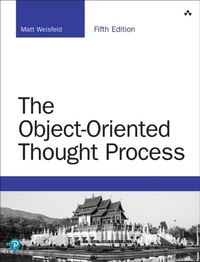
Object-Oriented Thought Process, The
5th Edition
Published on 4. April 2019
360 pages
978-0-13-518214-7 (ISBN)
Description

Object-oriented programming (OOP) is the foundation of modern programming languages, including C++, Java, C#, Visual Basic .NET, Ruby, Objective-C, and Swift. Objects also form the basis for many web technologies such as JavaScript, Python, and PHP.
It is of vital importance to learn the fundamental concepts of object orientation before starting to use object-oriented development environments. OOP promotes good design practices, code portability, and reuse-but it requires a shift in thinking to be fully understood. Programmers new to OOP should resist the temptation to jump directly into a particular programming language or a modeling language, and instead first take the time to learn what author Matt Weisfeld calls "the object-oriented thought process."
Written by a developer for developers who want to improve their understanding of object-oriented technologies, The Object-Oriented Thought Process provides a solutions-oriented approach to object-oriented programming. Readers will learn to understand the proper uses of inheritance and composition, the difference between aggregation and association, and the important distinction between interfaces and implementations.
While programming technologies have been changing and evolving over the years, object-oriented concepts remain a constant-no matter what the platform. This revised edition focuses on the OOP technologies that have survived the past 20 years and remain at its core, with new and expanded coverage of design patterns, avoiding dependencies, and the SOLID principles to help make software designs understandable, flexible, and maintainable.
It is of vital importance to learn the fundamental concepts of object orientation before starting to use object-oriented development environments. OOP promotes good design practices, code portability, and reuse-but it requires a shift in thinking to be fully understood. Programmers new to OOP should resist the temptation to jump directly into a particular programming language or a modeling language, and instead first take the time to learn what author Matt Weisfeld calls "the object-oriented thought process."
Written by a developer for developers who want to improve their understanding of object-oriented technologies, The Object-Oriented Thought Process provides a solutions-oriented approach to object-oriented programming. Readers will learn to understand the proper uses of inheritance and composition, the difference between aggregation and association, and the important distinction between interfaces and implementations.
While programming technologies have been changing and evolving over the years, object-oriented concepts remain a constant-no matter what the platform. This revised edition focuses on the OOP technologies that have survived the past 20 years and remain at its core, with new and expanded coverage of design patterns, avoiding dependencies, and the SOLID principles to help make software designs understandable, flexible, and maintainable.
All prices
More details
Series
Edition
5th edition
Language
English
Place of publication
Boston
United States
Publishing group
Pearson Education (US)
Target group
Professional and scholarly
File size
15,47 MB
ISBN-13
978-0-13-518214-7 (9780135182147)
Copyright in bibliographic data and cover images is held by Nielsen Book Services Limited or by the publishers or by their respective licensors: all rights reserved.
Schweitzer Classification
Other editions
Additional editions
Matt Weisfeld
Object-Oriented Thought Process, The
Book
11/2018
5th Edition
Addison Wesley
€41.49
Shipment within 15-20 days
Person
Matt Weisfeld is a college professor, software developer, and author based in Cleveland, Ohio. Prior to teaching college full time, he spent 20 years in the information technology industry as a software developer, entrepreneur, and adjunct professor. Weisfeld holds an MS in computer science and an MBA. Besides several editions of The Object-Oriented Thought Process, Matt has authored two other software development books and published many articles in magazines and journals, such as informit.com, developer.com, Dr. Dobb's Journal, The C/C++ Users Journal, Software Development Magazine, Java Report, and the international journal Project Management.
Content
1. Introduction to Object-Oriented Concepts
2. How to Think in Terms of Objects
3. Advanced Object-Oriented Concepts
4. The Anatomy of a Class
5. Mastering Inheritance and Composition
6. Frameworks and Reuse: Designing with Interfaces and Abstract Classes
7. Building Objects & Object-Oriented Design
8. Object-Oriented and Object Based Languages
9. Objects and Portable Data: XML, SOAP, and JSON
10. Persistent Objects: Serialization, Marshalling and Relational Databases
11. Objects in Web Services and Mobile Apps
12. Design Patterns
Appendix A Code Examples
2. How to Think in Terms of Objects
3. Advanced Object-Oriented Concepts
4. The Anatomy of a Class
5. Mastering Inheritance and Composition
6. Frameworks and Reuse: Designing with Interfaces and Abstract Classes
7. Building Objects & Object-Oriented Design
8. Object-Oriented and Object Based Languages
9. Objects and Portable Data: XML, SOAP, and JSON
10. Persistent Objects: Serialization, Marshalling and Relational Databases
11. Objects in Web Services and Mobile Apps
12. Design Patterns
Appendix A Code Examples
